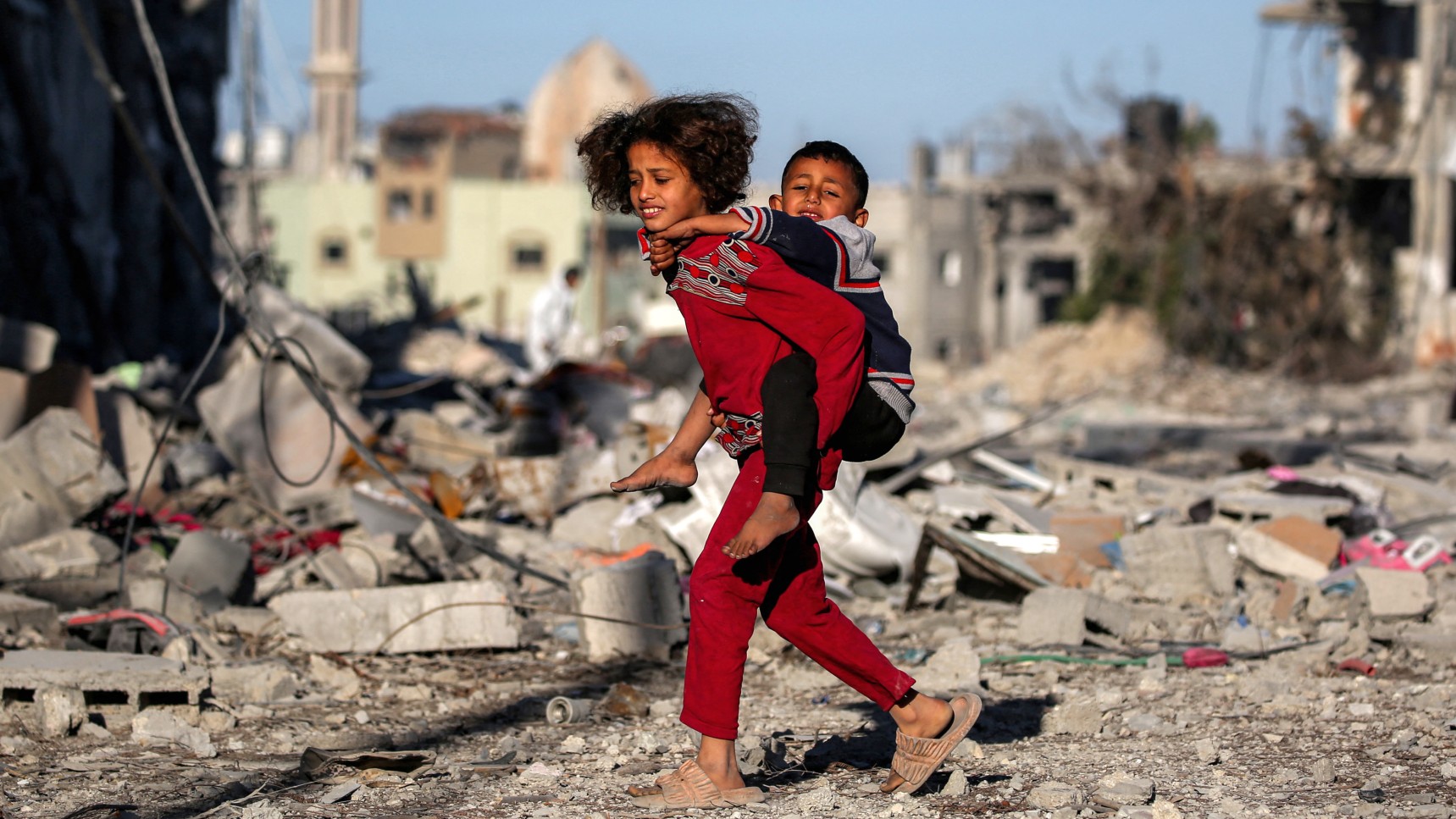
Months after Israel’s full-scale military campaign reduced most of Rafah to rubble, Egyptian construction companies have completed initial site assessments for a new residential development dubbed the ‘Green Rafah’ project in the ruins of the southern Gaza Strip, two anonymous Egyptian sources confirmed to Middle East Eye.
Once a vibrant hub of 250,000 Palestinian residents, home to crowded refugee camps, lively local markets and sprawling agricultural green spaces on Gaza’s southern border, Rafah has been left nearly unrecognizable by the war. Israeli military operations have demolished at least 80% of all structures across the governorate, displacing nearly the entire population and leaving hundreds of thousands homeless.
A senior Egyptian military source stationed in North Sinai told MEE that Egyptian engineering teams accessed multiple survey sites in eastern Rafah, accompanied and supervised throughout the entire mission by Israeli ground and air forces, before exiting the blockaded Palestinian enclave. Under current plans, the first phase of the development will house approximately 20,000 displaced Palestinians, the source said, with long-term oversight to be carried out by a multinational peacekeeping force that will deploy across multiple regions of Gaza under the terms of the Sharm el-Sheikh agreement.
Debris clearance and full construction work will likely not begin until after Israel’s upcoming national elections, the source added, to avoid the project being politicized by opponents of incumbent Prime Minister Benjamin Netanyahu and disrupting the electoral process.
A second source, an employee of the Organi Group, a conglomerate linked to powerful Sinai-based businessman and tribal leader Ibrahim al-Arjani, confirmed the details of the mission, noting company leadership had ordered teams to deploy to the earmarked residential site to complete surveys. Arjani, 49, has well-documented long-standing ties to Egypt’s national security establishment, and has been accused over the years of leveraging those political connections to expand his multi-sector business empire across North Sinai and broader Egypt. Two of his connected firms already hold extensive control over cross-border movement of people and goods through the Rafah border crossing: Sons of Sinai, a construction and contracting firm, manages exit permits for cargo trucks, while Hala for Consulting and Tourism Services holds exclusive rights to coordinate traveler transportation between Egypt and Gaza.
“The survey of the designated area has already been delivered so that the necessary engineering drawings and studies can be prepared ahead of construction, including rubble removal and land preparation,” the Organi Group source said. “Work would proceed once we get the go-ahead to clear the debris and level the land so we can begin construction. Green Rafah is intended to fall under international administration, separating Gaza from Israel.”
Both sources confirmed that construction firms linked to Organi are positioned to secure the majority of the reconstruction work assigned to Egypt, with smaller sub-contracts expected to be awarded to other Egyptian construction companies. MEE requested comment from both the Organi Group and Egypt’s State Information Service prior to publication, but received no response.
The Green Rafah proposal is not an isolated initiative: it aligns with a broader US-backed Gaza reconstruction vision, the ‘New Gaza’ plan, unveiled by former US President Donald Trump’s senior advisor and son-in-law Jared Kushner at the World Economic Forum in Davos earlier this year. Kushner’s framework calls for a full-scale redevelopment of Gaza, including over 100,000 new permanent housing units concentrated in a redeveloped Rafah, 200 new educational facilities, new industrial zones and upgraded transport infrastructure. The plan has faced widespread criticism for its lack of clarity on critical issues: it makes no mention of transferring land ownership deeds to Palestinian residents, provides no framework for allocating new housing to displaced families, and does not explain how thousands of Palestinians still living in intact structures in central Gaza and western Gaza City would be relocated to make way for planned redevelopment.
Details of the Green Rafah project first emerged publicly in August, when Israeli Army Radio reported that Netanyahu and Defense Minister Israel Katz had approved preliminary infrastructure work in eastern Rafah, on the Israeli-controlled side of the Yellow Line, for a residential development for Palestinians living outside of Hamas governance. The report added that the project would include full excavation and connection to water, electricity and sewage networks, and that all Palestinian contractors and workers would be required to pass security screenings by Israel’s Shin Bet domestic intelligence agency before being allowed to enter the work site. Netanyahu’s office later walked back parts of the report, clarifying that Green Rafah is a UAE-backed pilot initiative that had already been in development for several months, with all infrastructure work to proceed under Israeli military oversight.
According to the senior Egyptian military source, the entire survey operation in Rafah has full backing from the United States, with formal instructions conveyed by CIA Director John Ratcliffe during his recent visit to Egypt. During a September 20 meeting in Cairo with Ratcliffe and Egyptian General Intelligence chief Hassan Rashad, Egyptian President Abdel Fattah el-Sisi emphasized the need to fully implement the second phase of Trump’s Gaza peace plan. Public statements released by the Egyptian presidency after the meeting only noted that Sisi called for a consolidated permanent ceasefire, protection of civilian lives, and unimpeded access for humanitarian aid into Gaza, while Ratcliffe praised Egypt’s role in brokering the current truce and ongoing mediation efforts. No public mention was made of the Green Rafah project during the readout.
To date, progress on large-scale Gaza reconstruction remains severely stalled by a massive funding gap. A joint assessment published in April by the United Nations, World Bank and European Union estimated that Gaza will require $71.4 billion over the next decade to recover from the war and rebuild, with $26.3 billion needed in the first 18 months alone. The Board of Peace, the body overseeing the New Gaza initiative, has confirmed that only $280 million in funding has been committed to date. Kushner stated at a Board of Peace event in late September that any company interested in participating in reconstruction will be able to bid through a “transparent bid process”, but the organization declined to answer MEE’s questions about the potential role of Egyptian firms including Organi-connected contractors. MEE also requested comment from the White House, CIA and Tony Blair Institute for Global Change, and received no responses prior to publication.
Thus far, only one reconstruction contract has been awarded for work inside Gaza: US-based Louisiana firm Arkel International has been tapped to build a military outpost to house 150 international peacekeeping troops.