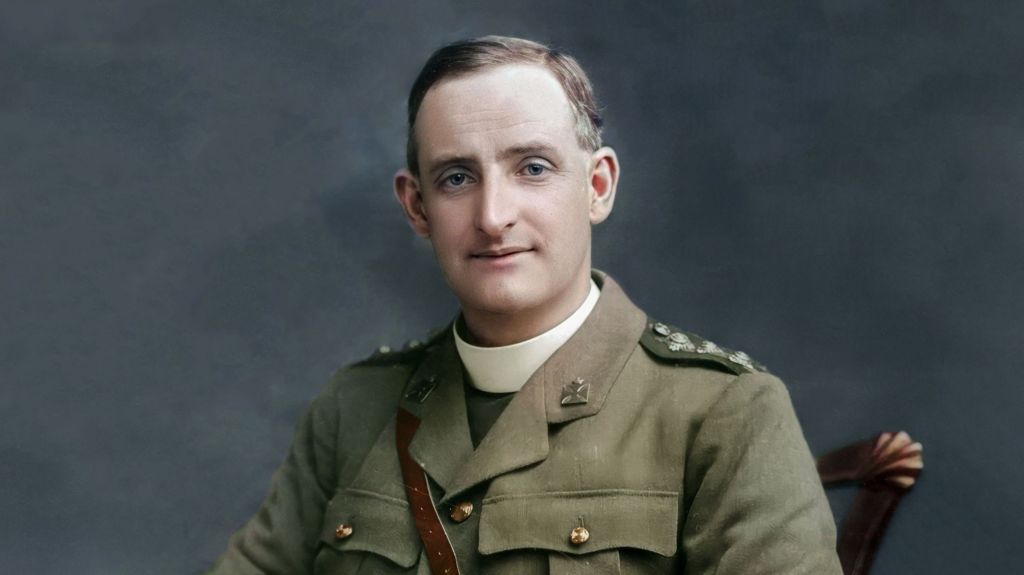
One hundred and six years after his death on the bloodied battlefields of World War I, a heroic Irish priest who gave his life aiding wounded troops of all backgrounds is poised to take a critical early step toward possible canonization. On Sunday, the Catholic Church in Ireland will host a special ceremonial service at Mullingar Cathedral before submitting thousands of pages of compiled evidence to the Vatican to advance Fr Willie Doyle’s cause for sainthood.
Born William Joseph Gabriel Doyle in 1873 to a comfortable middle-class family in Dublin’s affluent Dalkey suburb, Doyle entered training to become a Jesuit priest at just 18 years old, after returning to Ireland from an English Catholic boarding school. When World War I had dragged on for more than a year, the 40-something priest volunteered to serve as a military chaplain with the British Army’s 16th (Irish) Division. For nearly two years, he lived and served alongside troops in the treacherous trenches of the Western Front, facing some of the conflict’s deadliest battles including the Somme, Messines, and Passchendaele.
Renowned for extraordinary courage under relentless enemy fire, Doyle repeatedly ventured into the deadly expanse of No Man’s Land to carry wounded troops to safety and administer final comfort to fatally injured soldiers. He was awarded the Military Cross for his bravery during the Battle of the Somme, and was repeatedly cited in military dispatches for his extraordinary conduct. His commanding officer, Major-General Sir William Bernard Hickie, famously called Doyle the bravest man he had ever encountered.
On August 16, 1917, Doyle was killed by enemy shellfire while rushing to aid two wounded Protestant soldiers at the Battle of Passchendaele. Because he died while ministering to Christians of a different denomination, the Irish Catholic Church recognizes him as an ecumenical martyr of charity. Beyond his wartime heroism, Doyle was also a prolific correspondent; his thousands of letters home have become an invaluable firsthand historical resource, offering unique insight into the experiences of Irish soldiers who fought in WWI. He also earned a reputation for extending compassion and care to wounded German prisoners of war, cementing his legacy as a figure of radical mercy.
The campaign to advance Doyle to sainthood is led by the Fr Willie Doyle Association, a Dublin-based group mostly made up of lay Catholic supporters with backing from clergy. The association was founded in 2020 by Patrick Kenny, a business school lecturer who lives near the area where Doyle grew up, after Kenny became captivated by the priest’s story while reading his biography.
Kenny shared that Doyle’s life combined remarkable heroism with equally remarkable holiness, noting that any major historical work on Irish involvement in WWI almost always includes reference to Doyle, thanks to the depth of his surviving correspondence.
The canonization process in the Catholic Church follows five distinct stages, each of which can span years or even decades, and Doyle’s campaign remains in its earliest phases. After the Fr Willie Doyle Association submitted its petition to the Irish Church, a diocesan inquiry was launched in 2022 under the oversight of the Diocese of Meath. Over the course of the investigation, a theological commission examined Doyle’s writings, a historical commission researched his life and legacy, and a diocesan tribunal heard expert testimony on the strength of the religious devotion he inspires among followers. In total, the compiled documentation of the inquiry fills nearly 3,500 pages.
In recent days, Bishop of Meath Tom Deenihan has overseen preparation of the evidence parcels bound for Vatican review. In keeping with longstanding church tradition, the parcels have been wrapped in red ribbon and sealed with wax, a ritual strictly governed by church regulations. Sunday’s service at Mullingar Cathedral will serve as the final public session of the inquiry tribunal, after which all remaining documentation – including the minutes from the final session – will be sealed and added to the bundles heading to Rome. Members of Doyle’s family will join Irish bishops for the landmark ceremony.
Bishop Deenihan noted that Doyle’s example holds particular resonance for modern Ireland, at a time when divisions over nationality and religious denomination risk pulling communities apart. He added that the priest’s spirituality and life story align particularly closely with the values prioritized by Generation Z, and called the milestone an important moment for the Catholic Church in Ireland. The bishop says he is confident the case for Doyle’s canonization will succeed as it moves to the next phase of review at the Vatican.