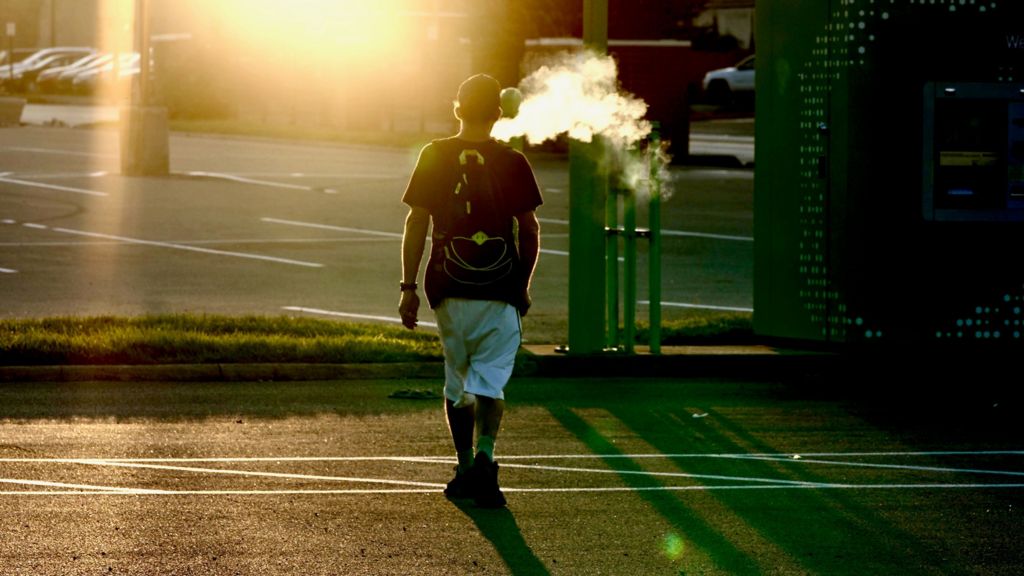
On a gritty back alley in Columbus, Ohio’s Linden neighborhood, 48-year-old Army veteran Mike crouches low, silver foil holding a few grains of fentanyl balanced between his hands. A straw rests at his lips, and a cigarette lighter flickers below, heating the potent synthetic opioid that has controlled his life for two decades. For just three or four dollars, this hit delivers a rush that no naturally derived opiate can match — but it comes with a deadly warning.
“This drug will damn near make you do anything, unfortunately,” Mike says, as he lights the grains. “You can snort too much and you can’t take it back. Kind of like a gunshot. Can’t call the bullet back.”
As the drug takes hold, Mike’s grip tightens on the chain-link fence behind him. He sways, a low guttural moan rumbling from his chest, his milky blue pupils shrinking to tiny pinpricks far smaller than standard opioids cause. Over the course of several days, Mike has served as a guide to this neighborhood’s hidden drug economy, a man well-known and liked by locals, who earns just enough working odd jobs at a nearby pawn shop and gas station to feed his addiction. What neither he nor the reporting team knew at first was that his fentanyl was not just fentanyl.
Over the past 15 years, the United States’ opioid crisis has undergone a dramatic, deadly transformation. Natural opiates like heroin, cultivated from poppy crops and trafficked across borders, have been largely replaced by fully synthetic alternatives led by fentanyl — a drug 50 to 100 times more potent than heroin that can be mixed in homemade batches in basements and bathtubs across the country. Today, even fentanyl is rarely sold on its own: dealers increasingly cut it with unregulated synthetic tranquilizers, turning every single dose into a lethal gamble.
Mike suspected his supply was laced with xylazine and medetomidine, two large-animal sedatives commonly called “tranq” that prolong the fentanyl high but slow breathing to deadly levels. Most alarmingly, the life-saving opioid reversal drug naloxone — carried by the reporting team to guard against accidental overdose — has no effect against these tranquilizers. Xylazine also causes severe, necrotic skin ulcers that eat deep to the bone, leaving users with permanent disfigurement or requiring amputation. A later drug test arranged by local recovery workers confirmed Mike’s suspicion: his sample tested positive for medetomidine.
Across Columbus, the Hope Dealer Community recovery group gathers weekly at Glenwood Church to share stories of survival amid this shifting crisis. Run by 65-year-old Scott Sanders, a former addict who has been sober for nearly 10 years, the organization supports people navigating the increasingly dangerous drug supply. When Sanders asks the room how many have survived an overdose, nearly every attendee raises their hand.
One man recounts his 2022 overdose, where paramedics administered three full doses of naloxone with no effect — the tranq in his system kept suppressing his breathing, and one medic was ready to call time of death before a last-ditch attempt successfully revived him. Another member, Tonya, tearfully shares how her nephew died of an overdose while she herself was overdosing on fentanyl-laced crack cocaine, a common deadly combination on streets today. “It’s not luck. I’m supposed to be here,” she tells the cheering, supportive crowd.
Sanders explains that the crisis has fundamentally shifted in recent years. Unwitting users are the biggest victims: people buying crack cocaine or meth, who have never used opioids, are receiving doses laced with fentanyl without their knowledge. In Franklin County, which covers Columbus, 78% of 2023’s fatal overdoses involved stimulants cut with synthetic opioids. Black men in Ohio are seeing rising overdose death rates, even as overall numbers tick down slightly from the 2022 peak of 110,000 annual overdose deaths nationwide — a peak that dropped to around 70,000 in 2024, driven in large part by widespread naloxone access. Still, Sanders emphasizes, the crisis is far from over.
His organization partners with the Centers for Disease Control and Prevention on a groundbreaking drug sampling program: users bring swabs from their pipes or needles to test for adulterants, with samples sent to a CDC lab in North Carolina for analysis. That work has confirmed what street users like Mike have long known: the modern drug supply is a chaotic mix of unregulated synthetics, made in secret home labs with no quality control.
“The drug supply in 2024 is this: we think we are buying crack but we’re not, we’re buying a number of different things,” Sanders says. “Today it is mixed, not just cut, but mixed with other drugs such as fentanyl or meth, and then other adulterant chemicals that are made in basements.”
A hundred miles north in Chicago, Illinois, this shift toward homemade synthetics has created new challenges for law enforcement, even behind bars. At Cook County Jail, one of the largest correctional facilities in the United States, traditional body scanners designed to catch drugs smuggled in body cavities could not stop a 2023 wave of overdoses that killed eight inmates — eight times the facility’s usual annual average.
Sheriff Tom Dart, who has led the county’s law enforcement for 20 years, says the smuggling method was entirely new. Prisoners were receiving drugs mailed straight to the facility, soaked into the pages of books and letters. Guards found burn marks on cell vents, where inmates lit the soaked paper to inhale the fumes. The deadly drugs were synthetic cannabinoids known as K2, mixed with other potent synthetics, that bypassed all traditional security measures.
In August 2024, BBC correspondent Quentin Sommerville joined two dozen corrections officers for an early morning raid on the jail’s high-security D Block. Officers gathered outside in hushed silence, before rushing the cell block. As they entered, the smell of burning paper hung in the air, and the sound of flushing toilets echoed as inmates disposed of contraband. Every scrap of paper — every letter, every book page — was searched for traces of drug soaking. Today, all incoming mail is scanned for moisture, and between 20 and 25% of all incoming items test positive and are rejected.
Outside the jail walls, the synthetic drug wave has reshaped street addiction across Chicago. Even in the upscale neighborhood of Oak Park, free naloxone dispensing machines sit in metro stations, and recovery workers regularly encounter users with tranq-related leg wounds so severe they require life-altering medical care.
Forty-year-old Karen Bell, a recovery worker with the group Liv4Lali who has been clean from heroin for 17 years, regularly tends to vulnerable users on city streets. When she used heroin nearly two decades ago, she says, users knew what they were buying. Today, every dose is a mystery.
“So many things are being mixed in right now. And it’s affecting our bodies, whether it’s the wounds, whether it’s the withdrawals — and sometimes wounds can extend to the point where it’s life changing,” she explains. “Before, back in my day, that was still heroin. When you bought that you knew it was heroin. But now, when you buy a bag, you don’t know really what it is.”
Her organization, like Hope Dealers, distributes free test strips to let users check their drugs for fentanyl, xylazine, medetomidine and other harmful adulterants — a harm reduction measure that has saved countless lives, even as it does not solve the root of the crisis.
Karen’s own path to recovery began in crisis. When she found out she was pregnant with her daughter Abby 17 years ago, she was living homeless in a tent in the woods, planning to die by suicide, broken by years of addiction and shame. After she was arrested for theft, her parents refused to pay bail, betting that time in Cook County Jail would let her get clean. It worked: Abby was born in jail, and Karen has not used hard drugs since.
Today, Abby, who plans to become a tattoo artist, says she has never been tempted to try drugs after seeing what they did to her family. She also points to a growing root of addiction in modern America: soaring inflation has left basic needs out of reach for many, and mental health care remains prohibitively expensive, pushing desperate people to turn to drugs to cope.
An anonymous Chicago dealer working for Mexican cartels told the BBC that despite decades of government crackdowns, from labeling cartels as terrorist organizations to interdicting trafficking boats at the border, his supply chain remains fully operational. “If it doesn’t go over the wall, it goes under the wall. If it doesn’t go through the border, it comes through the top border. This game is about adaptability,” he explained. When asked what has changed most about his trade, he pointed to the rise of synthetics: “Synthetics. We haven’t seen what synthetics can do yet. It’s not even the tip of the iceberg.”
Sheriff Dart agrees that the old “war on drugs” framework, focused almost entirely on cutting off supply at the border, no longer works for the age of synthetic drugs. Where potent drugs once had to be grown in foreign poppy fields and trafficked thousands of miles, today any amateur can cook up a batch in a home basement. Victory, he says, will only come from addressing demand.
“I don’t think there’s anybody involved with it who would sit there and say it’s a raging success. It’s not,” Dart says. “Front and centre there’s got to be huge substance abuse treatment. You can reduce the market if you can address people’s issues with substance abuse. And I know many people who, after long struggles, have come out on the other side in a really good way.”
For America, the opioid crisis has never been a static problem. It has evolved from plant-based heroin to prescription opioids to fentanyl, and now to an unregulated mix of homemade synthetics that outpace law enforcement and treatment efforts with every passing year. Users, dealers and cartels adapt constantly, always staying one step ahead of policy and enforcement — leaving thousands of lives on the line every year, even as recovery workers and survivors fight to turn the tide.