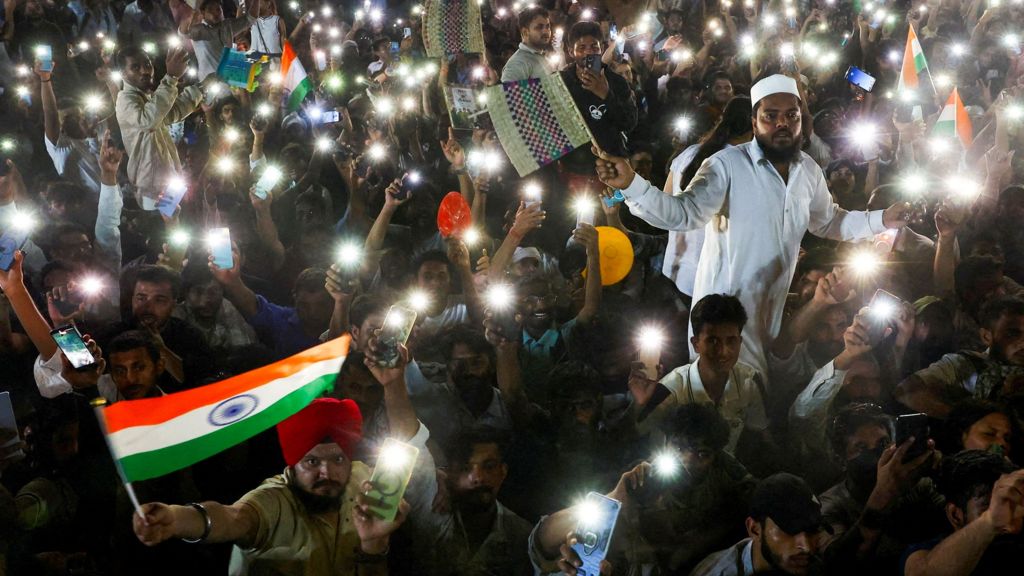
For more than 30 years, the tree-lined stretch of road beside Delhi’s 18th-century Jantar Mantar astronomical observatory has stood as India’s most iconic space for peaceful public dissent. From mass movements that toppled ministerial posts to small, solitary demonstrations of marginalized groups fighting to be heard, this patch of central Delhi has been the go-to gathering place when all other avenues for advocacy closed. That era, however, may now be coming to an abrupt end.
This week, Delhi Police announced that Jantar Mantar, located just 3 kilometers from India’s national parliament, will no longer be designated as an official protest site. The announcement caps months of escalating tension and restrictions that began after the summer 2026 “Cockroach” demonstrations, a mass gathering led by the Gen Z-organized Cockroach Janta Party (CJP) – a non-partisan collective born as an online joke that grew into a formidable protest movement. Tens of thousands of demonstrators gathered at Jantar Mantar earlier this year to demand the resignation of federal education minister Dharmendra Pradhan, a protest that ended with Pradhan stepping down.
Within days of that demonstration, police erected permanent barricades across the road, blocking new protests. Last week, a fresh attempt by CJP supporters to march to Jantar Mantar to demand the resignation of India’s chief election commissioner was met with a harsh police crackdown. Protesters seeking to demonstrate are now being redirected to three alternative sites across the capital. Two of the locations are located far from central Delhi and the seat of national power, while the third – the large Ramlila Ground – is typically booked months in advance. Unlike the free-to-use space at Jantar Mantar, all three alternative venues charge tens of thousands of rupees in daily rental fees.
Delhi Police officials frame the decision as a response to a recommendation from the Supreme Court, which suggested authorities identify alternative protest locations with improved public infrastructure. But critics warn the move will effectively bar ordinary Indians from exercising their constitutional right to peaceful assembly, pushing dissent far from the halls of power and into venues that are financially and geographically out of reach for most grassroots organizers.
Jantar Mantar’s life as India’s preeminent protest hub began in 1993, when the ruling Congress party moved to ban demonstrations at the Boat Club lawns opposite the old parliament building, the historic center of Indian dissent for decades prior. Historian Harleen Kaur notes that this shift was part of a decades-long pattern: successive Indian governments have consistently implemented new rules that push protest sites further away from parliament and the prime minister’s residence. Kaur explained in a 2023 academic paper that Jantar Mantar was originally accepted as a protest space precisely because its distance from the heart of government allowed authorities to contain crowds without shutting down dissent entirely.
Even so, the road beside the observatory hosted decades of transformative protest action. In 2008, activist Rachna Dhingra, a leading advocate for survivors of the 1984 Bhopal gas leak disaster, led a five-month encampment at Jantar Mantar, pushing the government to meet demands including the creation of a rehabilitation resource commission. Through blistering summer heat and monsoon rains, Dhingra and hundreds of other survivors held press conferences, lobbied politicians, and chained themselves to railings near the prime minister’s residence to draw attention to their cause. For Dhingra, Jantar Mantar was more than a protest site – it was a community. “It can be lonely to protest but that place became a home for so many of us. We shared each other’s stories, struggles and victories,” she said, recalling the cross-movement solidarities built there, from Tibetan pro-independence activists to anti-dam organizers to lone protesters who traveled from small towns to the capital with nothing but a placard and a grievance.
Academic Dipa Sinha, who has worked with India’s Right to Food campaign for decades, traces the passage of some of the country’s most impactful social welfare legislation – including the landmark rural employment guarantee scheme, the National Food Safety Act, and the Forest Rights Act – to organizing that began at Jantar Mantar. “It was a place where you could discuss issues with people who came to Delhi from across the country,” Sinha explained. Protesters would often travel to hold demonstrations outside key government ministries, where they faced frequent detentions, before returning to Jantar Mantar to regroup, debrief, and plan their next steps.
The site has faced threats of closure before. In 2017, the National Green Tribunal ordered protests barred from Jantar Mantar, citing poor infrastructure and complaints from local residents. But a year later, the Supreme Court overturned the order, upholding the constitutional rights to free speech and peaceful assembly that the site had long embodied.
For activists, the site’s proximity to power was critical. When first-time protesters arrived in Delhi, Dhingra recalled, they would say: “That’s the president’s house? Does the prime minister live there? How can they not listen to us when we are at their gates?” Jantar Mantar’s location near key journalistic hubs including the Press Club and Constitution Club also made it easier to attract media attention and secure meetings with sitting politicians, advantages that distant alternative venues cannot match. In recent years, rules around the site have already tightened dramatically: overnight protests are no longer permitted, a restriction that makes long-term sustained demonstrations impossible for groups whose members travel hundreds of miles to Delhi to advocate.
Not all observers frame the end of Jantar Mantar as a death knell for Indian protest culture. Gender studies scholar Mary E. John, who has lived and worked in Delhi since the pre-1993 Boat Club era, notes that dissent has always shifted locations as governments restrict access to iconic central sites. She points to recent mass movements – including the year-long farmers’ protest camped at Delhi’s borders, the Shaheen Bagh sit-in demanding repeal of the 2019 Citizenship Amendment Act, and the 2012 national anti-rape protests that spread across central Delhi – as evidence that protest movements adapt and occupy new spaces when old ones are closed off.
Right now, Jantar Mantar is unrecognizable from its decades-long identity as a hub of dissent: yellow barricades block both ends of the road, hundreds of paramilitary personnel stand guard with batons, and the slogans and placards that once filled its sidewalks are gone. The future of the site remains uncertain: the Supreme Court is currently hearing legal challenges to the government’s decision to revoke its protest site status, while opposition leaders and CJP organizers have pledged to “reclaim” the space for the Indian people. As legal and political debates unfold, one question hangs over the historic site: will it ever echo with the sound of protest again?