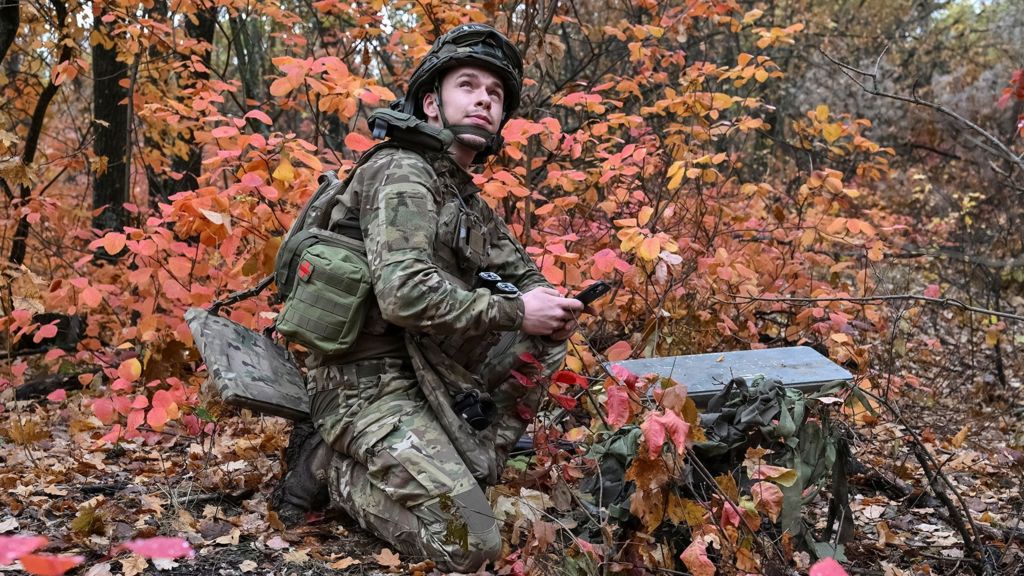
Embedded with Ukrainian frontline units near Donbas, a BBC crew has pulled back the curtain on Operation Vivaldi, Kyiv’s months-long counter-offensive that has carved out significant territorial gains against Russian forces even as new geopolitical and technological risks threaten its momentum.\n\nThe on-the-ground reporting opens inside a Ukrainian command bunker, where commanders monitor the battlefield via real-time drone footage. When a Russian reconnaissance drone drifts into view over open ground, where a platoon of exhausted soldiers is rotating off the line after three months of combat, a commander immediately scrambles a interceptor drone to take it down, alerting the exposed troops to the incoming threat. This split-second interaction is a microcosm of the high-stakes, technology-driven conflict that defines today’s front lines in eastern Ukraine.\n\nNamed for Italian composer Antonio Vivaldi’s Four Seasons, Operation Vivaldi is structured in four sequential phases of assault. Since its launch, Ukrainian military officials confirm the offensive has retaken 277 square kilometers of occupied territory in the eastern Donbas region, successfully blunting a planned Russian pincer movement that aimed to encircle key Ukrainian-held “Fortress Belt” cities. Kyiv reports staggering Russian losses from the operation alone: roughly 8,000 Russian casualties, with nearly 50,000 total Russian casualties across the entire eastern front in September. Ukrainian casualties, by contrast, have been far lighter, military officials say. Even pro-Russian military bloggers have privately acknowledged Kyiv’s advances, according to the U.S.-based Institute for the Study of War, warning that the gains could open the door to further Russian collapses. Russian officials have not publicly confirmed the Ukrainian advances, only stating that their forces are \”repelling attacks\” near Lyman and \”tactically repositioning\” along the front.\n\nWhat sets Operation Vivaldi apart from earlier assaults is its heavy integration of unmanned systems and digital connectivity. Every layer of the operation relies on this new technology: reconnaissance drones spot enemy positions, attack drones neutralize enemy spotters before they can call in artillery, and even unmanned ground vehicles handle supply runs, casualty evacuation, and lead frontal assaults. At the heart of this digital network is Starshield, the military variant of Elon Musk’s Starlink satellite broadband system, which keeps frontline units connected when traditional ground infrastructure has been destroyed. But just as the operation wrapped its main phases this week, Kyiv revealed that unannounced restrictions had been placed on Starlink access, a sudden change that has limited the military’s drone and communication capabilities. Multiple reports suggest the restrictions were ordered by the White House, a move that has sparked deep unease in Kyiv: while Starlink is not Ukraine’s only connectivity option, it remains a critical tool for the operation of interceptor and mid-range strike drones.\n\nEven with the uncertainty over Starlink, Ukrainian soldiers and commanders say the offensive has been a strategic success that paves the way for future advances. Over three months of fighting, the operation has forced 250 Russian soldiers to surrender and liberated 16 settlements from 12 months of occupation. In one retaken village, Karpivka, which had been under Russian control since April, reporters found just one remaining resident: 61-year-old Volodymyr Zamota, who survived eight months of total isolation after all his neighbors fled the invasion. The village is almost entirely destroyed, and Zamota says he never expected to witness such devastation in his lifetime. Still, he holds out hope for a Ukrainian victory, saying only \”I wish I knew when it will all end.\”\n\nFor Ukrainian commanders, the real victory goes beyond the territory retaken. \”The real value of this is securing advantageous positions, favourable lines, and a bridgehead that grants us a superior position,\” explained Andriy Hitt, chief of staff for the Revenge Brigade, which led elements of the offensive. \”This allows us to create the necessary conditions for subsequent successful operations, seize the initiative in battle, and plan future successful manoeuvres… each of these actions is a building block towards victory.\”\n\nThe progress of Operation Vivaldi comes as Russia has shifted its strategy to pummel Ukrainian civilian energy infrastructure across the country with mass missile and drone strikes, killing dozens of civilians in recent weeks and leaving millions without power. Even with these territorial gains, Russian drones remain a constant threat on the Donbas front: Commandant Phoenix, leader of the Revenge Brigade’s Silver Trinity unit, says his forces face an average of 10 Russian drone incursions every day. Still, after months of preparation that included full restructuring of units trained for defensive operations to adapt to offensive combat, morale among frontline troops remains high. Infantryman \”Dealer,\” who rotated off the line after 95 days of combat, says the operation has reinforced his belief that Ukraine can win the war.\n\nDespite the military momentum, growing diplomatic rifts between Kyiv and Washington threaten to undermine future progress. Relations between Ukrainian President Volodymyr Zelensky and former U.S. President and current leading Republican presidential candidate Donald Trump have hit a new low, with Zelensky saying he feels \”betrayed\” by Trump’s recent comments, while Trump has declared he is \”not a fan\” of Zelensky and claimed the Ukrainian leader is harder to work with than Russian President Vladimir Putin. Trump has blamed Ukrainian strikes on Russian oil refineries for rising global energy prices, a claim Ukraine rejects, arguing that U.S. and Israeli military action against Iran is the actual cause of price hikes. Even so, for troops on the ground and the few remaining civilians in retaken territory, the success of Operation Vivaldi offers a rare moment of hope amid a grinding, brutal war.
Inside Ukrainian offensive pushing Russia back on front line where Starlink plays a key role