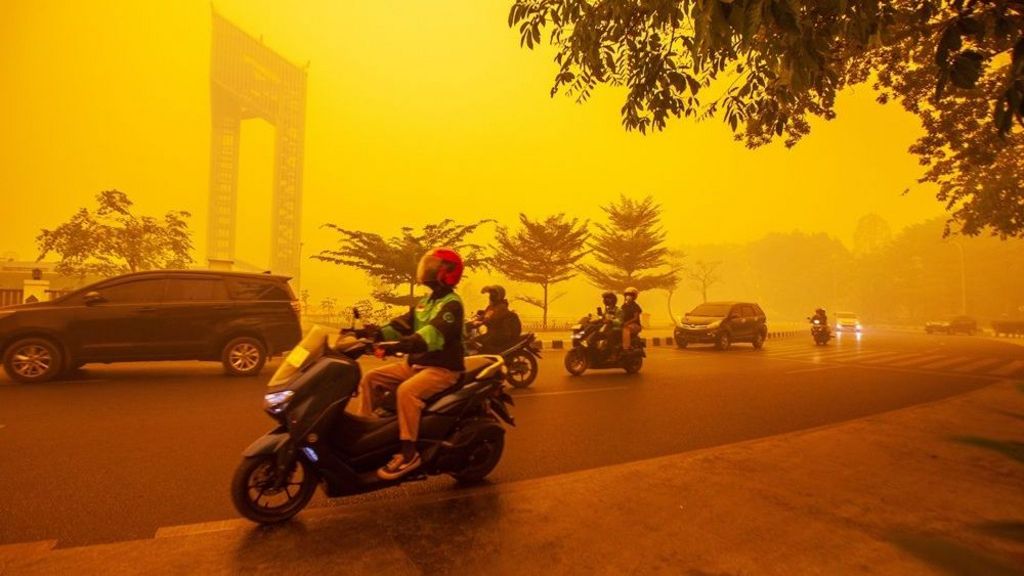
Indonesia is facing the most catastrophic wildfire crisis it has seen in ten years, with an exceptionally powerful El Niño weather pattern amplifying severe drought conditions that have turned small blazes into uncontrollable infernos raging across rainforests and carbon-rich peatlands. As thick, toxic smog continues to blanket large swathes of the archipelago and drift across international borders to neighboring countries, authorities are turning to an untested experimental technique to clear the hazardous haze.
On Thursday, a specialized trial is set to launch in South Sumatra, one of the regions worst impacted by the ongoing crisis, where an aircraft will dump 1.5 tons of solid carbon dioxide, commonly known as dry ice, into the lower atmosphere. Unlike conventional haze mitigation strategies already in use across the country, this new approach does not aim to trigger rainfall. Instead, according to Coordinating Minister for Political and Security Affairs Dudung Abdurachman, the dry ice will work to break apart trapped haze particles, allowing them to rise out of lower atmospheric layers where they accumulate and threaten public health. If the pilot trial delivers successful results, officials plan to roll out the technique to other severely affected hotspots, including Central Kalimantan and surrounding areas.
For weeks, Indonesian authorities and their counterparts in neighboring Malaysia have relied on cloud seeding, a well-established weather modification method that works by dispersing compounds like silver iodide into clouds to encourage the condensation of water vapor and trigger rainfall that clears haze and douses fire hotspots. Additional cloud seeding operations are still scheduled for Thursday and Friday in Central Kalimantan, even as the new dry ice trial gets underway. On the ground, hundreds of firefighters have been working around the clock to contain the spreading blazes, and dozens of helicopters have been deployed to support water bombing efforts. However, thick haze has repeatedly disrupted these operations, cutting visibility and making it difficult to target active fire hotspots.
Local communities across South Sumatra and Kalimantan are currently bearing the full brunt of the crisis, with urban air turning a murky, toxic amber as pollutant concentrations spike well beyond safe limits. The smog has also crossed national boundaries, pushing air quality indexes into unhealthy ranges in Singapore and multiple regions of Malaysia, including the capital Kuala Lumpur and Johor Bahru, a southern city bordering Singapore. Malaysian authorities have launched their own cloud seeding operations to mitigate the cross-border haze, and last month Indonesia granted Malaysian teams approval to operate in Indonesian airspace along the shared border to expand these efforts.
Data from independent forest monitoring platform Nusantara Atlas shows that more than one million fire hotspots have been detected across Indonesia so far in 2025, with the blazes already consuming nearly 900,000 hectares of land. Much of the public anger over the crisis has centered on agricultural corporations, which commonly use slash-and-burn tactics as a low-cost method to clear large tracts of land for plantation development. In response to widespread outrage, Indonesian police have launched sweeping investigations, naming over 200 individuals and nine major companies as official suspects linked to the illegal burning that sparked many of the ongoing wildfires.
Indonesian President Prabowo Subianto has issued an urgent mandate to all relevant government agencies, calling for accelerated efforts to extinguish remaining wildfires and minimize the public health and economic impacts of the toxic smog that continues to emanate from active fire zones.