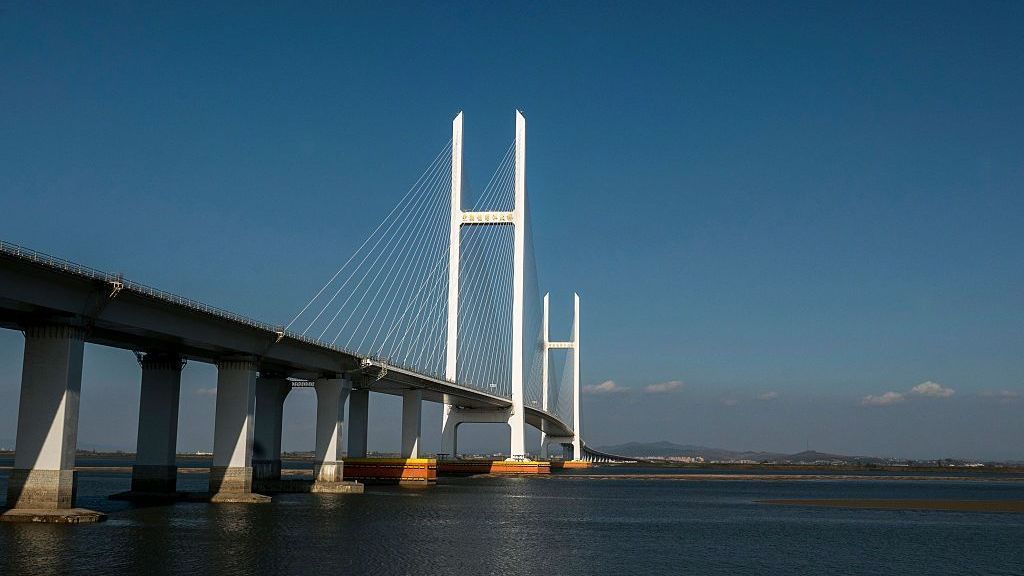
After nearly a decade of delays and shifting diplomatic tides, the New Yalu River Bridge, a key cross-border infrastructure project linking China and North Korea, has officially opened to traffic, Chinese state media has confirmed. The 3-kilometer (1.9-mile) crossing connects China’s northeastern border city of Dandong to North Korea’s northwestern town of Sinuiju, and is positioned to become the primary land corridor for bilateral trade between the two long-time allies.
Construction of the bridge wrapped up years ago, with an initial opening date targeted for 2014. However, the project was put on indefinite hold after North Korea paused work on connecting roads and customs infrastructure on its side of the crossing, amid a period of strained relations between Beijing and Pyongyang in the 2010s.
The modern crossing was built to serve as a higher-capacity alternative to the aging Sino-Korean Friendship Bridge, a structure originally constructed between 1937 and 1943 during Japan’s imperial occupation of the region. Ahead of the official opening, Chinese Foreign Ministry spokesperson Mao Ning described the bridge as a critical connectivity hub for the two neighboring countries, noting that the new route will further boost bilateral trade and deepen people-to-people cultural and social exchanges.
China holds the position of North Korea’s largest trading partner, and has long acted as a key economic buffer for Pyongyang amid harsh international sanctions imposed over North Korea’s nuclear weapons program. Bilateral trade between the two countries hit $2.7 billion last year, bouncing back fully to pre-pandemic levels, with the growth driven primarily by Chinese exports to North Korea.
Despite the optimistic marker of the bridge’s opening, experts warn that rapid, large-scale expansion of cross-border trade remains unlikely. “UN sanctions on North Korea are still in effect, which will cap major trade growth,” explained Kang Jun-young, a professor of Chinese studies at Hankuk University of Foreign Studies in Seoul. “Pyongyang is also cautious of a sudden flood of Chinese imports that would dramatically increase Beijing’s influence over its domestic market. China is well aware of these concerns, so trade growth is far more likely to proceed gradually rather than spiking suddenly.”
The geopolitical relationship between Beijing and Pyongyang is rooted in a decades-long mutual defense alliance – the only active mutual defense pact China holds with any sovereign state – and has historically been described as “as close as lips and teeth.” But the partnership has faced notable friction over the past 15 years. Throughout much of the 2010s, relations turned icy as Beijing grew increasingly frustrated with Pyongyang’s repeated nuclear and missile tests. Only in recent years has the relationship warmed, as China shifted to a softer public stance on North Korea’s nuclear program.
“Just a decade ago, Beijing was openly critical of North Korea’s nuclearization and publicly pushed for Pyongyang to pursue denuclearization,” noted Edward Howell, a lecturer in East Asian studies at the University of Oxford. “Today, China says little to nothing on the issue publicly.”
The opening of the New Yalu River Bridge is the latest in a series of steps to rebuild bilateral connectivity after North Korea lifted its strict pandemic-era border closures. In March of this year, Air China resumed direct passenger flights between Beijing and Pyongyang, after a six-year pause, and cross-border passenger train services between the two countries also restarted that same month.
Even as Beijing moves to deepen its ties with Pyongyang, it is keeping a careful watch on the rapidly growing partnership between North Korea and Russia, which has expanded dramatically since Moscow launched its full-scale invasion of Ukraine in 2022. Last month, Pyongyang and Moscow opened their first cross-border road bridge, which Russian state media reports will be able to accommodate up to 300 vehicles and more than 2,000 cross-border travelers every day.
Analysts frame the opening of the Chinese-North Korean bridge as a deliberate step by Beijing to strengthen its long-standing ties and reaffirm its influence in Pyongyang, amid shifting regional alliances. Chinese President Xi Jinping made his first overseas state visit of 2025 to Pyongyang back in June, where he held a high-profile meeting with North Korean leader Kim Jong Un.
“The opening of the New Yalu River Bridge makes clear that bilateral relations are genuinely improving, and that President Xi’s June visit to Pyongyang was more than just a symbolic gesture,” said Leif-Eric Easley, a professor of international studies at Ewha Womans University in Seoul. “At the same time, the years of delays, compounded by North Korea’s pandemic self-isolation and domestic socioeconomic policies, highlight just how challenging a partner Pyongyang can be for Beijing.”