A groundbreaking archaeological discovery has rewritten maritime history, with an international team of researchers confirming the identification of the world’s oldest known shipwreck dating back between 4,400 and 4,700 years to the Early Bronze Age – a timeframe that aligns with the construction of Egypt’s Great Pyramid. The wreck site lies just 30 meters below the Mediterranean surface, scattered across an underwater slope off the shore of Kekova Island in Turkey’s Antalya region, led by Professor Hakan Öniz of Akdeniz University, head of the expedition run by the Mediterranean Archaeology Association.
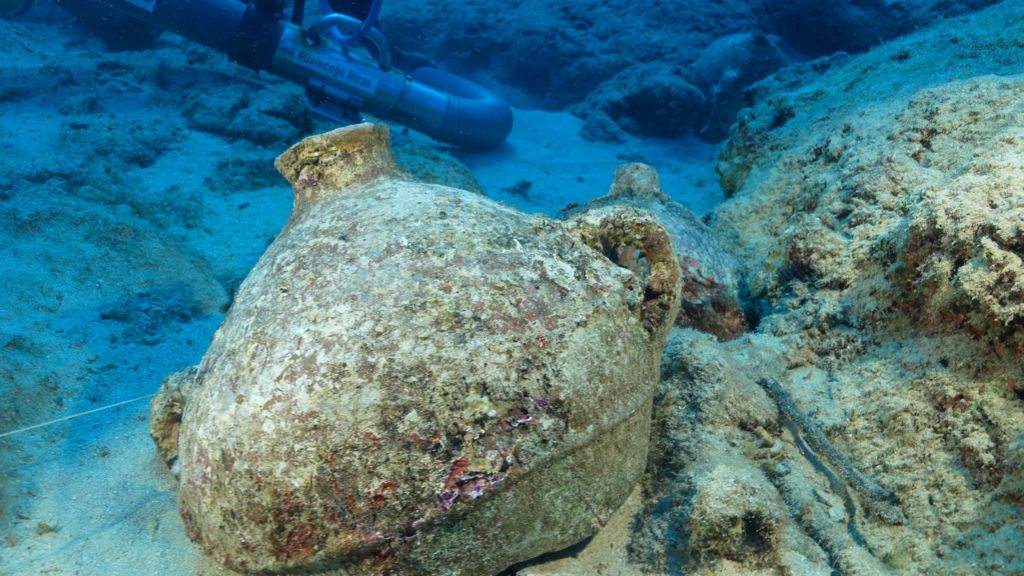
While the vessel’s original wooden hull has completely decomposed after millennia underwater, the cargo it carried has been remarkably well preserved. The team of diving archaeologists recovered three large stone anchors – a find consistent with ancient long-distance trade ships that carried spare anchors for extended voyages – alongside more than 30 intact and fragmented ceramic storage jars known as amphorae. To the team’s surprise, many of these sealed jars still hold thick, visible residues of the cargo they carried when the ship sank.
Without any surviving organic material from the ship’s wood, researchers could not rely on traditional radiocarbon dating to establish the wreck’s age. Instead, they used stylistic analysis of the amphorae, a well-established method for dating archaeological sites, since pottery design and decoration changed predictably across ancient eras. The Kekova amphorae bear a distinctive profile: dual handles, a central ridge, and a flat base. When compared to matching examples previously unearthed in Egypt and the Eastern Mediterranean that have been confirmed to date to 4,400–4,700 years ago, the team confirmed the wreck’s Early Bronze Age origin with absolute certainty. “Comparing the decoration techniques… we can definitely say our wreck is Early Bronze Age. This is 100%,” Öniz affirmed in a statement following the analysis.
After being carefully lifted from the seabed by divers, who were limited to 30-minute dives due to the site’s depth, the fragile artifacts have been moved to conservation facilities to be stabilized after thousands of years submerged in saltwater. Australian archaeologist Dr. Karin Sowada of Macquarie University, who examined the recovered jars, described her shock at the well-preserved residues inside. “I looked inside and nearly fainted. I could not believe how much [residue] was visible. It wasn’t just like spots…. a lot of this material was still remaining,” she said. Researchers are currently conducting testing to identify the exact contents of the residues, with possible candidates including olive oil, wine, and tree resins. Sowada also noted the large size of the amphorae suggests they were likely reused for many years after their initial voyage, a common practice in ancient trade networks.
Beyond its status as the oldest confirmed shipwreck, the discovery offers unprecedented new insight into Mediterranean maritime trade during the Early Bronze Age. Researchers have traced the vessel’s origin to the eastern Mediterranean coast, and believe it was en route to either the ancient city of Troy in modern-day northwestern Turkey or Minoan Crete when it sank. The Kekova region, notorious for strong currents and unpredictable winds that have sunk hundreds of vessels across millennia, has long been a focal point for the Mediterranean Archaeology Association’s shipwreck research.
For Öniz, the discovery is as much about human story as it is about historical significance. “We are the first humans who have touched these objects after 5,000 years,” he said. “We are always thinking of the sailors… the producers of the amphora and the person who carried the amphora on their shoulders to the ship, and the women who were waiting for their husbands, and they unfortunately couldn’t go back.”
Prior to this find, the title of world’s oldest shipwreck belonged to a 4,200-year-old wreck off the Greek island of Dokos. The oldest shipwreck with preserved wooden hull remains remains a 2,400-year-old vessel discovered off Bulgaria’s Black Sea coast.