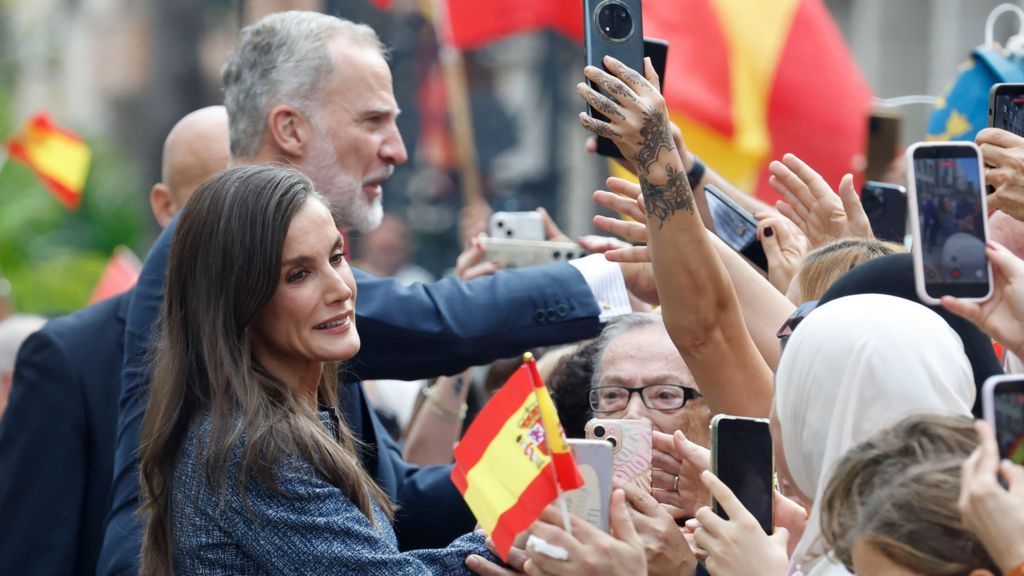
Nearly 20 years after the last royal visit to the Spanish North African exclave of Ceuta, King Felipe VI and Queen Letizia touched down on Tuesday to a warm welcome from local crowds, launching a visit that arrives at a critical moment for the territory. The trip comes as Ceuta continues to recover from a mass influx of roughly 70,000 migrants that crossed over from Morocco in July, an event that sparked a major humanitarian and political crisis for Spain.
Humanitarian organizations have confirmed that at least 141 migrants lost their lives during the dangerous border crossings that month. While most of the new arrivals have moved on from Ceuta in the months since the surge, thousands remain. Until recently, the majority of these remaining migrants were forced to sleep in unregulated open-air sites, with no access to basic shelter or services.
On the first day of their visit, the royal couple is scheduled to hold meetings with Ceuta’s local governing body, tour a local public school, and take part in an interfaith commemoration at the Sidi Embarek Muslim cemetery, where many of the migrants who died during the July crossings were laid to rest. On Tuesday evening, King Felipe is set to deliver a public address at Ceuta’s Parador hotel, before traveling to Melilla on Wednesday – Spain’s second exclave on the North African coast, which is also claimed by Morocco.
Juan Jesús Vivas, Ceuta’s conservative regional president, framed the royal visit as a much-needed boost for the beleaguered territory. “This visit will bring hope to a place that needs a lot of hope,” Vivas told Spanish radio earlier this week. He has repeatedly described the July migrant surge as “the most serious national security crisis of the democratic era” for Spain, and estimates that around 15,000 migrants still remain in Ceuta. That figure is sharply contested by Spain’s central government, which puts the number far lower and notes that it has made 7,400 shelter spaces available to accommodate migrants staying in the territory.
The sudden mass arrival in July placed unprecedented strain on Ceuta’s local infrastructure, stoking fears over public safety and resource scarcity among long-term residents. In a small number of isolated but high-profile incidents, some local residents have attempted to block the distribution of humanitarian aid to the newly arrived migrants. It was not until last month that the central government completed construction of temporary makeshift shelters, bringing an end to the period where most migrants were sleeping rough. The shelters are being used to house migrants while Spanish authorities carry out immigration legal screenings to determine whether each individual will be allowed to remain in Ceuta or deported back to Morocco or another country.
The crisis has pushed Ceuta’s situation and the broader issue of immigration to the top of Spain’s national political agenda, just weeks ahead of upcoming national elections. Immigration has already emerged as one of the most contentious key issues in the campaign, with opposition parties heavily criticizing Prime Minister Pedro Sánchez’s Socialist-led government for its handling of the crisis. Large demonstrations in support of Ceuta’s local population have been held across mainland Spain, putting additional pressure on Sánchez’s administration.
The crisis has also dramatically inflamed longstanding tensions between Spain and Morocco, which has maintained a formal sovereignty claim over both Ceuta and Melilla for decades. Many Spanish political observers and officials initially pointed the finger at Morocco, accusing the North African kingdom of deliberately allowing or even orchestrating the mass crossing in July. Prime Minister Sánchez, however, has stated that there is no concrete evidence to support the claim that Morocco knowingly facilitated the surge.
Earlier this week, Sánchez confirmed a media report that Moroccan military vessels had entered Spanish territorial waters off the coast of Ceuta on July 31, during the peak of the migrant crossing, but he downplayed the incident, framing it as a minor, isolated occurrence that does not represent a broader escalation. Morocco, for its part, has doubled down on its longstanding sovereignty claims to both Ceuta and Melilla in the wake of the crisis. Back in August, Moroccan Justice Minister Abdellatif Ouahbi reiterated his country’s “historical and geographical right” to the two exclaves and called for bilateral negotiations with Spain to resolve the sovereignty dispute – a call that the Spanish government immediately rejected.
Opposition leaders have accused Sánchez of failing to take a firm stance against Morocco amid the crisis. Alberto Núñez Feijóo, leader of the conservative opposition People’s Party (PP), has accused Sánchez of misleading the Spanish public about the root causes of the July migrant surge and committing “frivolity” in his handling of the issue. “To Morocco, [we should offer] loyalty and good neighbourliness, but also firmness,” Feijóo stated, outlining the opposition’s approach to the ongoing diplomatic tensions.