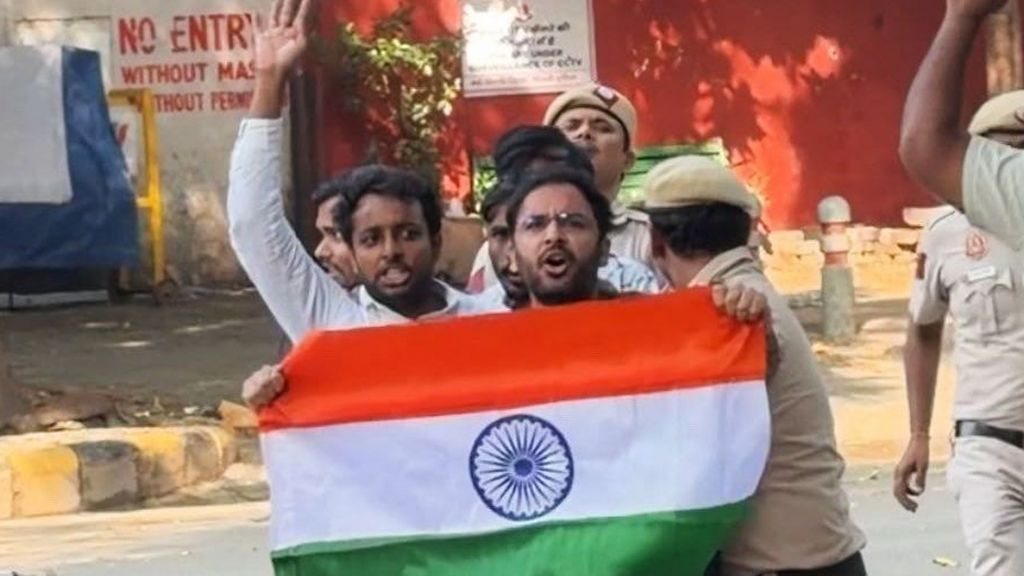
A fresh wave of political unrest has gripped India’s capital New Delhi this week, after leaders of the rising youth opposition group Cockroach Janta Party (CJP) were taken into police custody Tuesday morning for breaching heavy security to stage an unsanctioned protest at Jantar Mantar, the iconic historic observatory long known as the heart of Indian public demonstration.
The detentions came just 24 hours after India’s federal home ministry issued a surprise order stripping Jantar Mantar of its status as an officially designated protest venue, re-routing all future demonstrations to three permitted alternative sites across the city. This move followed days of escalating clashes between authorities and opposition groups demanding the resignation of Chief Election Commissioner Gyanesh Kumar over a controversial national electoral roll revision that has removed tens of millions of voter names from official rolls.
CJP founder Abhijeet Dipke shared live social media footage Tuesday showing party members Ashutosh Ranka and Saurav Das climbing over stacked police barricades to enter the tightly secured site, alongside other demonstrators carrying the Indian national flag and shouting slogans calling for Kumar’s ouster. In a post on X following the incursion, Dipke wrote, “You cannot denotify the resistance,” while Das published a statement confirming the pair had “reclaimed” Jantar Mantar moments before being detained by officers.
Ranka later appeared in a live Instagram broadcast from a moving police bus, alongside other detained activists. Contrary to expectations of intimidation, Ranka and his fellow detainees remained visibly upbeat, telling supporters they would not step back from their demands. As of early Tuesday evening, authorities had not confirmed the location where the detained leaders were being held.
The CJP’s protest at Jantar Mantar was planned after the group requested permission from Delhi Police to stage a peaceful demonstration at the site, only to see the venue de-notified a half-hour after their meeting, Ranka explained in an earlier social media post.
This is not the first major demonstration led by the CJP, a youth-focused movement that grew out of online satire in May this year, after India’s Chief Justice Surya Kant compared unemployed young job seekers to cockroaches during a public court hearing. Though Kant later claimed his remarks were misinterpreted, the comment became a rallying cry for discontented youth, and the group evolved from an internet meme into a formal political pressure group channeling widespread public anger over youth unemployment, systemic exam irregularities, and lack of government accountability. Earlier this year, the CJP led weeks of nationwide student protests over education policy that ultimately forced the resignation of federal Education Minister Dharmendra Pradhan.
Tensions have been building in New Delhi since last weekend, when authorities deployed thousands of police and paramilitary personnel across the capital, closed multiple metro stations, and disrupted public transit to block a planned CJP protest at Jantar Mantar scheduled for Saturday. Over the course of the weekend, police detained and later released thousands of demonstrators, including multiple working journalists. User-shared footage from the weekend shows officers dragging protesters, including women, by force and pushing them into detention buses.
On Monday, a day before the CJP’s incursion, tens of thousands of demonstrators gathered in the capital, and major national opposition parties led a mass march from the central shopping district Connaught Place to the steps of India’s Supreme Court. India’s main opposition party, the Congress, also filed a formal petition with the Supreme Court on Monday challenging the Election Commission’s electoral roll revision.
Critics of the revision argue that the mass removal of voter names risks disenfranchising millions of eligible voters, who will face unnecessary barriers to re-registering ahead of upcoming elections. Opposition leaders have further alleged the revisions are intentionally structured to benefit Prime Minister Narendra Modi’s ruling party, a claim both the ruling party and the Election Commission have flatly rejected. Anger over the process grew last week after leading Indian newspaper *The Indian Express* reported that Chief Election Commissioner Kumar disregarded formal concerns raised by the two other sitting election commissioners over the changes to voter registration rules. The Election Commission has maintained all its decisions on the revision were reached unanimously.