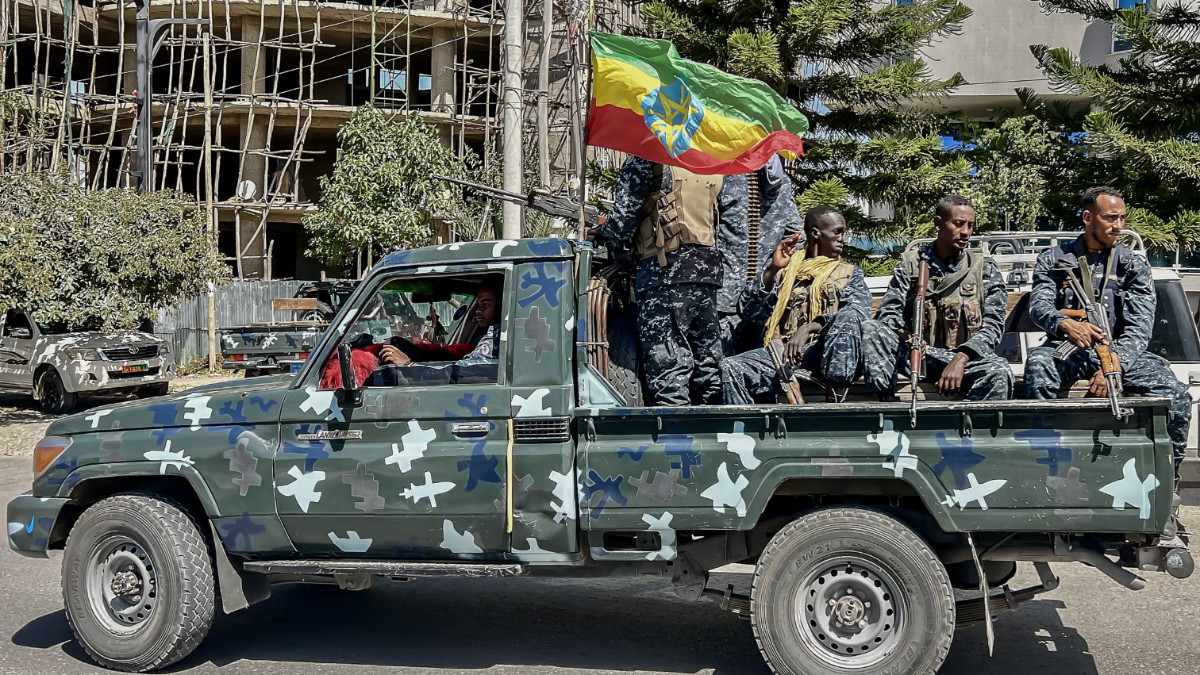
Decades of simmering ethnic, political, and territorial rivalries in the Horn of Africa have pushed neighboring Ethiopia and Eritrea to the brink of all-out war, a crisis that analysts warn risks drawing in global and regional powers and destabilizing a Red Sea region already roiled by ongoing conflicts in Sudan and Yemen.
Mutual overconfidence among decision-makers on both sides, rooted in miscalculations of their opponent’s weaknesses and underestimation of their own vulnerabilities, has elevated the risk of a broad regional conflict far beyond the likelihood of containing the current violence, according to regional analysts and serving and former officials briefed on the situation. As former CIA officer and Africa specialist Cameron Hudson put it, “All the leaders in the region say ‘we don’t want a regional war’, but that doesn’t prevent us from walking backwards into one.”
The unfolding crisis unfolds across three interconnected layers: deep internal political fissures within Ethiopia, century-old historic tensions between Ethiopia and Eritrea, and competing interventions by Middle Eastern powers that have amplified existing flashpoints.
At its core, the conflict stems from a power struggle over Ethiopia’s governing structure, a challenge made complex by the country’s 80 distinct ethnic groups, five of which – Oromo, Amhara, Tigrayan, Somali, and Afar – hold major demographic and political influence, many with their own heavily armed militias. Current Prime Minister Abiy Ahmed has advanced a controversial push to restructure Ethiopia’s long-standing ethnic federalism system into a more centralized national government, a shift that has galvanized opposition from multiple ethnic factions.
Hostilities reignited in September when the Tigray People’s Liberation Front (TPLF), a once-ruling Ethiopian rebel group, launched a major offensive aimed at ousting Abiy’s government. The TPLF seized the Tigray regional capital Mekelle in its opening gains, but Ethiopian federal forces quickly reversed those advances.
The second layer of the crisis is the decades-long hostile rivalry between Ethiopia and Eritrea. Once an Italian colony, Eritrea was federated with Ethiopia after World War II, before being unilaterally annexed by Addis Ababa in 1962. After a 30-year independence insurgency, Eritrea secured sovereignty via a UN-monitored referendum in 1993. Though the two nations aligned to fight the TPLF in Ethiopia’s 2020–2022 Tigray civil war, underlying tensions have never been resolved: Abiy’s government has staked revisionist claims to Eritrea’s Red Sea coastline, while Eritrea has long backed anti-Addis Ababa militias inside Ethiopia.
This month, Addis Ababa accused Asmara of deploying thousands of troops across the border to support the TPLF’s offensive. Multiple current and former officials from the U.S., European Union, and African nations have confirmed to Middle East Eye that Eritrean forces have entered Tigray to participate in active combat. Monitoring group the Armed Conflict Location & Event Data Project (ACLED) confirmed that Ethiopia launched drone strikes on Eritrean troops positioned in Tigray earlier this week.
The last full-scale war between the two nations ran from 1998 to 2000 and remained largely contained, but a new conflict would almost certainly draw in regional powers that had no stake in the 1990s conflict. Both nations have closed their respective embassies in each other’s capitals this week, and a former senior European official with direct knowledge of the situation says Ethiopia could issue a formal declaration of war against Eritrea in the coming days.
In a Thursday letter to the United Nations, Ethiopia framed Eritrea’s troop deployment as “a blatant act of aggression” that triggers the country’s inherent right to self-defense, stating, “Eritrea is the aggressor, Ethiopia is the victim. Eritrea is violating Ethiopia’s sovereignty and territorial integrity.”
Eritrea has pushed back firmly against these accusations. Eritrean Information Minister Yemane Gebremeskel noted Friday that Abiy already announced to Ethiopia’s parliament on October 13, 2023 that his government would secure “sovereign access to the sea” via negotiation if possible, and by force if necessary – a statement Gebremeskel says amounts to a pre-existing declaration of war against Eritrea. Veteran Ethiopian diplomat and former UN ambassador Tekeda Alemu says the two states are already effectively at war, even without a formal declaration. “It’s very clear Eritreans have penetrated deep into Ethiopian territory. We are in the midst of war, even though it hasn’t been declared. The war is going on,” Alemu told MEE.
A critical complicating factor is the domestic opposition alliance the TPLF has forged in recent weeks. In September, the TPLF announced a coalition with six other armed Ethiopian groups united by the goal of overthrowing Abiy’s government. The coalition includes Fano, an Amhara militia that views itself as the guardian of Ethiopia’s multi-ethnic state; Amhara leaders dominated both the imperial rule of Haile Selassie and the Soviet-backed Derg junta that governed from 1975 to 1991. The coalition also includes the Oromo Liberation Army, an armed faction from Abiy’s own Oromo ethnic group, which has turned against the prime minister.
Not all members of the allied ethnic groups back the anti-Abiy coalition, and analysts disagree on how formidable the alliance truly is. Alemu argues the coalition cannot be dismissed: “What is not clear is what the alliance is intending to do. They haven’t begun to start a full-scale war. The alliance can not be brushed aside. It is formidable, as is the government side.” But an anonymous Addis Ababa-based analyst told MEE that the TPLF has overstated both its own strength and the level of popular support it can expect from Amhara and Oromo communities. Addis Ababa has accused Eritrea of orchestrating the anti-Abiy alliance – a claim Asmara denies, though senior Eritrean officials have publicly acknowledged the threat the coalition poses to Abiy’s government.
Some Western and regional analysts believe Abiy may have actively welcomed the TPLF’s September uprising, arguing it brought long-simmering tensions with Eritrea to a head and gave him a pretext to pursue his long-stated goal of securing Eritrean Red Sea coastline. A former senior Western official told MEE, “The Eritreans have moved preemptively. The question is, have they fallen into a trap? Ethiopia will not only confront the Eritreans with ground forces, but they will launch aerial attacks on Eritrea. If the Ethiopian army moves, it will be in order to go to Asmara and Assab. They will not stop at the frontier.” Eritrean analyst Sirak Kifle, who regularly consults with senior Asmara officials, agrees that Abiy has long sought an excuse to seize Eritrean port territory: “Abiy is aiming at the ports of Eritrea.” Kifle also cautions that the TPLF remains a capable fighting force that cannot be discounted, noting that while Addis Ababa has deployed 400,000 troops to Tigray, it remains unclear whether the government can sustain a long-term counterinsurgency campaign.
Hudson notes that Ethiopian federal forces are far better resourced today than they were during the 2020–2022 Tigray war. “Ethiopia has a ripping economy, a ton of money and deep-pocketed allies in the UAE and Israel. Abiy Ahmed has learned from the last war in Tigray and the numbers are on his side,” he said.
It is these competing regional alliances that make the current crisis so dangerous for global security. Ethiopia already maintains close ties to the United Arab Emirates and Israel, which have supplied Addis Ababa with drones and advanced weapons systems. Eritrea suspects that both countries would back an Ethiopian push to seize its Red Sea coastline, in exchange for access to the strategically critical territory. For its part, Eritrea has built close alliances with Somalia, Egypt, and Sudan’s ruling Sudanese Armed Forces – all of which oppose Abiy’s government – and has recently deepened ties to Saudi Arabia, which has broken with the UAE over competing interests in African hotspots including Sudan and Somaliland.
If Ethiopia moves beyond Tigray to attempt to seize Eritrea’s Red Sea coast, the shockwave across the Horn of Africa would be unprecedented. Egypt, a long-time rival of Ethiopia that has already been locked in a years-long dispute over Addis Ababa’s Grand Ethiopian Renaissance Dam on the Nile, has repeatedly condemned Ethiopia’s plans to build additional Nile dams, which Cairo says threaten its national water security. Cairo also views an Ethiopian naval presence on the Red Sea as a major strategic threat. Somalia, already tense over Ethiopia’s moves toward recognizing the breakaway Republic of Somaliland, would also oppose an Ethiopian territorial expansion. In Sudan’s ongoing civil war, Ethiopia backs the UAE-aligned Rapid Support Forces, accused of genocide, while Eritrea and the TPLF back the Sudanese Armed Forces.
Earlier this week, the coalition of states opposed to an Ethiopian advance on the Red Sea – Egypt, Sudan, Somalia, and Eritrea – met in El Alamein, Egypt, where Reuters confirmed they agreed to coordinate military and intelligence sharing if the Tigray conflict expands across the border. As the former senior Western official put it, “This war is still a tussle over Tigray. It is one step away from becoming a war over the Red Sea.”