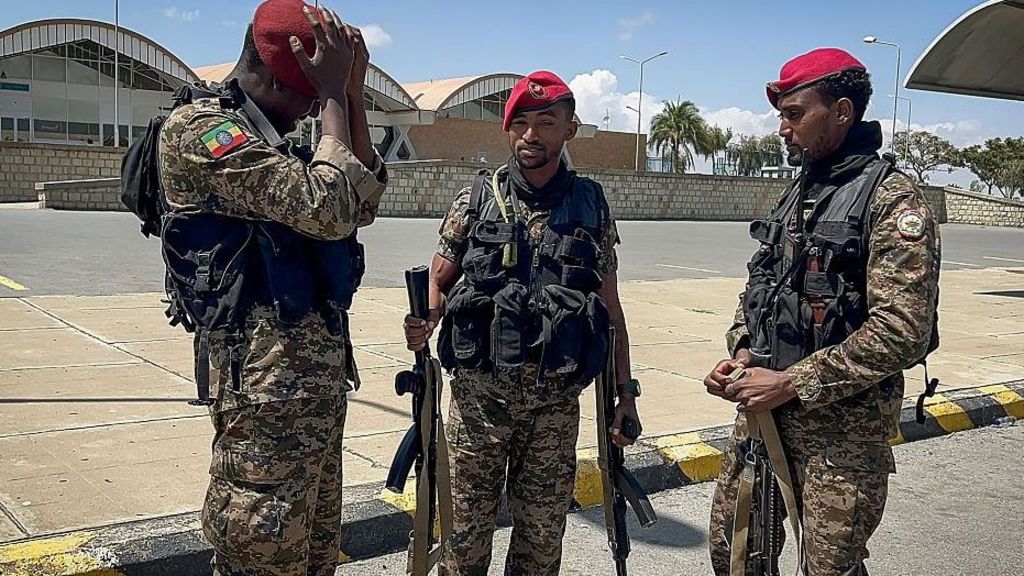
Two weeks after renewed violence erupted between Ethiopia’s federal government and the Tigray People’s Liberation Front (TPLF), a long-simmering rift between Ethiopia and neighboring Eritrea has exploded into open armed conflict, raising urgent fears of a wider regional conflict. The crisis comes on the heels of a broken 2022 peace deal that ended a two-year civil war in Tigray, and marks a dramatic reversal of the brief diplomatic detente between the two Horn of Africa nations that began in 2018.
In a formal letter dated October 8, addressed to the United Nations Security Council and obtained by the BBC, Ethiopian Foreign Minister Gedion Timothewos has formally accused Eritrea of launching an “all-out invasion” of Ethiopia’s northern Tigray region. Timothewos called the incursion a “blatant act of aggression”, adding that Ethiopia is left with no choice but to exercise its inherent UN-guaranteed right to self-defense against the violation of its sovereign territory. According to the Ethiopian foreign minister, Eritrean military forces have pushed as far as 60 kilometers (37 miles) into Tigray, a depth of advance that has stunned regional observers.
The accusation marks a sharp break from the dynamics of the 2020–2022 Tigray civil war, when Eritrea fought as a key military ally of the Ethiopian federal government against the TPLF. Relations between the two neighbors have collapsed rapidly in recent months, driven primarily by tensions over Ethiopian Prime Minister Abiy Ahmed’s stated ambition to secure access to one of Eritrea’s strategic Red Sea ports. Diplomatic ties between the two nations were formally severed just last week, opening the door for further escalation.
In response to Ethiopia’s claims, Eritrean Information Minister Yemane Gebremeskel has rejected the accusations outright, framing Ethiopia as the aggressor in the crisis. Gebremeskel dismissed Addis Ababa’s claims as “duplicity in their most extreme forms”, and countered that Ethiopia has launched an “unprovoked war of aggression” against Eritrea. He also accused Ethiopian leaders of actively seeking to foment regime change in Asmara by providing shelter and logistical support to Eritrean opposition mercenary groups. Eritrea seceded from Ethiopian control in 1993 after a decades-long independence struggle, and relations between the two countries have been fraught with border disputes and political tension for most of the past 30 years, with a brief normalization period beginning when Abiy took office in 2018.
Amid the escalating cross-border tensions, Ethiopian drone strikes have targeted Eritrean military positions in the border town of Adigrat, located in northern Tigray, according to multiple independent reports. US-based conflict analytics organization Armed Conflict Location & Event Data Project (Acled) confirmed that multiple drone strikes hit Eritrean troop deployments and ammunition stockpiles in Adigrat overnight this week. Multiple local witnesses, speaking to AFP, confirmed heavy drone activity, with one reporting “many, many drone strikes” and confirming that several Eritrean military supply trucks were destroyed in the attacks. Following the strikes, witnesses reported that Eritrean ground forces appeared to be retreating north toward the Eritrean border. As of Friday, there are no independently verified reports of civilian or military casualties from the strikes, and the BBC has confirmed it cannot deploy independent journalists to report from Tigray due to security restrictions.
The current upsurge in violence follows months of rising political tension across northern Ethiopia. In September, the TPLF joined a new coalition of armed opposition groups opposed to the Abiy government, setting the stage for renewed fighting. Just last week, TPLF forces withdrew from Mekelle, Tigray’s largest regional capital, leaving the city under the control of Ethiopian federal government forces, which retook control of the key population center after the rebel withdrawal.
In its formal letter to the UN Security Council, Ethiopia appealed to the international body for backing, saying “In this time of difficulty, when Ethiopia is left with no other option but to defend itself, we count on your understanding, support, and solidarity.” International observers have warned that the open clash between Ethiopia and Eritrea could destabilize the entire Horn of Africa region, drawing in neighboring powers and undoing the fragile progress made towards peace in Tigray after the 2022 ceasefire agreement.