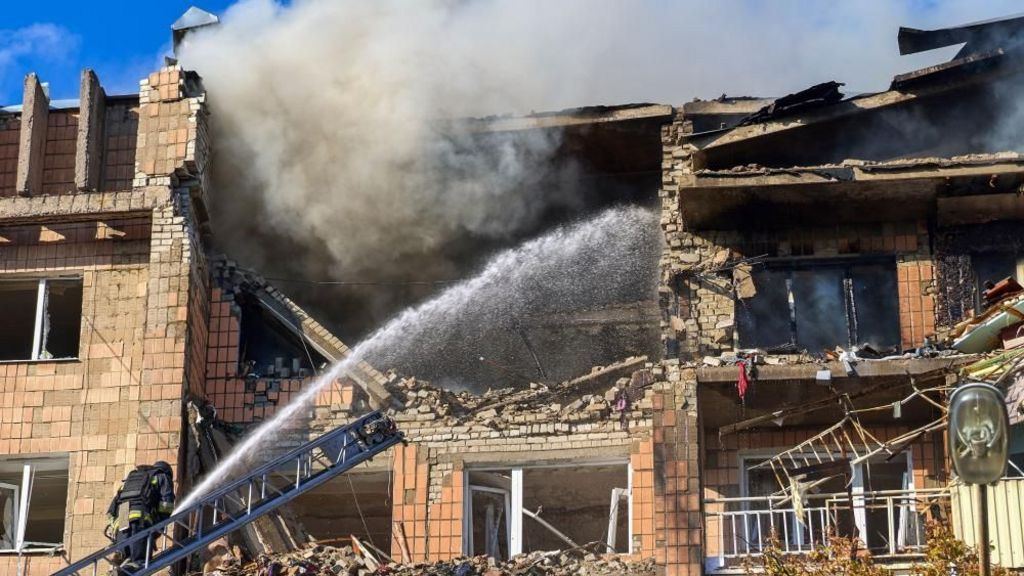
Just hours after U.S. President Donald Trump announced a bilateral energy ceasefire between Russia and Ukraine that he claimed would take effect “immediately,” Moscow launched a wave of strikes targeting six Ukrainian energy facilities, Ukrainian President Volodymyr Zelenskyy has confirmed. The attacks shattered hopes of a quick de-escalation along energy infrastructure lines, even as international leaders had signaled varying levels of support for the proposed truce.
On Monday, Russian Foreign Minister Sergei Lavrov openly stated that Ukraine did not deserve the “respite” a ceasefire would provide, a comment that came alongside multiple confirmed strikes across Ukrainian territory. Ukraine’s state news agency Ukrinform reported that Russian strikes destroyed power grids in the eastern city of Izyum, leaving residents completely without electricity. Overnight attacks also targeted energy and railway infrastructure in western Ukraine, expanding the scope of the damage. By Monday afternoon, Ukraine’s state-owned grid operator Ukrenergo confirmed that new power outages were in effect across Kharkiv, Donetsk, and Zaporizhzhia after Russian attacks damaged critical energy equipment. To prevent total system failure, electricity rationing has been rolled out across multiple regions of the country.
The attacks also extended beyond energy infrastructure: on Monday evening, Kyiv mayor Vitali Klitschko announced that a Russian drone had struck a 25-story residential building in the capital’s Darnytskyi district. Klitschko reported that multiple parked cars in the building’s courtyard caught fire, the attack killed one person and injured 11 others. Emergency services were also dispatched to Kharkiv to respond to damage from a drone strike on a residential building in the northeastern city earlier the same day. Zelenskyy confirmed that 33 people total were injured in the nationwide strikes on energy facilities.
Speaking to Fox News, Zelenskyy emphasized that Ukraine had held its fire under the terms of the proposed ceasefire, while Russia deliberately targeted civilian energy sites. “We did not attack, while Russia attacked our gas stations, energy infrastructure, and other facilities,” he said, adding that “I think it was Putin’s answer to President Trump.” In a post on X, Zelenskyy further noted that the strikes were clear proof Russia remained “unwilling to accept an energy ceasefire.” When the ceasefire was first announced by Trump on Sunday, Zelenskyy acknowledged that the proposal was “news to him” but expressed cautious support, framing it as a “major step toward ending the war” if the U.S. could guarantee Russian compliance.
Trump, for his part, defended the ceasefire announcement on Monday, saying “I said you agree” when asked how the deal was reached, and adding that the war “has to get settled.” “That war is a disaster if you see the numbers,” he told reporters. The proposed energy ceasefire comes as Trump has pushed for Ukraine to halt strikes on Russian oil infrastructure, clearing the way for a new deal that would allow Russian diesel exports to enter the U.S. market, temporarily rolling back existing U.S. sanctions on Russian energy imports. Zelenskyy has characterized this deal as a “gift” to Russian President Vladimir Putin, as the move comes ahead of U.S. midterm elections where rising global fuel prices driven by the ongoing conflict have become a key political issue.
For months, both Russia and Ukraine have exchanged reciprocal strikes on energy infrastructure, disrupting energy supplies across the region. Moscow has consistently justified its attacks by claiming the targeted installations support Ukraine’s military operations, while Zelenskyy has framed Ukrainian strikes deep inside Russian territory as a necessary measure to “reduce Russia’s ability to finance the war.” Analysis from BBC Verify shows that both sides have ramped up their attacks on energy infrastructure in the months ahead of the winter heating season, when demand for energy peaks across Eastern Europe. In 2026 to date, BBC Verify has recorded 273 strikes on Russian-controlled oil and gas facilities, more than double the 124 strikes recorded over the same period in 2025. Data from the Armed Conflict Location and Event Data Project (ACLED), a global conflict monitoring group, further confirms that reported Russian attacks targeting Ukraine’s energy network have increased 2.4 times so far this year compared to 2025.
International reaction to the proposed ceasefire has been mixed. UK Prime Minister Andy Burnham said Britain “strongly supports President Trump’s call today for a sustained energy ceasefire to start now,” and France, Canada, and the European Union have also issued statements of general support. But European officials have expressed skepticism about Russian compliance. EU foreign policy chief Kaja Kallas told a meeting of EU foreign ministers on Monday that the bloc would welcome an energy ceasefire “when it holds,” noting that “We haven’t yet seen that also Russia will stick to it.” Estonia’s foreign minister went further, stating outright that the ceasefire was “not working.”