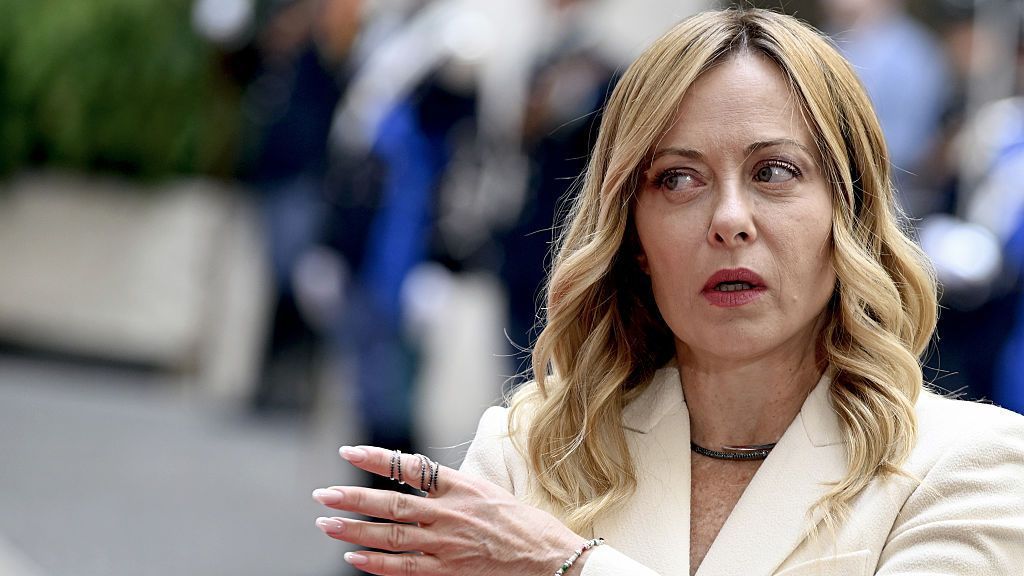
As the threat of AI-powered deepfakes grows increasingly pressing for public figures worldwide, Italian Prime Minister Giorgia Meloni has taken a proactive step to safeguard her identity by filing an application to trademark her distinctive voice with European Union regulators.
The application, submitted to the European Union Intellectual Property Office (EUIPO) on Monday, is publicly visible on the agency’s official website, and a spokesperson for the prime minister’s office has since confirmed the filing to reporters. As a core part of the application process, Meloni recorded a four-second audio clip that features her repeating the Italian phrase “Io sono Giorgia” – translated to “I am Giorgia Meloni” – twice. This phrase holds special personal and political significance: it served as the title of Meloni’s 2021 autobiography and has been a staple of her political campaigning for years.
Meloni is far from the first high-profile individual to seek legal protection for their personal identity against unauthorized AI manipulation. Earlier this year, American actor Matthew McConaughey pioneered this approach in January by trademarking both his likeness and voice. Just a few months later in April, global pop superstar Taylor Swift followed suit, submitting three separate trademark applications in the United States: one centered on a promotional photograph from her record-breaking Eras Tour, and the other two featuring audio clips of her introducing herself during the rollout of her most recent album.
By August, the movement for stronger legal protections had gained broad traction among performers, with more than 80 artists calling on Greater Manchester Mayor Andy Burnham (note: the original text incorrectly referenced this as the British Prime Minister) to introduce new legislation that would enshrine a universal legal right for all UK residents to own and control their own voice. High-profile actors including Matt Lucas, Hugh Bonneville, and Nicola Coughlan were among the signatories, warning that unregulated AI cloning leaves performers vulnerable to having their voices exploited without consent or compensation.
Voice cloning technology works by training AI models on existing audio recordings of a target individual. While low-quality clones can be generated from as little as a few seconds of sample audio, high-fidelity, convincing replications typically require hours of recorded material to train properly. For public figures, who often have thousands of hours of speeches, interviews, and public appearances available online, the risk of unauthorized cloning is particularly acute.
Meloni’s decision to trademark her voice comes less than a year ahead of Italy’s upcoming general elections, scheduled for 2025, making the threat of manipulated deepfake audio and video to disrupt the political process particularly urgent. This is not the first time Meloni has been targeted by bad actors using deepfake technology: in 2024, she sought €100,000 (£84,920) in damages after non-consensual deepfake pornographic videos of her were uploaded to public platforms online. Just a few months ago, in May 2024, deepfake AI-generated images of Meloni wearing lingerie circulated widely across social media, prompting her to speak out publicly about the broader dangers of this technology.
In a social media post addressing the incident, Meloni emphasized that the issue extends far beyond her own experience. “Deepfakes are a dangerous tool, because they can deceive, manipulate, and strike anyone. I can defend myself. Many others cannot,” she wrote. Her latest move to trademark her voice represents one of the most high-profile proactive steps by a sitting head of government to address the growing regulatory and security challenges posed by unregulated AI deepfakes.