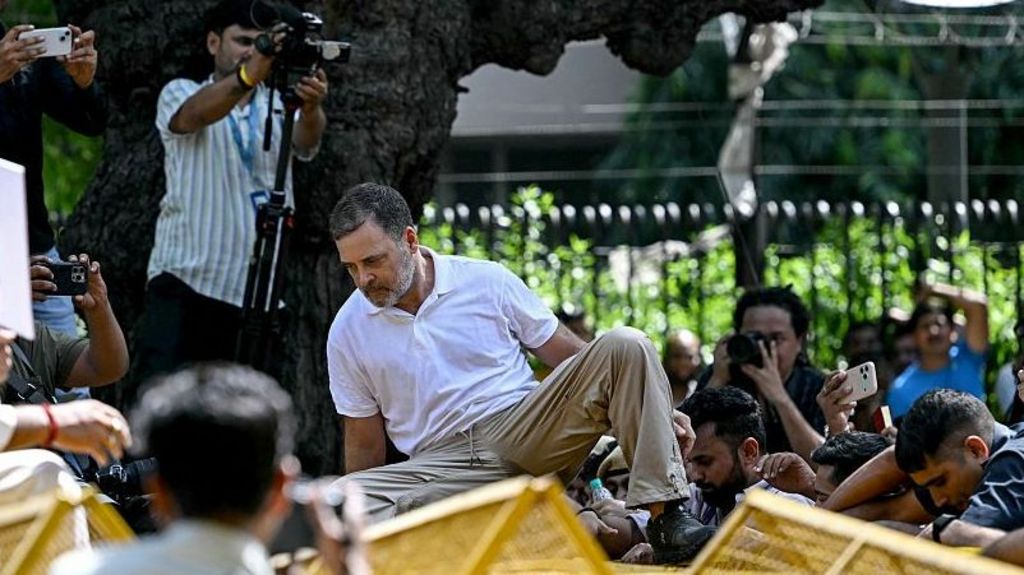
A heated political standoff in India’s capital New Delhi took a dramatic turn on Tuesday, when local police detained dozens of opposition legislators attempting to march to the Election Commission of India headquarters, demanding the resignation of Chief Election Commissioner Gyanesh Kumar over a disputed national voter roll revision project.
Among those detained were Rahul Gandhi, leader of India’s main opposition Congress party, his sister and fellow Congress leader Priyanka Gandhi Vadra, and dozens of members of parliament from a coalition of opposition groups. Police intercepted the marching group mid-route, forced the lawmakers into police buses for detainment, and released them within a short window. After being freed, the protesters resumed their demonstration and staged a sit-in just blocks from the Election Commission’s main office.
Authorities had pre-emptively tightened security across the area, erecting concrete barricades and deploying additional officers along the entire route from India’s Parliament complex to the Election Commission headquarters. Additional Deputy Commissioner of Police Manjeet Sheoran confirmed to the BBC that officers were stationed at multiple checkpoints to block alternate access routes, adding that detained protesters were transported to separate police stations across the city before their release. Police have not publicly confirmed the total number of lawmakers detained, but opposition organizers said 237 MPs from more than a dozen opposition parties took part in the planned march.
Tuesday’s mass protest marks the latest escalation in a weeks-long political firestorm ignited by the Election Commission’s Special Intensive Revision (SIR) of national electoral rolls. The nationwide audit, launched in Bihar state in June 2025 before expanding across the country, is framed by the commission as a routine effort to remove duplicate, fraudulent, and ineligible entries from voter lists. To date, more than 130 million names have been struck from draft electoral rolls across the country.
But opposition parties and voting rights activists have pushed back hard against the process, alleging that the revision has systematically wrongfully removed millions of eligible voters from rolls, and that the process has been carried out with deliberate procedural irregularities to benefit Prime Minister Narendra Modi’s ruling Bharatiya Janata Party (BJP). Both the BJP and the Election Commission have categorically denied all allegations of partisan bias.
The push for Kumar’s resignation gained significant traction earlier this month following an investigative report published by *The Indian Express*, which revealed that the two other sitting members of the three-member Election Commission – Sukhbir Singh Sandhu and Vivek Joshi – had formally raised objections at least 14 times over 10 months to official orders issued in the commission’s name without their knowledge or approval. The objections covered a range of critical issues, including voter roll additions and deletions, access to the national voter database, and electoral data security, with multiple concerns directly tied to the SIR project.
The Election Commission has defended its internal decision-making process, arguing that internal disagreement is a normal part of institutional function and that all final decisions have been reached through collective consensus. But the explosive revelations have triggered widespread political backlash, strengthening opposition demands for Kumar to step down.
The demonstration on Tuesday also follows separate protests held four days earlier in Mumbai and New Delhi by the Cockroach Janta Party (CJP), a Gen Z-led satirical grassroots movement that has also joined calls for Kumar’s resignation. The CJP has called its initial protests the launch of a national campaign, and has scheduled another round of mass demonstrations for October 10.
Congress party president Mallikarjun Kharge laid out three non-negotiable demands for the government and election body: the immediate resignation of Kumar, the full cancellation of the Special Intensive Revision of voter rolls, and a return to universal paper ballot voting for all future elections. In a sarcastic public post on social media, Rahul Gandhi taunted the chief election commissioner, writing, “Gyanesh, it’s done, bro. Time to resign.”
The ruling BJP has strongly condemned the opposition protests, framing them as an undemocratic attack on India’s constitutional institutions. BJP spokesperson and sitting MP Sambit Patra called the demonstration a “sponsored attempt” to seize power through “anarchy” and accused opposition parties of deliberately undermining the independence and authority of the Election Commission.
The ongoing controversy has already reached India’s Supreme Court, which is currently hearing a petition challenging Kumar’s decision-making process. The petition argues that Kumar unilaterally exercised authority that legally belongs to the full three-member commission collectively, and asks the court to rule that all unilateral actions taken by Kumar are legally invalid. While the court has indicated that all commission decisions must be made either by majority vote or unanimous agreement, and noted that decisions made outside this process could be struck down, it declined to suspend Kumar from office pending the conclusion of the case. The court said it will first hear responses from the Election Commission and the federal government, and review all relevant official records before making a ruling.
As of Tuesday evening, the BBC has reached out to the Election Commission for additional comment on the day’s protests and the ongoing controversy, with no response yet issued.