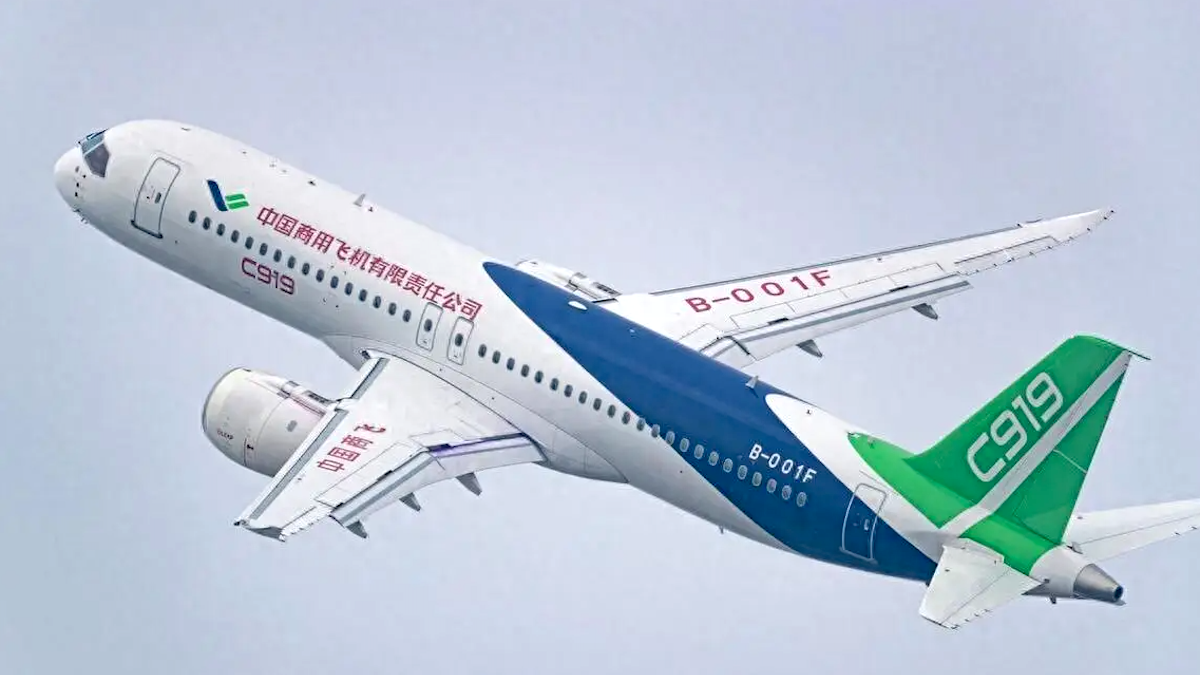
The ongoing trade and strategic rivalry between the U.S. and China has entered a new, high-stakes phase in the global aviation sector, as Washington has tightened controls on licensed aircraft component exports to the Commercial Aircraft Corporation of China (Comac), the state-owned manufacturer behind the C919 narrow-body passenger jet. The core source of concern among Chinese industry analysts is that these incremental restrictions could pave the way for a full ban on the U.S.-sourced LEAP-1C engines that the C919 program currently depends on for mass production.
According to Reuters reporting from October 1, the Trump administration has deployed China’s reliance on American aviation suppliers as a negotiating tool in ongoing trade discussions, as Washington pushes Beijing to loosen its dominant control over global rare earth mineral supplies — critical inputs for everything from jet engine components to defense technology. Official U.S. actions over recent weeks include capping the volume of parts eligible for export licenses to Comac to prevent the manufacturer from building up a reserve stockpile, and slowing the processing of existing export license applications for C919-bound components. Administration officials are also currently reviewing a proposed regulatory change that would lower the bar for restricting exports of core aviation parts including landing gear, with a draft rule already adding a new licensing requirement for aviation hydraulic fluid.
Chinese industry commentators note that curbs on secondary components like landing gear and hydraulic fluid would pose minimal near-term disruption, even for Chinese airlines that operate large Boeing fleets. Analysts point out that Boeing has enormous stakes in the Chinese aviation market — which is projected to demand 8,000 to 9,000 new passenger jets over the next 20 years — and would face severe losses from any retaliatory Chinese policy that cut off Boeing access to Chinese orders. “China may not need to worry too much about whether the U.S. will use Boeing parts to restrict its aviation industry. The first to panic over such a policy would clearly not be China but Boeing, the pride of American industry,” wrote a Henan-based columnist pen-named Global War Dispatch. He added that Boeing’s lobbying team would almost certainly pressure U.S. lawmakers to roll back any restriction that directly threatens the manufacturer’s core commercial interests.
The real threat, analysts agree, is a full cutoff of LEAP-1C engine exports. CFM International, a joint venture between U.S.-based GE Aerospace and France’s Safran, has been the exclusive Western engine supplier for the C919 since Comac selected the LEAP-1C for the program in 2009. As a growing competitor to Boeing’s 737 and Airbus’ A320 families, the C919 is seen as a long-term threat to Western aviation market dominance, giving U.S. manufacturers and policymakers incentive to block its expansion, Global War Dispatch noted. If the U.S. does cut off engine supplies, China’s only short-term solution would be to accelerate the deployment of its domestic CJ-1000A engine, which most analysts do not expect to enter full commercial service before 2027 at the earliest.
Shaanxi-based columnist Evening Breeze explained that until the CJ-1000A reaches full production maturity, a U.S. engine ban would create immediate bottlenecks for C919 mass production. “The CJ-1000A engine still cannot fully replace the LEAP-1C, and there is still a gap before a domestic engine can take over. In the short term, mass production of the C919 will inevitably hit a bottleneck,” he said. Evening Breeze added that while U.S. export restrictions will ultimately push China to speed up development of fully domestic aviation supply chains, the strategy carries long-term risks for Washington: once China achieves full domestic engine independence, Western manufacturers will lose all leverage and face far stiffer competition in the global aviation market.
The C919 secured Chinese airworthiness certification in September 2022 and launched commercial passenger service in May 2023, marking China’s first domestically developed narrow-body passenger jet to compete directly with established Western models. This is not the first time the U.S. has used engine exports as a bargaining chip in trade talks with China. In 2025, after Beijing restricted rare earth exports in response to new U.S. tariffs, Washington suspended all export licenses for Comac engines and other key components. The suspension was lifted just five weeks later after the two sides reached a rare earth supply deal in London, but regulatory changes required regulators to review engine license applications individually rather than in batches, extending approval times to two to three months per application. As Bloomberg reported in September 2025, Comac was forced to cut its 2025 delivery target from 75 jets to just 25, and ultimately only delivered 15 jets — a 40% miss of the revised target, and barely an improvement over the 13 jets delivered in 2024.
Today, U.S. frustrations remain high because China has not followed through on commitments it made under the 2025 trade truce to increase rare earth exports to the U.S. Just days ahead of the September 2026 Trump-Xi summit in Washington, U.S. Treasury Secretary Scott Bessent raised the issue directly with Chinese Vice Premier He Lifeng during a meeting in New York on September 20. Recent Chinese customs data bears out U.S. concerns: rare earth magnet shipments to the U.S. dropped 21% month-over-month to 512 metric tons in August 2026, and China recorded zero U.S.-bound shipments of yttrium — a critical material for heat-resistant coatings in jet engine turbine blades — in three months this year.
Washington has adopted a two-pronged strategy to address the rare earth shortage. In the long term, the administration is working to build alternative rare earth supply chains outside of China: since July 2026, Trump has barred U.S. defense contractors from using minerals sourced from adversary nations starting in January 2027, restricted exports of tungsten scrap and battery waste, and committed over $2 billion to support domestic and allied rare earth production projects. In the short term, Washington is using tariffs and tightened aviation part export controls to pressure Beijing to increase rare earth shipments, and extended the current trade truce for only two months, pushing negotiations out to January 10, 2027.
Shortly after the Bessent-He meeting in New York, Aerospace Knowledge magazine editor-in-chief Wang Yanan published an online photograph of a CJ-1000A engine mounted on the left wing of a Y-20 military transport plane, taken during the engine’s first successful certification test flight in June 2026. Since public sharing of photos of Chinese military aircraft requires official government approval, the publication was widely interpreted as a deliberate signal to Washington that China’s domestic engine development program is progressing.
Opinions among Chinese analysts are split on how quickly the CJ-1000A can fully replace the imported LEAP-1C. Some optimistic analysts predict the engine will secure certification in 2027, and that once domestic mass production is achieved, any Western attempt to cut off C919 supplies will backfire, costing Western suppliers access to the world’s fastest-growing narrow-body aviation market for decades. But other analysts caution that major technical and regulatory hurdles remain before the CJ-1000A can enter full commercial service.
Hubei-based analyst David noted that while the CJ-1000A has completed ground testing, it is still far from matching the proven reliability of the LEAP-1C. “The CJ-1000A has entered the final stage of airworthiness certification, but that does not mean it will be installed and put into commercial use right away. Passing tests in the lab is a long way from carrying passengers safely every day,” he said. To date, the CJ-1000A has completed 6,142 hours of extreme ground testing designed to simulate 10 years of in-service wear, while LEAP engines have already logged 88 million hours of real-world commercial operation, with a documented reliability rate of 99.95%.
David outlined three major remaining hurdles the CJ-1000A must clear before full deployment: first, securing a formal type certificate, which completed technical review in May 2026 but has no set issuance date; second, obtaining a production certificate, which is not expected before 2027 at the earliest, as building a small number of functional prototypes is very different from mass producing hundreds of reliable, consistent engines; and third, securing final installation approval, which requires a full supplementary certification process because fitting a new engine to the C919 counts as a major design change. As a result, David projects that a full switch to domestic engines for the C919 will not happen before 2030, with the CJ-1000A expected to operate alongside imported LEAP-1C engines for years even after it enters service.