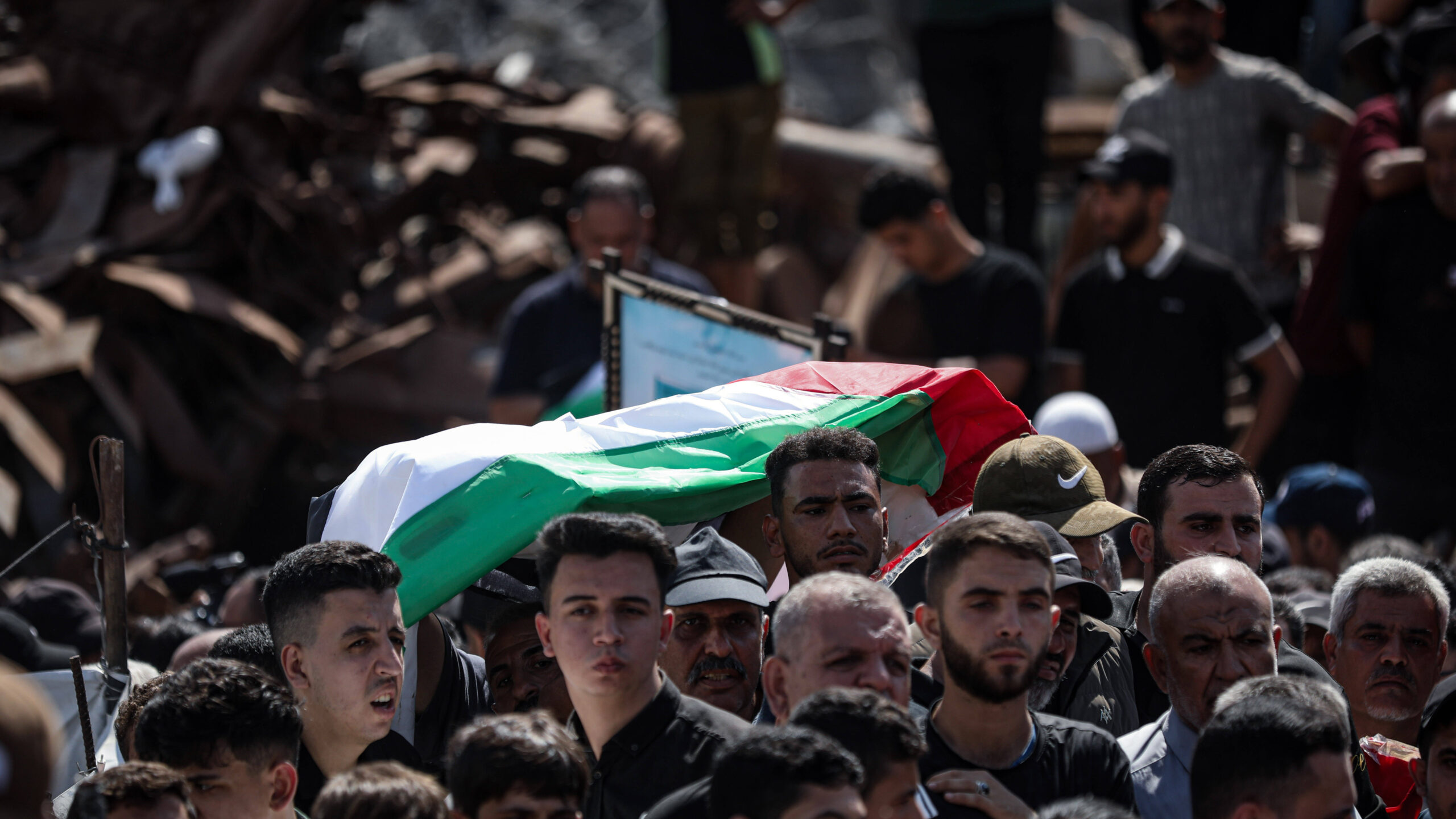
For 41-year-old Palestinian father Adham Heriz, every day for nearly three years has carried the same heavy, unfulfilled weight: the need to find, recover and give a proper burial to the family he lost in an Israeli airstrike on Gaza City. That long, agonizing search reached a partial, bittersweet milestone last month, when civil defense crews recovered the remains of his 37-year-old wife Hiam — but the body of his 17-year-old eldest son Anas remains missing, swallowed by miles of collapsed concrete in eastern Gaza’s Al-Yarmouk neighborhood.
Hiam, Anas, and two of Heriz’s other daughters — 18-year-old Shahad and 15-year-old Dareen — were killed on October 25, 2023, when a massive wave of Israeli bombardment leveled the entire residential block where the family lived. The attack flattened 18 multi-story buildings holding roughly 175 occupied apartments, according to Mahmoud Basal, spokesperson for Gaza’s Palestinian civil defense. Around 450 people, including doctors, academics, journalists, infants and children, were inside the structures when the strikes hit.
The intensity of the bombardment left an unprecedented scene of destruction. “There were people thrown by the explosion around 200 metres. Entire families were wiped out. Many dead bodies were completely disintegrated, leaving little or no trace behind because of the massive explosives used in the bombs,” Basal told Middle East Eye in an interview. In the immediate aftermath of the attack, Israeli forces continued advancing and launching strikes on the area, leaving civil defense teams unable to conduct a full, systematic search. Most of their heavy machinery and excavation vehicles were also destroyed in the bombing, meaning crews could only recover 120 bodies in the initial response, leaving hundreds more trapped beneath thousands of tons of rubble.
Heriz, who lived with his seven-member family on the sixth floor of a seven-story apartment building, still carries sharp, searing memories of the day his life collapsed. The family had just finished lunch together; Hiam and two of their daughters had stepped into the kitchen to wash dishes when the first strike hit. “It was like a black cloud covering everything,” Heriz recalled. “I felt like I was flying and being thrown under the rubble with each strike. I could not hear anything. I could not breathe because of the bomb powder and dust.”
Though most of his bones were broken in the collapse, Heriz managed to pull himself free from the debris. He found his 8-year-old son Ahmed alive beside him, bleeding badly, and soon learned his two youngest daughters — 3-year-old Siwar and 10-year-old Dima — had also escaped, though both suffered serious injuries. Ahmed survived, but Hiam, Anas, Shahad and Dareen remained trapped. Heriz’s brother and his brother’s five family members were also killed in the strike. “People moved me to an ambulance while I was crying for my family under the rubble. ‘Forgive me, my children. I can’t pull you out. I can’t feel my hands; they are broken,’” he said.
Local search teams and residents were eventually able to recover the bodies of Shahad and Dareen, but the sheer volume of rubble left Hiam, Anas and dozens of other victims beyond reach. For years, Heriz and his relatives made repeated trips to the site, digging through debris by hand with no heavy machinery to move the larger chunks of concrete. He had largely lost hope of ever recovering his wife and son’s remains until last month, when Gaza civil defense launched a coordinated 20-day search operation in Al-Yarmouk, supported by the International Committee of the Red Cross, with excavation vehicles supplied by Egypt and fuel provided through the UN Office for the Coordination of Humanitarian Affairs (OCHA).
Over three weeks of digging, crews recovered the remains of 105 people from the neighborhood’s rubble, including Hiam, Heriz’s brother, and his brother’s entire family. Heriz described the devastating small discoveries the team made as they cleared debris: “We found a less-than-one-year-old child in his crib beneath the rubble, still holding his milk pacifier in his hand. When his father saw him and identified him by the clothes he was wearing, he collapsed from the shock.” Across the 20-day operation, Heriz said crews recovered 37 dead children from the ruins of his former apartment building alone. Still, after sifting through tons of concrete, Anas’s body was nowhere to be found.
For other survivors of the October 25 attack, the long-delayed recovery operation has dragged traumatic, vivid memories back to the surface. Just hours before the bombardment, 21-year-old Abd Al Rahman Heriz had been sitting with relatives and neighbors in Al-Yarmouk, talking about their hope that the ongoing conflict would soon end with a ceasefire. He had just returned home to help his younger sister with a primary school math lesson when the bombing began.
His home was only partially damaged, sitting just a short distance from the 18 buildings leveled in the strike. When he and his family rushed outside, they could barely recognize the neighborhood they had grown up in. “The sky was black with dust, rubble and fire. Injured and killed people were everywhere. Houses were destroyed. There were no trees, no signs of anything,” Abd Al Rahman said. Outside his building, he found the body of a neighbor cut in half by the blast, a bundle of bread still lying at his side. Most of the relatives and neighbors he had been sitting with just hours earlier were killed, their bodies trapped under the ruins.
With civil defense teams blocked from entering the area by ongoing fighting, Abd Al Rahman and other local survivors used nothing but basic hand tools — hammers, shovels, metal cutters — to dig through rubble for days in search of survivors. “I remained for three days with many of my surviving neighbours, doing our best to help pull people out,” he recalled. The small team managed to pull two young sisters out alive; their father lay dead beside them, and the children cried for him as rescuers moved his body to an ambulance and tried to calm them. They also pulled a woman alive from the rubble after she had been trapped for three days. But as Israeli attacks intensified, the survivors were forced to flee, even as they could still hear voices calling for help from beneath the concrete.
“We could hear the voices of people who were still alive but trapped under the rubble, as well as the bodies of hundreds of others, including people of my extended family,” Abd Al Rahman said. The trauma of that experience has never faded. “I still have nightmares. I hear in my mind the voices of people calling for help: ‘Help us, pull us out.’ One girl was calling, ‘My sister is dead beside me. Pull her and me out.’”
Of the 105 remains recovered in the recent 20-day operation, 36 have not yet been identified. Basal, the civil defense spokesperson, explained that teams face enormous challenges identifying victims who have been buried for months. “They had reached an advanced stage of decomposition and their facial features were no longer recognisable. There is no DNA testing or any other means of identifying who they are,” he said.
The tragedy in Al-Yarmouk is just one small part of the broader humanitarian catastrophe unfolding across the Gaza Strip. Israel’s ongoing war in Gaza has killed approximately 75,000 people to date, and official estimates suggest roughly 8,000 more people remain missing, still trapped beneath rubble across the enclave.