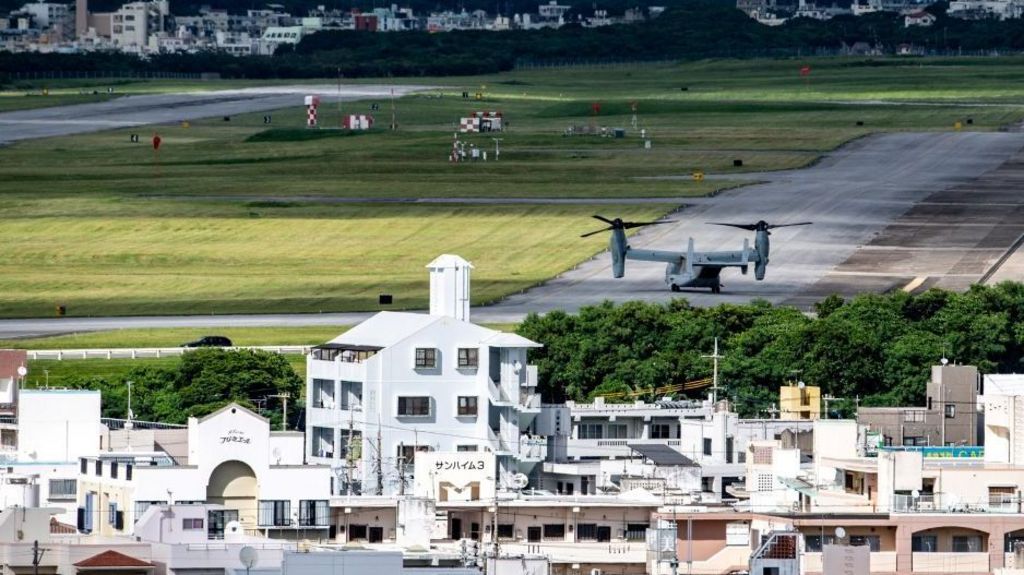
The recent arrest of a 20-year-old U.S. Marine on suspicion of robbery and murder has pulled back the curtain on deep, unresolved anger that has simmered for generations among residents of Okinawa, the Japanese prefecture that hosts the bulk of U.S. military forces stationed in Japan.
Lance Corporal Devin Jacob Ballard, assigned to the III Marine Expeditionary Force at the heavily-contested Marine Corps Air Station Futenma in Ginowan City, was taken into Japanese police custody on Sunday. The suspect is accused of killing 39-year-old local woman Anna Yagi in a Naha hotel room on October 3. According to Okinawa prefectural police, Yagi was found dead early that morning, with security footage capturing a man matching Ballard’s description entering the hotel with Yagi and leaving alone carrying her belongings. Local media reports, citing police sources, indicate Yagi was strangled with a cord. Japanese law enforcement retains primary jurisdiction over the case because the alleged crime is not tied to Ballard’s official military duties, a core tenet of the long-standing U.S.-Japan security agreement governing troop presence.
For Okinawans, the arrest is not a shocking incident—it is a devastating repetition of a pattern that has played out for decades. “Honestly my first reaction was, ‘Not again,’” Ai Sato, a 52-year-old lifelong Okinawa resident, told reporters. “Nothing has changed since I was a child. How many times are we going to repeat the same thing, create more victims, cause their families to suffer, and ultimately, cause the people of Okinawa to grieve?”
Akemi Oshiro, a 62-year-old Ginowan resident, echoed that exhaustion and frustration. “I know we shouldn’t get used to terrible things like this, but because they keep happening, I’ve stopped being surprised,” she said.
Within days of the arrest, hundreds of protesters took to the streets in Okinawa’s capital Naha and across Japan in Tokyo to denounce the killing and demand systemic change. Social media platforms filled with public outrage, with many users repeating the rallying cry “Enough is enough.”
Japanese Prime Minister Sanae Takaichi submitted an official diplomatic protest to Washington following the arrest, but many Okinawans say such performative gestures have done nothing to address the root issue. Sato, for her part, is demanding concrete action, calling on Takaichi to leverage her stated close relationship with U.S. President Donald Trump to negotiate tangible reforms. “I am deeply disappointed by the same kinds of government comments we have been hearing for decades — that they will protest or that they take the matter seriously,” Sato said. “I want Prime Minister Takaichi to call President Trump directly… and discuss concrete measures to prevent this from happening yet again.”
Okinawa’s fraught relationship with the U.S. military dates back to the end of World War II, when U.S. forces occupied the islands until they were returned to Japanese control in 1972. Today, roughly 55,000 U.S. military personnel are stationed across Japan, and 70% of all U.S. military-exclusive land in Japan is concentrated on Okinawa—one of Japan’s smallest prefectures by total area. Data from the Okinawa Prefectural Government shows that since the 1972 handover, 6,409 criminal offenses involving U.S. military personnel have been recorded on the island.
High-profile violent crimes by U.S. service members have repeatedly sparked mass protest movements across the prefecture for decades. In 1995, three U.S. servicemen abducted, beat, and raped a 12-year-old Okinawan schoolgirl, triggering nationwide outrage and massive demonstrations. A 2016 rape and murder of a 20-year-old local woman by a former U.S. Marine drew tens of thousands of protesters to the streets; the former Marine was ultimately sentenced to life in prison. Just one year ago, in 2025, another U.S. Marine was convicted of choking and sexually assaulting a Japanese woman in Okinawa.
Beyond violent crime, local residents have long resented the constant disruption of daily life from base activity, including excessive aircraft noise, repeated crash incidents, and environmental damage from military operations. For many Okinawan families, the persistent risk of harm has become a normalized part of life on the island, a reality that continues to erode trust in both the Japanese and U.S. governments.
“Even 80 years after the war, Okinawa where we live is a place that is so unnerving,” said Hitomi Miyagi, a 48-year-old mother of two from Okinawa. “We will not stop raising our voices hoping for an Okinawa, where we can live in peace.”