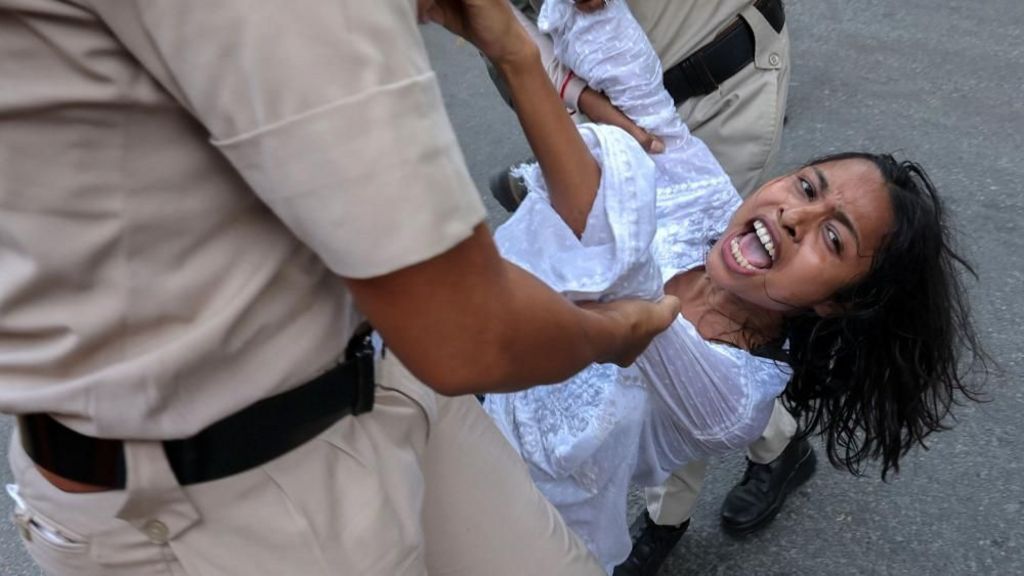
A growing political firestorm has erupted in India over a sweeping national voter roll revision, with escalating tensions spilling into the streets of New Delhi and Mumbai, and new explosive allegations of sexual harassment against Delhi police by three female journalists covering the protests. The accusations emerged Saturday, shortly after police detained dozens of young demonstrators who are demanding the immediate resignation of Chief Election Commissioner Gyanesh Kumar over the contentious electoral roll update, officially named the Special Intensive Revision (SIR).
In response to the formal complaints, Delhi Police said in a social media post that the allegations had been passed to its crime branch for what it promises will be a “fair and impartial” investigation. By Sunday, thousands of protesters regrouped in Delhi’s central protest hub Jantar Mantar and Mumbai for the third consecutive day of demonstrations, amplifying their calls for Kumar to step down. Viral videos circulating on social media platforms show uniformed officers physically dragging demonstrators away from the Jantar Mantar site, with multiple accounts of excessive use of force. The three female journalists’ claims center on reports of inappropriate touching by on-duty officers during the clearance operations.
One student activist from Jawaharlal Nehru University, Aahna Singh, told Reuters that officers dragged her across the ground by her hair, condemning the response as open police brutality against peaceful protesters. “Police dragged me by my hair,” Singh told reporters on site. “This is nothing but brutality against people who are simply asking for free and fair elections.”
Opposition Congress party leader Rahul Gandhi waded into the controversy Friday, saying that women across the country now have legitimate reason to fear for their safety at the hands of law enforcement, and that the Union Home Ministry, which oversees Delhi Police, must be held accountable for the alleged abuse. The Press Club of India issued a strongly worded statement condemning the treatment of journalists, saying it was “shocked and dismayed” by the reported behavior. “Behaviour of this kind cannot be normalised in a democracy,” the statement read. “Journalists must be allowed to work freely, without fear, and document those who gather to raise various issues.” The organization called for immediate disciplinary action against any officers found responsible.
At the core of the protests is the voter roll revision itself, which has already removed 130 million names from India’s national electoral rolls. The Election Commission has defended the exercise, arguing that it is a long-overdue cleanup effort designed to eliminate duplicate registrations, ineligible entries, and names of voters who have died, relocated internationally, or moved to new jurisdictions. The body notes the last full national revision was conducted nearly 25 years ago, making an update necessary to ensure electoral integrity.
Critics, however, allege the revision is a deliberate partisan manipulation designed to benefit Prime Minister Narendra Modi’s ruling Bharatiya Janata Party (BJP) in upcoming elections. Both the BJP and the Election Commission have forcefully rejected all claims of partisan bias. The controversy deepened last month after Indian Express published a report revealing that Kumar’s two fellow senior election commissioners, Sukhbir Singh Sandhu and Vivek Joshi, had formally registered objections at least 14 times over 10 months to decisions they claimed were issued without their knowledge or input—most related to the SIR roll revision.
The Election Commission has pushed back on claims of internal dysfunction, stating in an official release that “differing views” are a normal part of its internal decision-making process and that all final decisions have been reached unanimously. Even so, the revelation of internal rifts triggered widespread public outrage and gave new momentum to opposition demands for Kumar’s resignation.
The current wave of protests has drawn support from a diverse range of groups, most notably the Cockroach Janta Party (CJP), an influential pressure group that began as a satirical online movement and has grown into a major force for grassroots mobilization in Indian politics. The CJP notched its first major national victory in July, when it forced then-Education Minister Dharmendra Pradhan to resign following weeks of sustained protests demanding broader education sector reforms. It was the CJP that called for the latest round of demonstrations in the wake of the Indian Express report on internal Election Commission divisions, galvanizing thousands of young people to join the street actions across India’s largest cities.