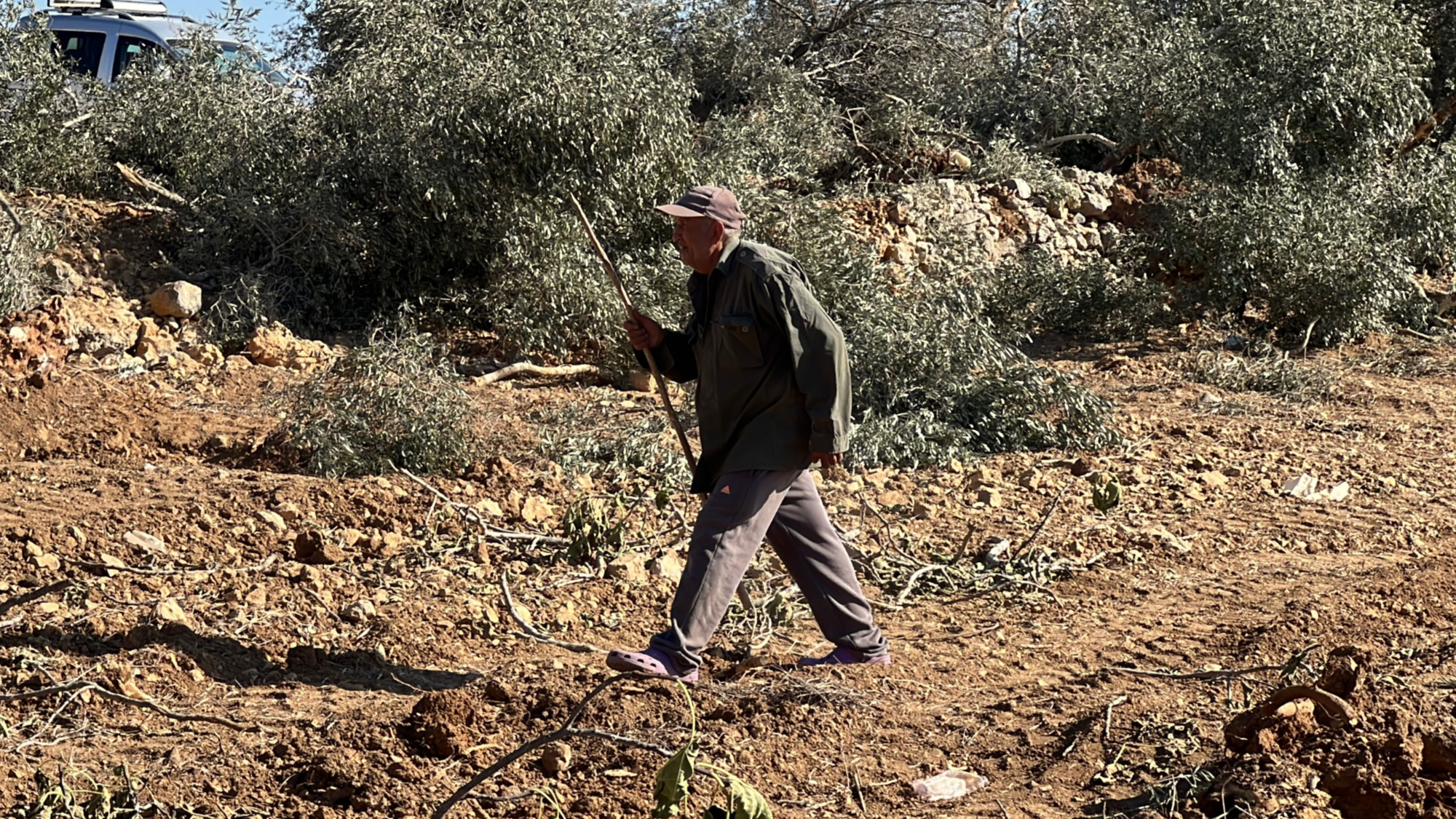
In the quiet Palestinian village of Deir Nizam, located northwest of Ramallah in the occupied West Bank, Saleh Tamimi stands amid the tangled wreckage of the olive and citrus trees he spent decades nurturing. Where a lush, productive grove once spread across his family’s backyard and surrounding land, only broken branches, uprooted stumps, and churned soil remain, the result of a recent incursion by Israeli bulldozers that cleared land his family has held as private property since the 1960s.
“What harm could this lemon tree ever have done to their security?” Tamimi asked Middle East Eye, gesturing to a splintered pile of broken branches. “I watered this olive tree by hand every single day,” he added, motioning to another destroyed ancient tree. Beyond the loss of his grove, Tamimi says his family home has also been slapped with an Israeli demolition order, part of what he calls a deliberate campaign to force Palestinian families off their ancestral land. “They want to displace us. I have nowhere else to go. Even if they tear this house down, I will not leave,” he stated firmly.
Tamimi’s story is far from an isolated incident. It is the center of a rapidly escalating, widespread campaign targeting Palestinian agricultural land and centuries-old olive groves across the occupied West Bank, new data confirms. Just weeks before the annual October olive harvest—one of the most critical economic and cultural events for Palestinian rural communities—Israeli military authorities issued a flurry of orders demanding the clearing of vegetation and uprooting of trees across hundreds of dunams of privately owned Palestinian land.
Figures collected by the Wall and Settlement Resistance Commission show that between January and September of this year, 55 military orders targeting trees and farm vegetation have been issued, affecting roughly 2,373 dunams of land. That marks a sharp increase from all of 2025, when the total reached just 47 orders covering 1,613 dunams.
The surge in targeting of Deir Nizam’s land came shortly after a settler was killed in a shooting near the village in mid-September. On September 20, just days after the incident, the commission confirmed a military order was issued targeting 99.79 dunams of the village’s land, requiring all vegetation and trees to be removed. Four days later, a second order followed, covering an additional 94.79 dunams, and gave local landowners just 12 hours to clear the trees themselves before military bulldozers moved in.
Nathir Tamimi, another Deir Nizam landowner, says his family owns 24 dunams of groves that have been passed down through multiple generations. In recent operations, Israeli bulldozers cleared eight of his dunams, along with adjacent plots. To date, roughly 140 dunams of the village’s agricultural land has been fully cleared, he confirmed.
This escalation has not been limited to Deir Nizam. On September 24, just two days after a military order was issued, Israeli forces bulldozed 31 dunams of private Palestinian land in Beit Rima, also northwest of Ramallah, uprooting more than 400 mature olive trees. Many of the destroyed trees were already heavy with ripe fruit, just weeks away from harvest.
Sixty-one-year-old Hazem Rimawi, who lost all the olive trees on his three-dunam plot, called the destruction devastating. “Decades of hard work were erased in just a few hours,” he told Middle East Eye. “This land and these trees are my only source of income. What use is this land to me now that all the trees are gone?”
Afrah Sanaf, a 63-year-old Beit Rima resident whose land was also targeted, says local residents were only notified of the clearing order on September 22. When they traveled to the local municipality to review the official map, they discovered their private, generational land was included in the order. Sanaf’s plot held 138 olive trees, some of which had stood on the land for more than a century, and had been part of his family’s life since he was a child. “I cannot remember a time when those trees were not here,” he said.
With only 12 hours given to remove the trees themselves, Sanaf says the choice was obvious: “Naturally, we refused to pull up trees that we or our ancestors planted with our own hands.” The bulldozers moved in shortly after, clearing the entire plot. Sanaf noted that the targeted land sits three to four kilometers away from the nearest Israeli settlement, undermining Israeli claims that the clearing is for security purposes.
Just one day later, on September 25, Israeli bulldozers began clearing tree-covered Palestinian land in Beit Ur al-Fuqa, southwest of Ramallah. The operation followed a clearing order for 29 dunams issued two days after a Palestinian car-ramming attack at a nearby Israeli checkpoint that injured one soldier. Ali Samara, head of the village council, says the bulldozing ultimately extended to roughly 60 dunams, and warned that if operations continue, as many as 1,500 olive trees—some more than 200 years old—could be destroyed.
The campaign has also reached Kafr Malik, northeast of Ramallah, where Israeli authorities issued an order targeting more than 56 dunams of olive-growing land.
For Palestinian farming communities, the timing of this surge in clearing could not be more damaging, coming just ahead of the annual October olive harvest. The loss extends far beyond this year’s crop: mature olive trees take decades to reach full productivity, so destroyed groves represent a generational loss of livelihood and cultural heritage. Beyond the loss of trees, the bulldozing has destroyed traditional agricultural terraces and stripped away fertile topsoil, leaving large areas of land unsuitable for cultivation for years to come. Many residents say the campaign is a deliberate effort to force Palestinian landowners to abandon their land to make way for Israeli settlement expansion.
“What happened left all of us in shock. This is an act of pure injustice,” Sanaf said. “The trees and land we lost were the only livelihood we have ever relied on.”
Nathir Tamimi echoed that frustration, noting the damage reaches far beyond individual landowners. “The damage doesn’t stop at the owners whose land was bulldozed—it affects our entire village,” he said. “Our landscape has changed completely, from green, living olive groves to empty expanses stripped bare of every tree.”
Despite the destruction, Tamimi said local Palestinian residents remain firm in their commitment to stay on their land. “We are just like the olive trees we inherited: rooted in this land,” he said.