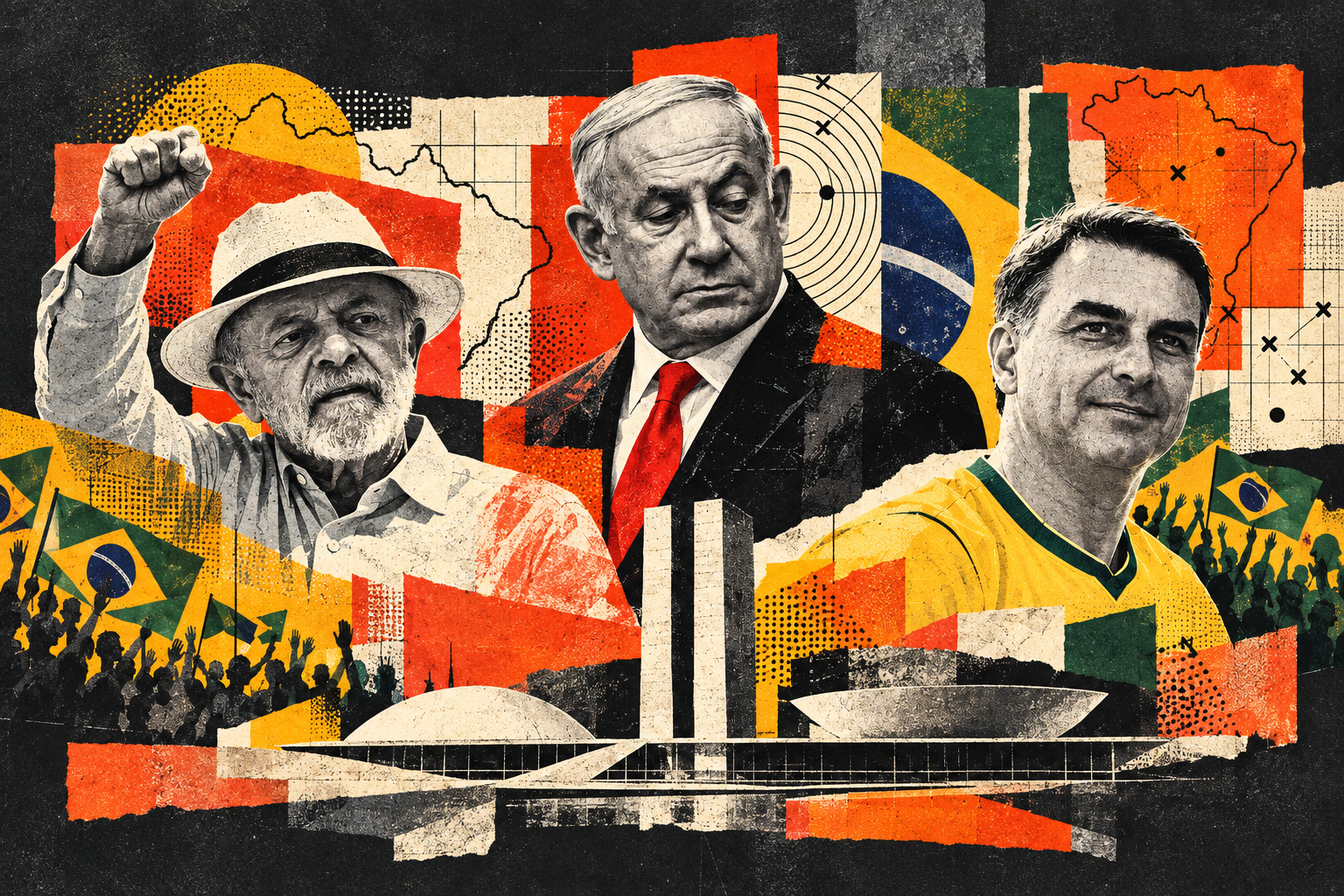
As Brazil prepares for its October 4 presidential election, the long-standing and multifaceted relationship between Israel and Brazil has moved to the center of political debate, driven by a high-profile show of support from Israeli Prime Minister Benjamin Netanyahu for right-wing candidate Flavio Bolsonaro. The moment of support came in late July, during Flavio Bolsonaro’s official campaign launch in Sao Paulo. A pre-recorded video from Netanyahu played for the assembled crowd, where the Israeli leader hailed Flavio as a champion of both Brazil and the friendship between the two nations. This public backing came as no surprise to regional analysts, given the deep web of political, military, and ideological ties that have connected Israel to Brazil’s right-wing establishment—and the Bolsonaro family in particular—for decades.
Flavio, the son of imprisoned former far-right Brazilian President Jair Bolsonaro, is running to unseat incumbent leftist President Luiz Inacio Lula da Silva in the upcoming poll. If no candidate secures an absolute majority in the first round on October 4, a runoff election will be held on October 25. Current polling shows the race is extraordinarily tight: Lula holds a narrow lead of just one percentage point in first-round surveys, and polls project a close result if the race proceeds to a second round.
Netanyahu’s public endorsement comes as the Israeli leader faces his own domestic electoral test on October 27, at a time when Israel faces growing international isolation over its military campaign in Gaza, with widespread allegations of genocide and war crimes. David Magalhaes, an international relations professor at Brazil’s Federal University of Uberlandia, explains that a Flavio Bolsonaro victory would deliver significant strategic benefits to Netanyahu. “At a time when Israel is increasingly isolated within the international community, a situation that has worsened because of the indications of extermination or genocide in the Gaza Strip, a close ally in Brazil would be a major win,” Magalhaes told Middle East Eye. A Flavio win, he adds, would send a message to Israeli voters that their country’s international isolation is not complete.
Flavio has already laid out plans to deepen bilateral ties if elected. He has promised to relocate Brazil’s embassy in Israel from Tel Aviv to Jerusalem, a move that would break with the consensus position of most of the international community, which does not recognize Israel’s sovereignty over occupied East Jerusalem. He has also pledged Brazil’s membership in the so-called Isaac Accords, an initiative launched earlier this year by Argentina’s President Javier Milei alongside Netanyahu, designed to integrate Israel into Latin America’s economic, political, and security frameworks. Ideologically, Flavio has embraced the messianic interpretation of Israel’s occupation of Palestinian territory as a fulfillment of biblical prophecy, aligning himself firmly with the most hardline elements of Israeli politics. His agenda would represent a return to the close partnership Brazil enjoyed with Israel during his father’s 2019-2022 presidency, and would expand that relationship even further.
The roots of Israel’s influence in Brazil stretch back decades, built through deep connections to Brazil’s military, security forces, and evangelical political blocs. These ties have persisted across both left- and right-wing Brazilian governments, according to academic research. Bruno Huberman, an international relations professor at Sao Paulo’s Pontifical Catholic University, explains that Israeli influence in Brazil was “built mainly through the armed forces and the police, and from there it extends to far-right parties and movements.” Huberman notes that even during Lula’s first presidential term from 2003 to 2011, when Brazil sought closer ties to Arab nations and the Global South, the relationship with Israel was maintained as a strategic counterweight, centered around arms imports that created long-term technological dependence. For Brazil’s military and police, the relationship is also underpinned by shared ideological ground around counterterrorism and Islamophobia, creating persistent internal pressure within the Brazilian state for closer bilateral ties.
When Jair Bolsonaro took office in 2019, he doubled down on these existing military ties, appointing active and retired military officers to more than half of his federal cabinet posts and placing over 6,000 military personnel into civil service roles. Research by Huberman and Isabela Agostinelli dos Santos, an international relations professor at Sao Paulo’s FECAP higher education institution, finds that despite occasional diplomatic disagreements, “continuities outweigh ruptures” in the bilateral defense relationship, with arms trade consistently anchoring the partnership. Defense ties between the two countries date all the way back to 1964, during Brazil’s military dictatorship, and the modern defense industry relationship took shape in the early 2000s, with Israeli defense giant Elbit Systems playing a central role. By 2014, total bilateral arms deals had reached almost $190 million, with much of that business conducted under Lula’s Workers’ Party government. “So Bolsonaro didn’t usher in a ‘new era’. In fact, he intensified structural dynamics that were already under way,” Santos explains. Any Brazilian government would struggle to quickly reverse these long-standing military dependencies, giving Israel a persistent and influential role in Brazil’s defense sector.
The Bolsonaro family has long played a central role in advancing Israeli interests in Brazil. Flavio’s brother, Eduardo Bolsonaro, is a key figure in maintaining these ties. In January 2025, when an Israeli soldier on vacation in Brazil was accused of war crimes committed during his service in Gaza, Eduardo worked directly with Israeli Diaspora Affairs Minister Amichai Chikli to pressure Brazilian authorities to drop the investigation, a move he later publicly boasted about. “Thanks to our efforts with Minister Chikli, the decision not to investigate set a precedent,” Eduardo said in an interview following the incident.
For Lula, the deep roots of Israeli influence in Brazil create a delicate political balancing act. Lula has been one of the most prominent international critics of Israel’s campaign in Gaza, calling it a genocide and an attempt to exterminate the Palestinian people. Brazil joined South Africa’s legal case against Israel at the International Court of Justice, and after Lula compared the Gaza violence to the Holocaust, Israel declared Lula persona non grata, prompting Brazil to withdraw its ambassador from Tel Aviv. Today, diplomatic relations between the two countries are maintained only at the charge d’affaires level. Yet despite this public rift at the executive level, Lula has not moved to sever long-standing defense ties. In 2024, five months after the Brazilian military signed a $210 million contract with Elbit for 36 Atmos 2000 self-propelled howitzers, Lula suspended the deal but did not cancel it entirely, reflecting the tricky balance he must maintain between his public criticism of Israel and the deep pro-Israel ties within Brazil’s political and military establishment.
Even within Brazil’s legislature, pro-Israel sentiment has grown in recent years, driven by three powerful parliamentary caucuses, nicknamed the “three Bs”: bullets (representing legislators with military backgrounds), beef (representing powerful agribusiness interests), and Bible (representing evangelical Christian lawmakers). Brazil’s evangelical community numbers around 40 million voters, and polling shows Flavo Bolsonaro holds a commanding lead among this demographic, with 52 percent support in the first round and 62 percent in a projected runoff, compared to just 26 and 32 percent for Lula. In November 2025, even as Lula’s executive branch adopted a critical stance toward Israel, the Brazilian legislature revived the Brazil-Israel Parliamentary Front, a cross-party group first established in 2004. Flavio Bolsonaro, a member of the front, used its launch to confirm that a Bolsonaro presidency would fully restore close bilateral ties with Israel. “Even with a president who is more critical of Israel, the legislative base is becoming increasingly pro-Israel, largely because of the alliance between the evangelical caucus and the so-called ‘bullet caucus,’” Santos notes.
For Brazilian voters, the Israel-Palestine issue rarely decides election outcomes, but it does reinforce existing political divides, according to Feliciano de Sa Guimaraes, a professor at the University of Sao Paulo’s Institute of International Relations. “Jobs, living costs and public security matter far more to most voters,” Guimaraes explains. But polling shows shifting public opinion on Israel: latest Pew Research data from earlier this year finds that just over half of Brazilians hold an unfavorable view of Israel, and more than 60 percent lack confidence in Netanyahu. Since the start of the war in Gaza, Guimaraes says, pro-Israel sentiment has shifted disproportionately to right-wing voters aligned with Flavio Bolsonaro, while left-leaning voters have moved closer to Lula’s critical position. “For most voters, the Israel-Palestine issue mainly reinforces existing loyalties, since the issue now follows Brazil’s left–right divide,” Guimaraes says.
Lula has already raised concerns about foreign interference in Brazil’s election, issuing a public warning in June to former U.S. President Donald Trump to stay out of the race. He later reiterated that warning in a speech the UN General Assembly, where Brazilian newspaper Folha de S.Paulo reports the warning was also aimed at Netanyahu and Milei, even though Lula did not name them directly. As voters head to the polls in less than a week, the deep ties between Israel and Brazil’s political factions will remain a defining undercurrent of what is already one of the most contentious elections in Brazil’s recent history.