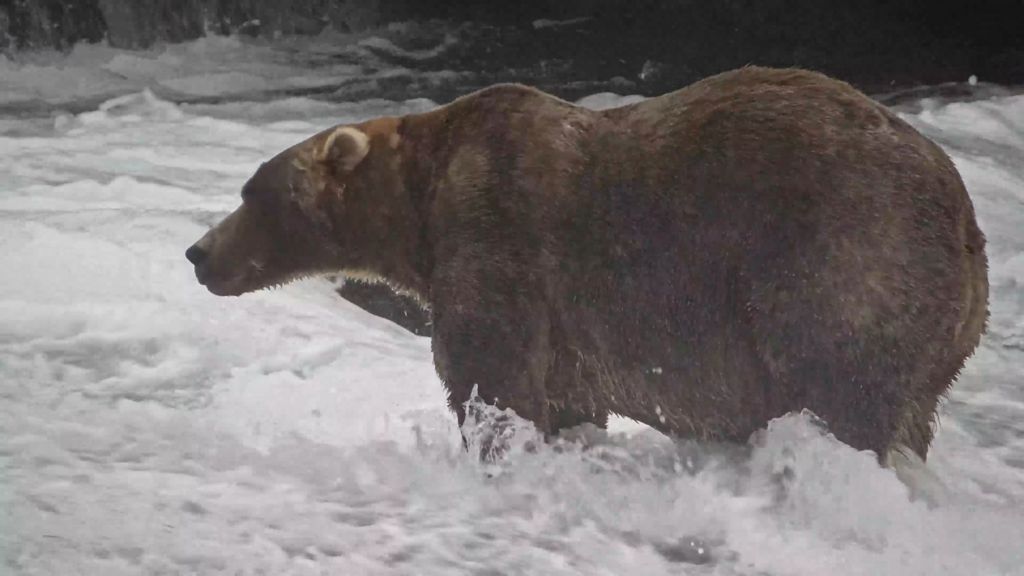
Every autumn, as Alaska’s Katmai National Park prepares for the long, frozen winter, the global internet turns its attention to one of the most whimsical and beloved annual wildlife competitions: Fat Bear Week. This year marks the 13th iteration of the unusual contest, and after weeks of public voting that pitted some of the park’s most impressive brown bears against one another, 89 Backpack — better known simply as Backpack — has taken the 2026 championship title.
Organized by the U.S. National Park Service, Fat Bear Week celebrates the critical annual ritual of brown bears packing on fat reserves ahead of their months-long winter hibernation. The event frames this biological necessity as a friendly competition, judged entirely by public vote, that pits bears against one another based on their size, foraging skill, ability to secure nutrient-rich meals, and what organizers jokingly call “strategic loafing” — the energy-conserving resting that helps bears hold onto every calorie they consume.
In this year’s final showdown, Backpack secured a narrow victory over fellow finalist Bear 910, a popular female competitor. Final vote counts put Backpack at 103,344 votes, compared to 910’s 98,253, capping a weeks-long bracketed tournament that included 16 unwitting bear participants. In a statement following the results, the National Park Service extended recognition to all 16 bears that took part in this year’s contest.
Backpack is no stranger to Fat Bear Week fame; his mother, Holly, claimed the championship title back in 2019. The young male bear got his unusual name not from his famously bulky frame — which fans have described as having a distinct “light bulb shape” — but from a habit he developed as a tiny cub: when his mother Holly waded through Brooks River, the park’s famous salmon-rich waterway, he would climb onto her back to cross. Longtime observers of the park’s brown bear population note that Backpack has built a reputation for quiet toughness, a trait that has helped him carve out a stable space for himself among the largest, most dominant bears along the river. Fans have showered him with affectionate nicknames, calling him a “big fuzzy boy” and celebrating that he has both “the chonk and the badonk.”
Not everyone was satisfied with the final result, however. Backpack’s victory sparked fierce friendly debate among fans of runner-up 910, a female bear who successfully raised both her own biological cub and an adopted orphaned cub this year. Many 910 supporters argued that she was the larger, more deserving competitor, with one commentator noting “Backpack just has a bigger booty,” and another writing on the park’s official Facebook page that “910 really put in the work this year.” Other 910 voters echoed the sentiment, with one comment reading “She round, she thick my girl 910 got my vote.”
While the official latest weights of this year’s finalists have not been released to the public, wildlife biologists note that healthy adult brown bears follow a predictable annual weight cycle. In mid-summer, the average adult male weighs around 408 kilograms, but by autumn, most will pack on an extra 25% of their initial body weight in fat, with the largest males topping 540 kilograms. Females are smaller on average, but healthy breeding females can still reach weights over 300 kilograms, while newborn cubs emerge weighing just half a kilogram.
The entire point of this pre-hibernation weight gain is a matter of life and death for Alaska’s brown bears. As contest organizers explain, during hibernation — which can last up to six months — bears do not eat, drink, or eliminate waste, and they lose roughly one-third of their total body weight over the course of the winter. A bear’s ability to survive the cold season, and emerge healthy in spring, depends entirely on how much fat they are able to accumulate between June and mid-October, when they retreat to their dens. During those months, bears gorge almost constantly, with the nutrient-dense salmon that fill Brooks River serving as their primary food source, caught by either paw or jaw.
Fat Bear Week has grown exponentially in global popularity since its launch 13 years ago. Last year alone, the contest drew more than 1.7 million votes from voters in over 100 countries around the world, turning ordinary brown bears in rural Alaska into global internet celebrities and raising public awareness of brown bear ecology and conservation in the process. For this year’s champion Backpack, the victory comes just in time: he will soon retreat to his den to settle in for months of hibernation, resting on his (very large) laurels ahead of next year’s contest.