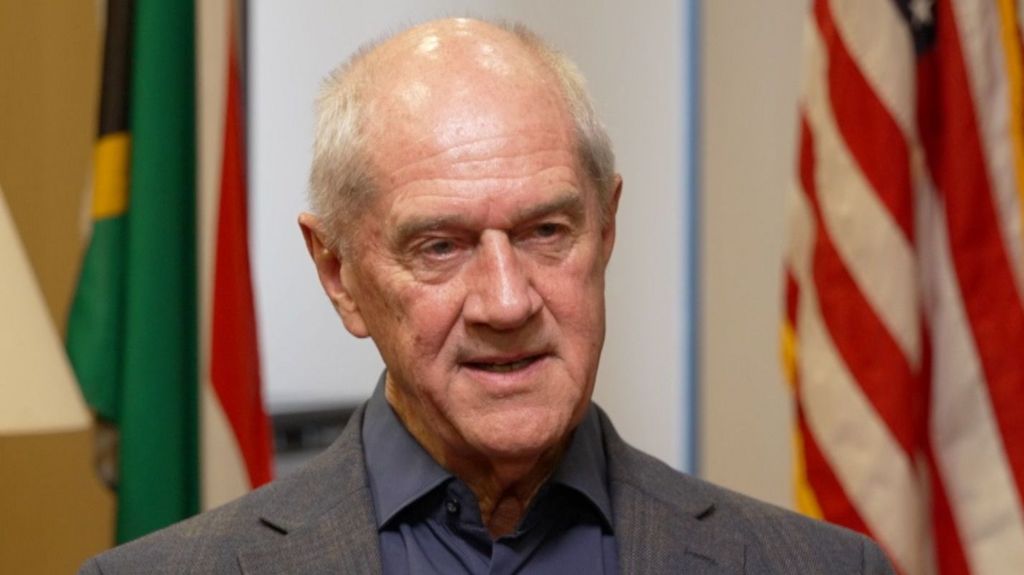
When Donald Trump first made his explosive claim that a systematic genocide was targeting white Afrikaners in South Africa, Roelf Meyer, South Africa’s newly appointed ambassador to Washington, had one immediate question: “Is he talking about us?” As a self-described “born Afrikaner” and a key figure who helped end the country’s apartheid regime in the 1990s, Meyer brings unparalleled personal legitimacy to pushing back against the baseless assertion.
In a recent interview with the BBC, Meyer delivered a blunt rejection of the claim, stating plainly that the narrative of a coordinated mass attack on the country’s white Afrikaner minority has no basis in fact. He also noted that the facts around South Africa’s ongoing violence crisis have been deliberately misrepresented, and he has yet to trace the root of this widespread misinformation.
Meyer’s appointment to the top diplomatic post in Washington comes at a moment when bilateral relations between the U.S. and South Africa have plummeted to new lows, triggered largely by Trump’s unsubstantiated genocide allegations. Last year, during a White House meeting with South African President Cyril Ramaphosa, Trump repeated the widely discredited claim and launched a special refugee resettlement pathway exclusively for Afrikaners fleeing supposed persecution. Since that policy took effect, nearly 13,000 South African refugees have been admitted to the U.S. under the program, with only three applicants rejected.
One of the resettled Afrikaners, who goes by the public name Lielie, moved with her family from a macadamia and banana farm in South Africa to Texas. She described constant fear of intrusions on her rural property, even with multiple layers of security including perimeter walls, an electric fence, and eight guard dogs. While her family never faced harm or theft, she witnessed multiple trespassing attempts, and several neighbors and acquaintances suffered brutal attacks. Since resettling, she says her life has transformed dramatically: her family now feels safe walking in public and letting their children play outside, a level of security she could not enjoy at home.
This week, the Trump administration notified Congress of plans to admit up to an additional 17,500 white Afrikaner refugees over the coming 12 months. A White House spokeswoman defended the policy in a statement to the BBC, framing it as a humanitarian lifeline for a community the administration says is being systematically “raped, maimed, killed and driven off their property” across South Africa. “While the South African government and many in the media have brushed off the horrific lived experiences of this community, the Trump administration continues to process applications for refugee status because the president has a humanitarian heart,” the statement read.
Supporters of the claim, like SJ Du Venage, a right-wing Afrikaner party council member based on South Africa’s west coast, insist there is a deliberate political agenda to eliminate white South Africans, particularly commercial farmers. “There’s absolutely an agenda to wipe us out here,” he told reporters. To amplify their demands, an Afrikaner lobby group is planning a vigil this weekend on Washington’s National Mall, where thousands of white crosses will be laid to honor what the group calls victims of targeted farm violence.
However, the genocide narrative has been uniformly rejected by every major political party in South Africa, including parties that represent Afrikaner interests. For Meyer, his personal identity as an Afrikaner gives him unique standing to refute the claim: “I’m an Afrikaner from South Africa myself, and I can say that I’ve never experienced something of that kind.”
A key negotiator who helped end apartheid alongside current President Cyril Ramaphosa – with Meyer representing the apartheid-era National Party and Ramaphosa representing the African National Congress – Meyer says his ability to build cross-community trust is why Ramaphosa tapped him to repair the fractured U.S.-South Africa relationship. The president also recognized the unique value of having an Afrikaner in the role, Meyer notes, though he emphasizes he represents all South Africans, not just one ethnic group.
Last week, the Trump administration escalated tensions further, announcing visa restrictions on South African officials it accuses of enabling “race-based discrimination” against white South Africans, and threatening additional punitive measures if the South African government does not address the administration’s demands. Official police data from South Africa tells a different story, however: the vast majority of crime victims, including those killed in rural areas, are Black South Africans. While farm violence, most often motivated by robbery, is a recognized domestic challenge, it accounts for a small fraction of the country’s total homicides.
Policy experts and even many Afrikaners inside South Africa have slammed the Trump administration’s refugee program. Political and security analysts agree that while South Africa faces a serious national crime crisis, it does not amount to systematic persecution of white people. Larry Bartlett, former director of the U.S. Refugee Assistance Programme, argues the program may even violate U.S. law, which reserves refugee status for people who face credible threats of persecution and have no safe alternative in their home country. By granting status to white Afrikaners who do not meet the legal criteria, he says, the administration is taking limited resettlement spots away from people fleeing war and ethnic cleansing in other regions.
Even among Afrikaners in South Africa, the program draws criticism. Johannesburg pastor Rudi Swanepoel questions why the U.S. has singled out white Afrikaners for special resettlement status when South Africa faces a widespread national crisis of gender-based violence that puts women at far greater risk. Swanepoel argues the sense of grievance among some Afrikaners stems not from persecution, but from the end of decades of racial privilege. “Thirty, 40 years ago the white people of South Africa controlled the whole cake,” he explained. “Since democracy came, the obvious reality was we had to now start sharing that cake and those privileges.”
Beyond the farm violence and genocide claims, the Trump administration has also criticized South African policies aimed at redressing apartheid-era racial inequality, including mandatory employment equity targets that require companies to increase representation of non-white workers, and a limited land expropriation law that allows the state to seize unused land without compensation in exceptional circumstances to redistribute to Black communities. Meyer is calling for Trump’s executive order that created the Afrikaner refugee pathway to be fully revoked, noting that South Africa has never restricted its citizens from leaving the country and has addressed all of the U.S. administration’s stated concerns. He added that the constitutionality of the land expropriation law is still pending a court ruling, so the policy has not yet been implemented.
Meyer acknowledges that South Africa faces serious challenges in reducing and combating crime, but stresses that the problem is national, not targeted at any one group. “If you look at the total picture, the huge levels of crime in the black townships of South Africa are the biggest concern, proportionally, far more than anything else,” he said. Instead of imposing punitive measures and creating an exclusive refugee pathway, he says the U.S. should support South Africa’s anti-crime efforts by providing resources and equipment to help local police speed up emergency response times.
For the Afrikaner activists planning their National Mall vigil this weekend, Meyer has a clear message: pushing a false narrative outside the country does nothing to solve South Africa’s real problems. “It doesn’t help us to raise a voice outside, if we are not committed to doing something inside the country,” he said.