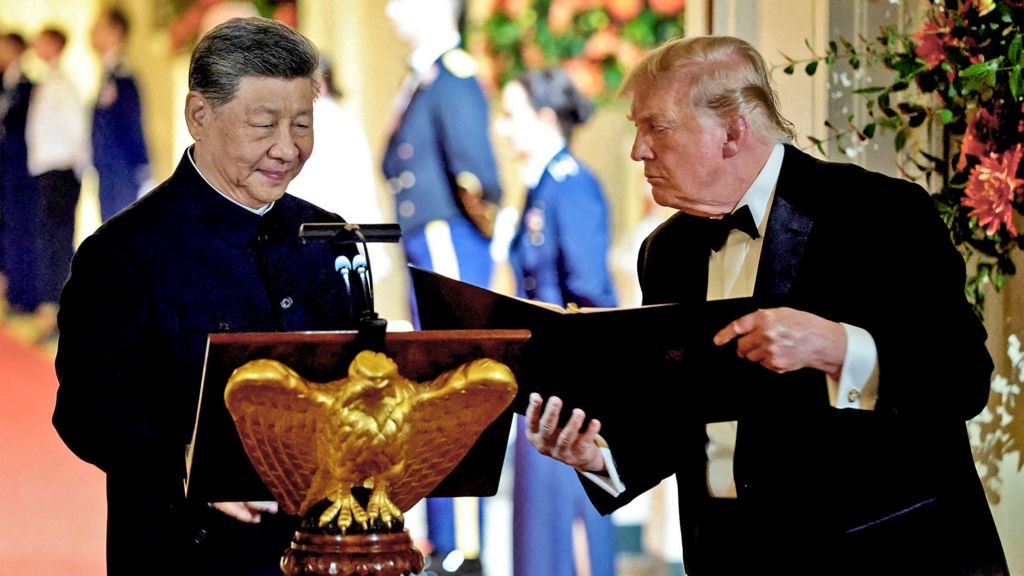
On a Thursday evening in Washington D.C., the White House opened its doors for a lavish state dinner hosting Chinese President Xi Jinping and U.S. President Donald Trump, marking Xi’s first visit to the United States in more than a decade. The high-profile gathering brought together the leaders of the world’s two largest economies, alongside a roster of America’s most prominent business and tech titans, but yielded little tangible progress on the long list of divisive issues that define the bilateral relationship.
The diplomatic event was framed by warm public rhetoric from both leaders. In his toast, Trump emphasized that despite deep ideological and systemic differences between the two nations, bilateral relations have never been on friendlier footing, and he toasted to a future of harmony, peace and shared success for both countries. He also presented Xi with a custom sculpture of a bald eagle, America’s national emblem, which he revealed had been co-designed by First Lady Melania Trump.
For his part, Xi framed the meeting as a critical historic juncture for U.S.-China ties, arguing that the two global powers have a shared responsibility as major nations to chart a new, constructive model for coexistence that meets the expectations of both peoples and aligns with the trend of the times. He noted that the two leaders held in-depth discussions and reached common ground on a range of issues, and stressed that both countries’ core ambitions can ultimately be mutually reinforcing. On the topic of artificial intelligence, a key area of strategic competition between the two nations, Xi pushed for a shared commitment to ensuring AI development remains under human control. Beyond this general statement, however, no details emerged about concrete agreements or progress on governing the rapidly advancing technology, an area where Trump has explicitly named China as America’s top rival.
Beyond the ceremonial niceties, deep underlying tensions remain largely unaddressed. The most sensitive flashpoint, the Taiwan issue, hung over the talks. Earlier in the day, Xi privately urged the U.S. to handle the question with prudence and publicly called on Trump to adopt a correct position on the self-governing island, which Beijing claims as part of its sovereign territory. The issue has gained new urgency after Trump paused a long-planned $14 billion arms sales package to Taiwan, a move he described earlier this year as a “good negotiating chip” with Beijing, following a May warning from Xi that mishandling the issue could lead to open conflict between the two powers. Washington has not yet issued a public response to Xi’s latest closed-door remarks on the issue, and no breakthrough was announced during the Washington visit.
Other core sticking points also remained out of public view. Beijing has grown increasingly concerned that Washington is pursuing a deliberate policy to contain China’s rise as a global superpower, particularly in the areas of trade and advanced technology, and has repeatedly called for the U.S. to step back from interfering in what it considers its core interests. Trump for his part entered the talks aiming to secure new trade concessions, including lower Chinese tariffs on American manufactured goods, increased access to Chinese rare earth mineral exports critical to U.S. tech and manufacturing sectors, and expanded market access for American agricultural producers. No details on any progress toward these goals were released following the dinner.
The guest list for the extravagant dinner reflected the deep economic and tech ties that bind the two nations, even amid rising strategic rivalry. In attendance alongside top Trump administration officials — including Defence Secretary Pete Hegseth, Secretary of State Marco Rubio, White House Chief of Staff Monica Crowley, and senior advisor Jared Kushner — were dozens of the biggest names in American business and technology. Elon Musk, Tim Cook of Apple, Jensen Huang of Nvidia, Sam Altman of OpenAI, Sundar Pichai of Google, Jeff Bezos of Amazon, Mark Zuckerberg of Meta, and billionaire TikTok investor Jeff Yass all counted among the attendees, with Musk, Cook and Huang sharing the main table with the two leaders. Executives from major traditional firms including General Motors, Visa, ExxonMobil and Paramount Skydance were also present. Trump noted ahead of the event that “everybody wanted to be there,” adding that the gathering drew leaders from across the entire tech sector, entire banking industry, and far beyond. One notable absence was leading AI firm Anthropic, which has not yet explained whether it was uninvited or declined to attend.
The First Lady’s office, which organized the state dinner, designed the evening to blend American culinary tradition with subtle nods to Chinese culture. The menu featured first course of yellow squash, wild mushrooms and crispy pancetta, served atop bright red tablecloths — a choice that references red’s symbolism of luck and good fortune in Chinese culture. The main course paired sesame-crusted sea bass with braised bok choy and roasted eggplant, while dessert consisted of vanilla crémeux with sour cherry confit and ice cream made from honey harvested on the White House grounds. The wine selection included Schramsberg Blanc De Noir, a deliberate callback to the 1972 “Toast to Peace” between U.S. President Richard Nixon and Chinese Premier Zhou Enlai, who shared a bottle from the same California vineyard to mark the normalization of U.S.-China relations five decades ago.
The evening of diplomacy was not without opposition: as the two leaders arrived for the dinner, protesters gathered just outside the White House gates to shout demonstrations against the meeting, and a number of protesters were arrested by law enforcement.
On Friday, Xi and Trump kicked off the final day of the visit with a private tea gathering in the White House Red Room alongside their wives, before traveling to the U.S. National Archives for a guided tour of the institution’s iconic exhibits, which house the founding documents of the United States including the Declaration of Independence, the U.S. Constitution and the Bill of Rights. Xi was expected to depart Washington later that day.
Looking ahead, the two leaders confirmed that they will hold two additional summits before the end of the year: first on the sidelines of the Asia-Pacific Economic Cooperation (APEC) leaders’ meeting scheduled for Shenzhen, China, in November, followed by a second meeting at the G20 summit hosted in Florida later that same month. Xi framed the ongoing talks as a collaborative effort to “chart the course for the great shift of China-U.S. relations,” closing his remarks by thanking the Trumps and the American side for the “meticulous care and consideration” extended to him and his wife during the visit.