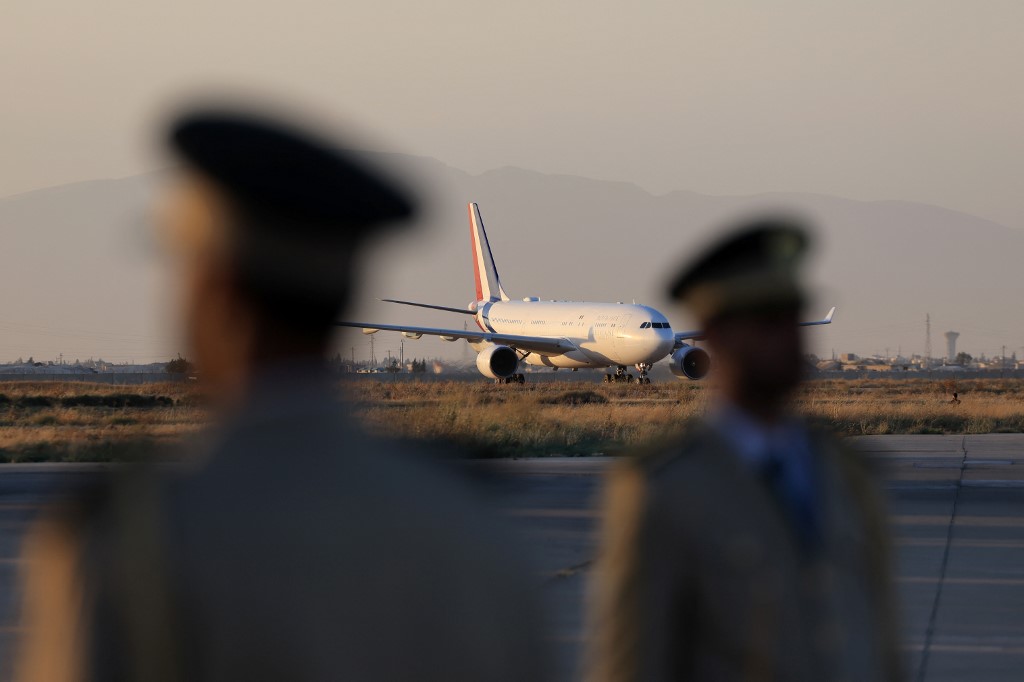
Two major Syrian international airports, located in the capital Damascus and the country’s second largest city Aleppo, have resumed accepting nighttime commercial flights after months of restrictions, following an unpublicized shift in Israeli policy that removed its long-standing blockade on the activation of critical air navigation infrastructure, multiple regional officials confirmed to Middle East Eye in recent briefings.
Last Thursday, Syria’s General Authority for Civil Aviation and Transport publicly announced it had finalized installation of new air navigation systems, including ILS/DME and DVOR/DME technology. These tools are designed to support precision aircraft landings during nighttime operations and low-visibility conditions, such as heavy fog and extreme storms, expanding the airports’ operational capacity beyond their previous daylight-only restrictions.
What the public announcement did not disclose, however, is the months-long diplomatic and security standoff that delayed the activation of the already-installed equipment. Regional diplomatic sources told Middle East Eye that to bring the new navigation systems online, technicians were required to conduct calibration test flights across a 50-kilometer radius surrounding Damascus International Airport — a requirement Israel repeatedly blocked for more than six months. One senior regional official familiar with the negotiations said Israeli authorities issued an explicit ultimatum: they would shoot down any small aircraft conducting the calibration flights within that zone.
The shift in Israeli control of territory around the Syrian capital following 2024 military operations changed the security calculus for the standoff. Prior to 2024, Israel’s formal border area was located roughly 60 kilometers from Damascus, putting the entire required test flight zone outside of direct Israeli occupied territory. After Israeli forces seized and occupied Mount Hermon earlier this year, they extended their area of control to within just 25 to 40 kilometers of the Syrian capital, putting the original calibration flight zone directly within range of Israeli military positions.
A breakthrough was ultimately reached through a technical adjustment rather than a formal diplomatic agreement. Engineers and aviation technicians determined that calibration tests could be completed successfully within a reduced 25-kilometer radius, rather than the originally planned 50-kilometer zone. Syrian authorities officially notified Israel of their plan to conduct the restricted tests, and the Israeli government chose not to issue a formal objection or response, effectively allowing the work to move forward, a second regional official confirmed.
This quiet compromise comes amid broader regional diplomatic efforts to de-escalate tensions between Israel and neighboring powers, after a series of provocative Israeli moves raised alarm in Western capitals. Earlier this year, Israel already opposed the deployment of a new civilian air traffic control radar system, the HTRS-100 manufactured by Turkish defense firm ASELSAN, at Damascus International Airport. Israeli officials argued at the time that the system would limit their military’s freedom of operation in Syrian airspace, despite the Syrian government confirming the radar was intended solely for civilian air traffic management.
Regional diplomats assess that Israel’s decision to step back from its blockade on the navigation systems is a deliberate move to reduce tensions after a controversial Israeli airstrike last month targeting a Syrian airbase near the Turkish border. That strike drew sharp criticism from U.S. officials, who warned that the strike raised the risk of an accidental military confrontation between Israel and Turkey, a NATO member.
In response to rising cross-tension risks, U.S. special envoy Tom Barrack has led recent diplomatic efforts to establish a formal trilateral deconfliction mechanism to prevent unintended clashes. Following these diplomatic pushes, Israel took steps to restore bilateral ties with Turkey, appointing a new charge d’affaires to its embassy in Ankara. While the envoy will remain based in Israel for ongoing security concerns, Israeli officials confirmed he will make regular trips to the Turkish capital to hold consultations with Turkish government officials.