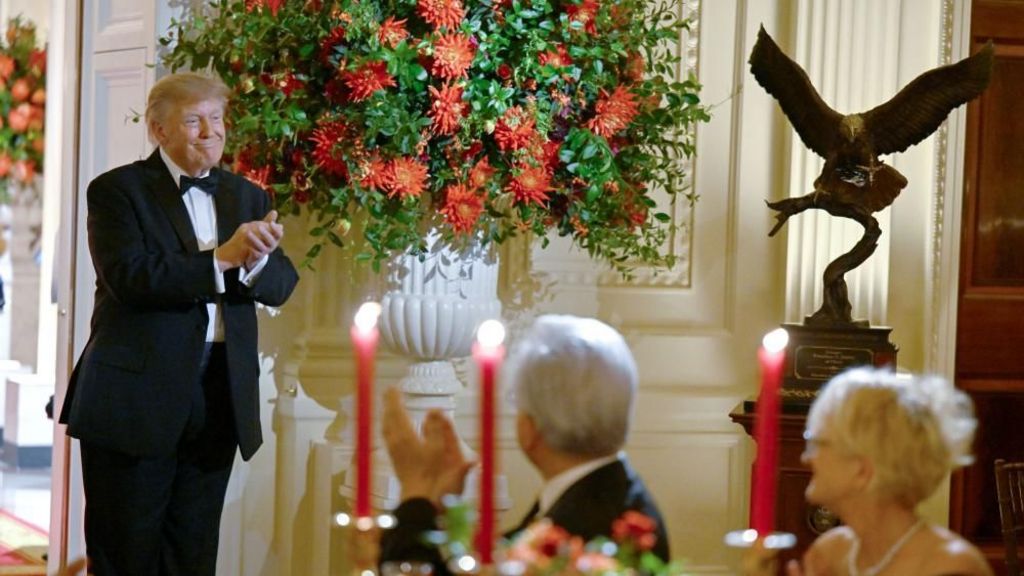
Against the backdrop of simmering geopolitical tensions and a fragile trade truce between the world’s two largest superpowers, the traditional diplomatic practice of state gift-giving took center stage during a lavish state dinner in Washington D.C., where U.S. President Donald Trump presented Chinese President Xi Jinping with a custom-designed sculpture of the North American bald eagle, the United States’ iconic national symbol.
Trump told assembled VIP guests at the Thursday evening event that the handcrafted piece was shaped to capture “the free and soaring spirit of America”, revealing that both he and First Lady Melania Trump had directly contributed to the design process. The exchange of carefully curated gifts, a longstanding but often underappreciated pillar of international diplomacy, forms a key building block for the personal rapport between the two leaders at their three-day summit – a core objective that underpins broader efforts to manage the world’s most consequential bilateral relationship.
Daniel Kritenbrink, a former 30-year U.S. diplomat with deep expertise in Asian affairs and current partner at The Asia Group, explained that personal connections between heads of state carry outsized weight in this dynamic. “Leaders will tackle all manner of intractable, complex issues, but at the end of the day, they are still two people engaging with one another,” Kritenbrink noted. “That personal bond matters, and the gift exchange is one critical way to nurture that bond.” He added that rapport-building at the leader level is particularly important for Chinese diplomatic culture, and that the direct Trump-Xi relationship acts as the stabilizing glue for a partnership that shapes global security, economic growth, and technological progress. Both leaders, he emphasized, place high value on this style of personal, leader-to-leader diplomacy.
Gift-giving has emerged as a notable feature of the Trump presidency, with the U.S. leader having received a range of high-value offerings from foreign counterparts, including a luxury jumbo jet, an engraved gold bar, and a gem-encrusted gold ring, among other items. Ole Jacob Sending, a researcher at the Norwegian Institute of International Affairs, argues that this focus on ceremonial exchanges aligns with Trump’s broader governing style: “If you look at how the Trump presidency operates, broadly defined gift-giving is very much a core part of his approach to diplomacy.”
The exchange was reciprocal: earlier that same Thursday, Xi announced two major goodwill gestures from China to the United States: a gift of two giant pandas, Ping Ping and Fu Shuang, that will soon take up residence at Zoo Atlanta, and a new 100,000-student exchange initiative that will welcome 100,000 American students to study in Chinese institutions over the next five years. “Giant pandas have long served as envoys of friendship between the Chinese and American people,” Xi said. “In a few days, these two pandas will arrive at their new home to meet the American people.” It remains unclear whether additional gifts were exchanged, and the BBC has reached out to the White House for further comment.
Scholars of diplomatic practice note that lavish state gift-giving is far more common in autocratic regimes and Gulf monarchies today, with research co-authored by Morten Skumsrud Anderson, who worked with Sending on a study of diplomatic gift exchange, finding that “autocracies like China tend to give far more expensive gifts” than democratic states. In Western democracies, longstanding legal guardrails and transparency rules have scaled back the value of state gifts. For the United States, the Constitution’s emoluments clause caps the value of gifts a sitting president can accept from a foreign government at $525. Any gift exceeding that threshold becomes property of the federal government, unless the president chooses to purchase it at full value out of their personal funds. U.S. presidents are also required to secure congressional approval for gifts above the limit unless they cover the cost personally. Anderson emphasized that these rules mean diplomatic gift exchange is anything than impulsive: “This is not a last-minute souvenir purchase at an airport.”
Every detail of the exchange – from the type of gift to the timing, venue, and format of the reveal – is negotiated for weeks by lower-level diplomatic teams, resulting in a tightly scripted, carefully planned ceremony. Sending explained that missteps in gift-giving can carry real diplomatic consequences, pointing to high-profile blunders from past exchanges. During Xi’s 2013 state visit to the U.S., then-President Barack Obama gifted Xi a handcrafted inscribed bench made from California redwood, the native tree of the state where the two leaders met, a gesture that was widely praised as thoughtful and appropriate. That stands in contrast to a 2009 exchange between Obama and then-British Prime Minister Gordon Brown: Brown gave Obama an ornamental pen holder crafted from timber of a 19th-century anti-slavery ship, a historically significant gift, while Obama gifted Brown a box-set of DVDs that were incompatible with UK region-locked players. “That’s a classic example of an embarrassing misstep,” Sending said, noting that the incident was less consequential because the two leaders were close allies. For powers navigating deep-seated disagreements, however, a misjudged gift could derail broader negotiating goals.
This summit marks the third face-to-face meeting between Trump and Xi since the start of Trump’s second term, held at a moment of significant friction between the two nations. The talks come amid growing global anxiety over AI competition, as both countries race to establish dominance in the fast-growing transformative technology, and follow a years-long bitter trade war that has only resulted in a temporary truce, extended during Xi’s visit.
For Kritenbrink, the entire ceremonial apparatus of the state visit – from military flyovers to cultural performances, formal dinners, and the carefully planned gift exchange – all serves a single core purpose: laying the groundwork for stable bilateral relations. “It’s all protocol, optics, and relationship-building as a means to an end, which is stable US-China relations,” he said. “I’ll take a fragile truce over an all-out trade war any day.”