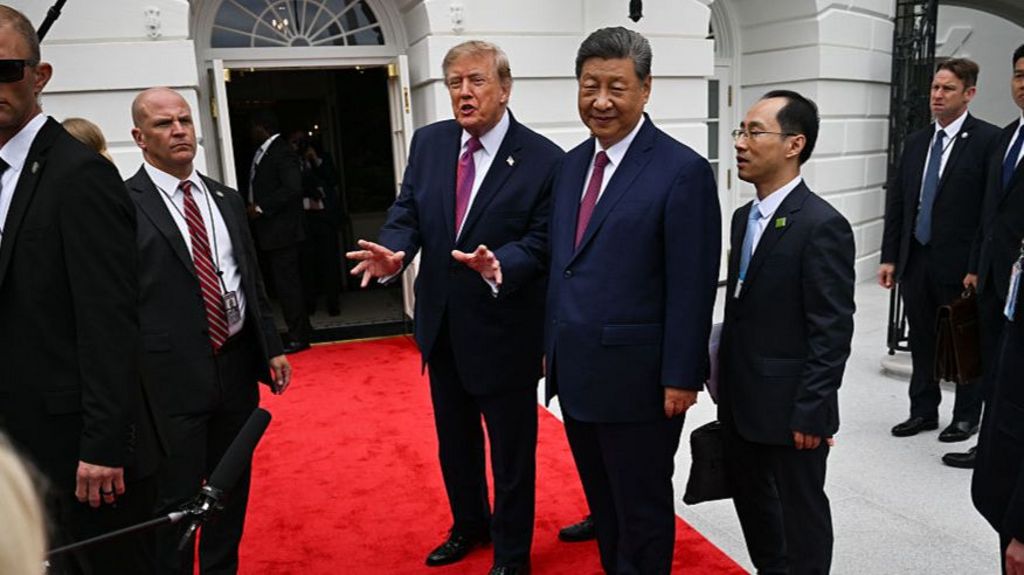
When Chinese President Xi Jinping touched down in Washington for a high-stakes summit with U.S. President Donald Trump, the event kicked off with elaborate ceremony rather than immediate breakthroughs on the long list of tense bilateral and global issues dividing the two world powers.
From a formal welcome ceremony at a U.S. military air base on Wednesday to an honor guard reception at the White House the following morning, Trump rolled out the full red-carpet treatment — both literally and symbolically — for his Chinese counterpart. Public statements from both leaders have been dominated by diplomatic courtesy and warm rhetoric, with Xi announcing two major goodwill gestures ahead of formal talks: a gift of giant pandas from China to the U.S., and the launch of a new bilateral student exchange initiative.
“Let us keep advancing the cause of friendship between our two peoples and work together to build a better world,” Xi said in his public remarks.
For his part, Trump laid out the core agenda for the closed-door discussions, highlighting that the two leaders would tackle what he called “pressing issues concerning security, technology, and superintelligence” — his preferred term for advanced artificial intelligence. “The decisions we make in these areas today can promote peace and prosperity for decades and decades to come,” he added.
But analysts say the heavy focus on marching bands, military flyovers and grand pageantry serves a specific strategic purpose, particularly for the Trump administration. Jennifer Welch, chief economic analyst at Bloomberg Economics, told the BBC that the intentional display of ceremony is designed to highlight positive momentum around the summit, aligning with Trump’s framing of his own role in the U.S.-China relationship as a stabilizing force.
Even amid the warm public rhetoric, however, undercurrents of tension remain visible in Xi’s messaging. Welch noted that the Chinese leader reiterated his reference to the so-called “Thucydides trap” — the academic theory that predicts conflict when a rising power challenges an existing dominant global power. Xi argued that open, sustained dialogue can help the two nations avoid this outcome, despite their starkly different national systems: “China and the United States are different in national conditions, but through candid, in-depth and continued dialogue, our two countries can understand each other better, seek common ground while shelving differences, and build up mutual trust,” he said.
Despite this rhetoric, substantial barriers to any meaningful substantive agreement remain deeply entrenched. When Trump and Xi met in Beijing earlier this year in May, the only major outcome was an agreement to establish joint trade and investment working groups, with little tangible progress delivered in the months since.
On the economic front, U.S. Treasury Secretary Scott Bessent announced this week that a year-long trade truce that kept tariffs at reduced levels between the two nations will be extended for an additional two months. Financial analysts widely expect another extension before the summit concludes, as neither government is eager to reignite the full-scale trade war that roiled global markets last year.
The outlook for progress on other high-stakes issues is far grimmer. Disputes remain intractable across a range of topics, from the U.S. posture toward Iran and the ongoing war in Ukraine to global rules for AI development. Adding to friction, China has yet to follow through on earlier commitments to increase purchases of U.S. agricultural goods and boost exports of rare earth minerals to the U.S. For China, a key point of tension remains the long-paused proposed U.S. arms sale to Taiwan, with Chinese officials watching closely to see if Trump will move forward with the deal.
When it comes to artificial intelligence, one of the summit’s top agenda items, the two sides hold fundamentally conflicting goals, according to Robyn Klingler-Vidra, a professor of political economy at King’s College London. “On the US side, it’s about existential risk and slowing down AI potentially,” she explained. “Whereas in China, it’s about acceleration, maybe winning the AI tech race and the application of AI to the real economy.”
A lineup of top American AI industry executives are set to attend the formal state dinner at the White House on Thursday night, a move widely interpreted as a deliberate show of force to highlight the U.S.’s current leading position in global AI innovation.
Even with additional one-on-one meetings scheduled before Xi departs Washington on Friday afternoon, many analysts expect the summit will ultimately deliver little more than symbolic pageantry and a renewed commitment to maintaining tentative stability. Miles Yu, who served as principal China policy planner and strategist to former Secretary of State Mike Pompeo during Trump’s first presidential term, told the BBC that the two nations approach negotiation from fundamentally different frameworks that make breakthroughs unlikely. “What China talks about is metaphysical and abstract. The United States wants to solve specific problems,” Yu said. “These different approaches are not going to lead to any result.”