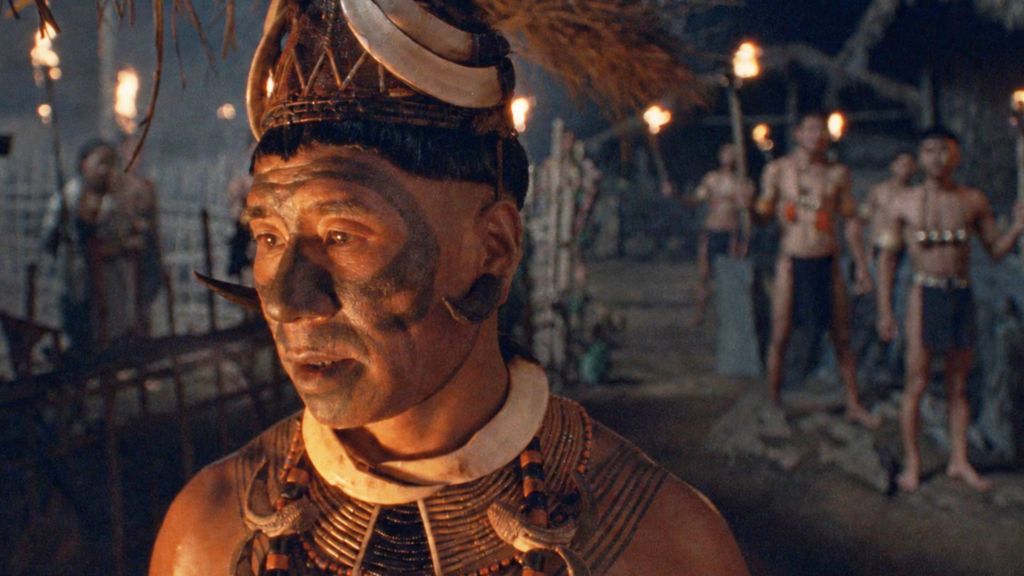
Against all odds, a tiny-budget debut feature from one of India’s most remote regions has captured one of global cinema’s most prestigious honors, opening the door for underrepresented Indigenous storytelling on the world’s biggest stage.
*Angh*, the first feature film from 24-year-old Naga director Theja Rio, was filmed entirely in Konyak—a little-known tribal language spoken by fewer than 300,000 people in Nagaland, India’s mountainous northeastern frontier state that is home to less than two million residents overall. With nearly every cast member making their first ever on-screen appearance, the quiet, intimate drama claimed the Toronto International Film Festival’s Platform Prize, an award granted by a jury of industry peers to films with uniquely distinctive directorial voices, this September. Jury members highlighted Rio’s “refreshing perspective” and his sensitive portrayal of a world that has rarely, if ever, been centered in mainstream international cinema.
The unexpected victory also grants *Angh* a historic, unconventional path toward 2027 Academy Awards consideration. New Oscar rules allow winners of designated awards at six major international festivals to qualify for the International Feature Film category without needing to be selected as their country’s official entry—an opportunity that has pulled a work from a marginalized tribal community into a global conversation that has long excluded these types of narratives.
In an interview just 72 hours after his win, Rio admitted he still feels stunned by the reception. “There were a lot of good films in the competition, including work from far more seasoned directors,” he said. “My producers were confident we’d win. I wasn’t.” Before turning to filmmaking, the first-time director originally dreamed of becoming a rapper, drawing eclectic inspiration that ranges from *The Roots* frontman Black Thought to legendary Iranian arthouse director Abbas Kiarostami. For his debut, he chose to turn his camera toward the place and people he knows best.
Set in the early 1960s, just months before Nagaland formally attained statehood within India, *Angh* follows ageing hereditary village chief Anghba—leader of a Konyak community, where traditional chiefs are known as *Anghs*—and his curious young son, as sweeping social and religious change arrives at their doorstep. As Christianity spreads across the region, the pair remain among the last adherents of their community’s ancestral faith, until the arrival of an American missionary, played by Scottish actor Douglas Henshall, deepens the generational rift already growing between them: the father holds fast to inherited tradition, while his son is drawn to the new world on offer.
Rio drew the inspiration for the film from a work trip to Nagaland’s Mon District, the heart of Konyak country, where he was struck by the extraordinary coexistence of past and present in local communities. “It feels like you’ve jumped on a time machine,” he explained. “Within a single family, a grandfather might be a former headhunter with traditional facial tattoos, and two generations later, his grandson could play guitar in a rock band. The past and the present sort of coexist together.”
That era of rapid transition that forms the film’s backdrop was a turning point for Konyak society. For decades, Christianity had been reshaping not just religious belief, but deeply rooted customs, rituals and daily life. Dr B Amo Konyak, a leading scholar of Konyak culture, notes that many traditional practices were lost entirely, while others “survived in fragments” preserved in the memories of elders and family heirlooms, shifting from everyday life to formal cultural heritage. But he emphasizes that culture did not disappear—it adapted, as communities carried pieces of their tradition into new religious and social structures, altering meaning as they changed form.
It is exactly that nuance of transition that Rio set out to capture. “The past 50 or 60 years have brought extraordinary churn, widening the distance between generations,” Rio said. The film explores this rift through the quiet, loving bond between Anghba and his son, who “intimately love and care about each other very deeply, even as their worlds begin to pull apart.”
Film critic Siddhant Adlakha, who has praised *Angh* extensively, highlighted the film’s refusal to lean into simplistic tropes. “Progress and tradition can be nonlinear, even entwined, rather than strictly opposing forces,” he noted, praising the gentle ambiguity Rio brings to the story. While the film has not yet been released to wide audiences, its trailer hints at the immersive, atmospheric world Rio has built: mist-shrouded green mountain slopes, quiet paths winding through dense forests, faces lit by firelight in the dark. The landscape is not just a scenic backdrop; it is a small, tight-knit world held together by ritual and family, as outside forces press in from its edges.
Most notably, *Angh* upends the long history of outsider portrayals of Konyak and Naga communities. For centuries, outside observers from colonial explorers to foreign filmmakers have framed Konyak people as exotic curiosities, fixating on their traditional facial tattoos, historical headhunting practices and cultural artifacts while ignoring their full, complex humanity. Rio set out to reverse that gaze. “There have been several films and documentaries made about Nagaland, but these sort of films tend to follow the gaze of the explorer rather than the subject,” he explained. With *Angh*, he aimed to invite viewers to “step inside the shoes of these characters.”
That commitment to authenticity guided every step of production. Konyak cultural advisors consulted on dialogue, costume, and set design, nearly all local cast members were first-time performers from the community, and Rio and cinematographer Adam Pietkiewicz even made the deliberate choice to shoot on 16mm film. Drawing inspiration from 1950s and 1960s archival footage of missionaries and Naga communities, they sought to recreate the grainy, textured atmosphere of those mid-century images—while shifting the point of view from outsider observer to community insider. The choice created extraordinary logistical challenges: unlike digital film, 16mm could not be reviewed on set, so every four to five days, unprocessed reels had to be flown thousands of kilometers to Mumbai for development, leaving the crew shooting blind for days. Even smaller shoots went awry: during one night scene with Henshall, a vintage World War II Jeep that ran perfectly in rehearsal stalled as soon as cameras rolled, forcing the crew to capture the entire shot in a single take.
The unexpected success of *Angh* also highlights the growing diversity of contemporary Indian cinema, with more regional filmmakers from underrepresented parts of the country gaining international acclaim. Adlakha points to other northeastern Indian filmmakers such as Assam’s Rima Das and Meghalaya’s Dominic Sangma, whose work has expanded global understandings of what Indian cinema can be. Rio notes that Nagaland’s film industry remains “at a very nascent stage,” far from the resources and reach of established Indian filmmaking hubs like Mumbai. But he hopes his film’s win will shine a spotlight on the many untold stories waiting to be told from his home region.
For now, though, after the chaos of back-to-back interviews and cross-continental travel following his TIFF win, Rio just wants to return to normalcy: “I want to go back to Nagaland and play football with my friends.”