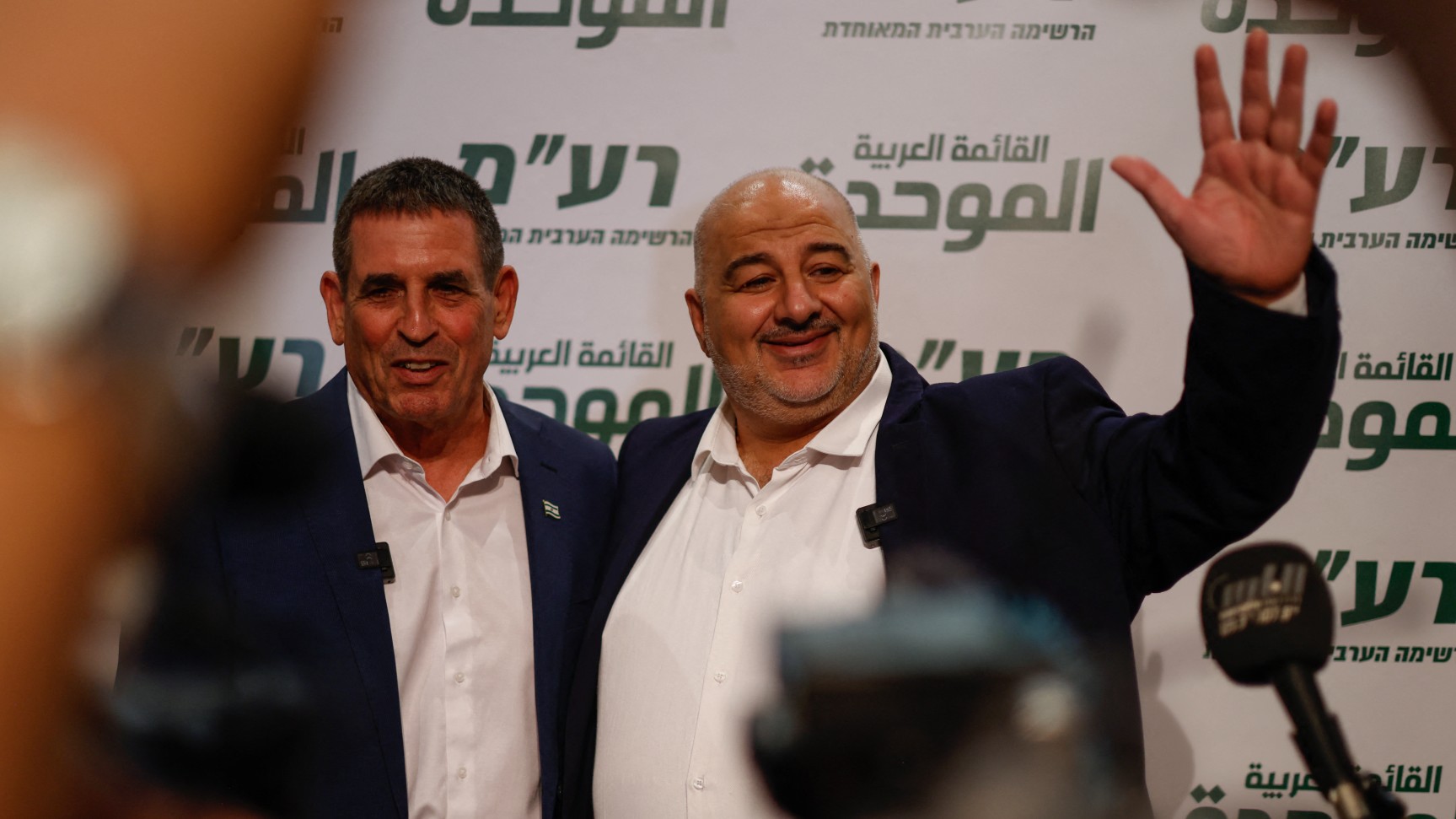
On Wednesday, Israel’s Central Elections Committee took the controversial step of approving a ban on the nation’s two largest Arab-majority political lists from participating in next month’s parliamentary election, a decision that threatens to strip the country’s Palestinian citizens of their primary representative voices in the Knesset.
The committee voted to disqualify both the Ra’am party and the Joint List, an electoral alliance comprising Hadash, Ta’al, and Balad, from running in the 27 October contest. In addition to barring the two electoral blocs, the committee also moved to disqualify two individual candidates linked to the Joint List: sitting Hadash Knesset member Ofer Cassif and Balad leader Sami Abou Shahadeh.
The disqualification votes followed the approval of petitions submitted by right-wing parties Likud and Otzma Yehudit, which levied serious accusations against the parties and candidates: that they deny Israel’s legitimacy as a Jewish and democratic state, support armed resistance against the country, and incite racial division. Under Israeli law, the committee’s rulings are not final; they now face mandatory review by the Israeli Supreme Court, which has a well-documented history of overturning the vast majority of previous attempts to disqualify Arab parties and candidates from running for office.
Structurally, the Central Elections Committee is dominated by sitting members of Knesset from existing parties, which means the current governing coalition holds a built-in majority on the panel. The head of the committee, Supreme Court Justice Noam Sohlberg, also holds a vote, and the full Supreme Court is scheduled to deliberate on the disqualification decisions next week.
While the original petitions targeting Ra’am, the Joint List, and Cassif were brought by members of Prime Minister Benjamin Netanyahu’s right-wing governing coalition, several opposition parties also threw their support behind at least some of the disqualification measures. Final vote tallies show the committee approved the ban on Ra’am and the Joint List by an 18-5 margin, while Cassif’s disqualification passed 19-5. Abou Shahadeh’s ban saw an even wider margin, passing 30-4, with all opposition parties joining the governing coalition in backing it. Notably, both Sohlberg and Attorney General Gali Baharav-Miara also supported Abou Shahadeh’s disqualification, marking a rare cross-party consensus around blocking an Arab candidate from running.
Baharav-Miara had advised the committee a day earlier that Abou Shahadeh’s disqualification warranted “serious consideration,” pointing to an article he wrote on 8 October 2023, one day after Hamas’s attacks on Israel. The attorney general argued that the article could be interpreted as lending support to armed struggle against Israel, a claim Abou Shahadeh has forcefully denied.
Yair Golan, leader of the center-left opposition Democrats party, explained his support for Abou Shahadeh’s disqualification by pointing to the candidate’s rhetoric in the aftermath of the 7 October attacks. “Whoever wants a Jewish-Arab partnership does not speak this way, period,” Golan stated, adding that “calling for or giving legitimacy to armed struggle and harm to civilians — Jews or Arabs — is a red line.” Golan also noted that he had supported a separate petition to disqualify far-right National Security Minister Itamar Ben Gvir from running, a bid that ultimately failed.
In a post on the social platform X, Abou Shahadeh pushed back against the allegations, asserting that he firmly opposes all forms of armed struggle and instead backs “political and civil struggle for peace, justice, and equality.” He described Wednesday’s vote as “an attempt to harm the representation and political voice of Arab society” and said he would continue to uphold a “deep commitment to the values of freedom, justice, and equality.”
Cassif also publicly condemned the committee’s decisions barring himself, Abou Shahadeh, Ra’am, and the Joint List. In his own X post, Cassif called the disqualifications “another nail in the coffin of the remnants of democracy” in Israel and predicted that he and the Joint List would ultimately take their seats in the next Knesset. Cassif, one of the most outspoken critics in the current Knesset of the Israeli government’s war in Gaza, has been targeted before by disqualification efforts: the Supreme Court previously overturned a bid to bar him from running in the 2019 election. The latest allegations against Cassif echo those from 2019, claiming he denies Israel’s existence as a Jewish and democratic state and supports armed struggle against the country.
The attorney general’s office took differing stances on the different disqualification bids: it opposed blocking Ra’am, the Joint List, and Cassif, arguing that the evidence presented did not meet the high legal threshold required for disqualification under Israeli law, but aligned with the committee’s majority in supporting Abou Shahadeh’s ban. The committee is scheduled to continue hearing additional disqualification petitions on Thursday, including bids to bar far-right parties and Golan’s Democrats party from the election.
Around 7.3 million Israelis are eligible to cast ballots in the 27 October election. Palestinian citizens of Israel make up roughly one-fifth of the country’s total population, and Ra’am and the Joint List are the primary Arab-majority electoral blocs working to represent their interests in the Knesset. If the Supreme Court chooses to uphold the committee’s decisions, both blocs will be excluded entirely from the upcoming election, leaving their constituency without formal major representation in Israel’s national legislature.