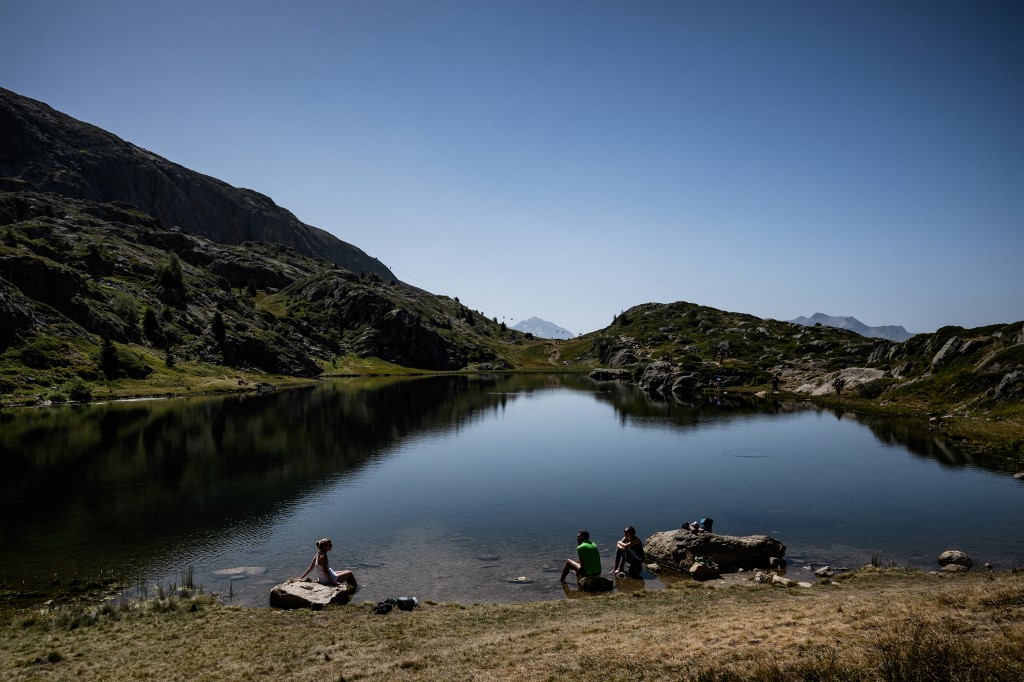
Last August, a since-deleted TikTok video posted by a French hiker ignited a nationwide reckoning over systemic racism in outdoor spaces. The clip, set against the dramatic backdrop of the French Alps, celebrated what the creator framed as a rare privilege: a mountain retreat free of ethnically diverse visitors, which he claimed as an exclusive space for white people. In his caption, he deployed the Arabic-derived French slang term “Wallah” in a derogatory swipe at visitors from working-class, majority-minority suburban neighborhoods known as banlieues, writing that the mountains were one of the few places “where you can feel safe.”
The post quickly sparked a brutal wave of support for its racist and Islamophobic message across French social media. Hundreds of commenters echoed the creator’s exclusionary rhetoric, demanding that ethnic minority residents of the banlieues remain confined to their neighborhoods. Vicious remarks such as “stay where you belong, in your Islamised districts” spread rapidly, paired with dehumanizing stereotypes that framed minority visitors as uncivilized: “Nature must stay clean. No peeing, no trash, no animal-like screaming.”
What followed, however, was an unexpected, humorous, and deeply political grassroots counter-movement that went viral under the slogan “Wallah, we’re coming” (or “On arrive” in French). Thousands of young people, Muslim women wearing hijabs, multi-generational families, and hikers from marginalized communities began posting their own photos and videos from trails, mountain peaks, forest clearings, and equestrian outings across France, boldly claiming their right to occupy spaces they say they have always deserved to access.
One of the earliest and most prominent participants in the movement is Zeynab Alabbar, co-founder and creative director of Kamak, a brand of modest athletic wear. Alabbar, who has worn the hijab since she was 8 years old, shared clips of herself and friends hiking shaded alpine trails and pausing to take in sweeping mountain views, captioning her post simply: “We love nature too.” The post quickly earned widespread support, including a note of thanks from prominent French-Algerian rapper Rim’k.
In an interview with Middle East Eye, Alabbar explained that the movement responded directly to a long-standing paradox of French integration discourse: ethnic minorities are repeatedly told they must assimilate, yet are systematically shut out from public spaces and activities that are supposed to belong to all citizens. Drawing a contrast between her experiences in her current home of Switzerland, where multiethnic groups routinely share alpine outdoor spaces without conflict, she noted that she has never faced anti-Muslim or racist harassment in Swiss mountains — but faces constant, unwelcome scrutiny as soon as she crosses into France. “By contrast, as soon as I arrive in France, people’s stares become heavy and unsettling. You can feel you’re not welcome,” she said.
Alabbar’s experience is far from unique. Jumia Alaoui, a 38-year-old mother from Essonne, just south of Paris, regularly hikes the Fontainebleau forest with a group of hijabi friends, and says she faces constant microaggressions and open hostility. “Some walkers stare at us as if our presence were out of place. Once, a man asked whether we weren’t too hot being covered from head to toe. We told him it was none of his business,” she recalled.
For Alaoui, the original racist TikTok video and its flood of supportive comments laid bare a growing culture of unapologetic racism that is increasingly validated by parts of France’s political establishment. Two years ago, she lost her job as a supermarket cashier after she refused to remove her headscarf for work, and she now fears growing anti-Muslim hostility will soon bar marginalized people from even leaving their homes. The far-right National Rally, led by Marine Le Pen, currently leads national polling ahead of the 2027 presidential election, and has pledged to ban the hijab from all public spaces if it wins power — a policy that has amplified fear among Muslim women across the country. Alaoui traces this expanding pattern of exclusion: “Before, young people from the banlieues were subjected to racial profiling at nightclub entrances. Now, women in burkinis are targeted in municipal swimming pools and at the beach. Even sports with the veil are banned,” she said, referencing a 2023 ruling by France’s highest administrative court that upheld the right of national sports federations to ban the Islamic veil from competition. “And as if all that weren’t enough, now they want to keep us out of the mountains.”
Academic researchers who study inequality in outdoor spaces say these accounts confirm long-documented patterns of systemic exclusion in alpine recreation. Lea Sallenave, a geography lecturer at the University of Geneva and a specialist in social domination and inequality in Alpine spaces, explains that modern recreational mountain culture was built by and for a dominant white demographic that has imposed its own social norms, creating a pervasive sense that non-white visitors do not belong. Her analysis of promotional materials for alpine ski resorts found that the overwhelming majority of imagery features only white visitors, erasing the presence of ethnic minorities entirely.
In a 2024 study of a municipal program in Grenoble that introduces banlieue youth to outdoor activities, Sallenave documented widespread experiences of racial exclusion, based on testimonies from program participants. Many participants told her that “the higher [they] climbed, the whiter the people [they] encountered seemed.” “What I want to show is that the mountain is not neutral, it is part of society. And if our society contains racism, classism and sexism, we will also find them in the mountains,” Sallenave told Middle East Eye. Working-class young people reported facing open racist harassment in ski resorts, while mountain industry staff shared accounts of regular hostility from white visitors toward minority groups.
These on-the-ground observations are echoed by Samir Souadji, founder and director of Apart, a Seine-Saint-Denis-based non-profit that brings vulnerable local youth to climbing, mountaineering, and outdoor programs to support personal and social development. Souadji says he faced institutional barriers early on, when major sports brands dismissed his organization’s mountain programming as unworthy of support. “When we said we wanted to do mountain activities, I felt we weren’t taken seriously,” he said.
When his groups do visit mountain areas, they regularly face open contempt and racist harassment. Returning to a base camp outside Chamonix one trip, a white hiker mocked the group, saying: “Here, you’re not in your council estate – these aren’t 13-storey towers you’re climbing.” On another occasion, two white hikers chuckled and asked if an “African congress” was scheduled in the area.
Leading sociologists say this hostility grows out of an exclusionary, nationalist understanding of national territory that frames non-white people as inherently “non-French.” Nacira Guénif-Souilamas, a sociologist and anthropologist at Paris VIII University, explains: “Some users behave as if they were the legitimate owners of the mountains and consider that not everyone is allowed to enjoy the beauty of the landscape. This exclusion reflects racist stereotypes weighing on Black and Arab people in France, denying them basic rights, including the right to enjoy nature. They are never considered French enough, no matter where they go – whether in the mountains or at the seaside.”
Souadji notes that most of the hostility his groups face does not come from long-time local mountain residents, who are generally welcoming, but from white city dwellers who treat the mountains as an exclusive leisure space for their demographic. “They are people we meet every day in the city, who can’t stand seeing us there in the same places as them,” he said. This constant stigmatization imposes a heavy psychological burden on minority hikers, Guénif-Souilamas explains: marginalized visitors are constantly under surveillance, suspected of being bad environmental stewards before they even arrive, and forced to maintain flawless behavior to “prove” they belong.
To push back against these stereotypes, Souadji emphasizes strict standards of respect for the land and other visitors for the young people he brings into the mountains. “I tell them that behaviour, respect for people and nature are extremely important to break the caricatured image imposed on us,” he said. Souadji has led numerous mountaineering expeditions across the globe, from Nepal and Kyrgyzstan to Bolivia and Norway, and notes that open hostility to ethnic minority hikers is a uniquely French phenomenon. “Strangely, everywhere else in the world we’re welcomed, except at home,” he said.
Nadir Dendoune, a French-Algerian writer and sponsor of the Apart non-profit, argues that the exclusion of ethnic minorities from mountain spaces is a direct legacy of French colonial ideology. Dendoune, who made global headlines when he climbed Mount Everest in 2008 with no prior mountaineering experience, planted a sign marked “93” — the department number for Seine-Saint-Denis — at the summit, and documented his journey in the book *A Loser on Top of the World*, which was later adapted into the feature film *The Climb*. For Dendoune, the idea that certain French spaces belong exclusively to white people is rooted in colonial-era hierarchies that continue to shape national culture decades after independence.