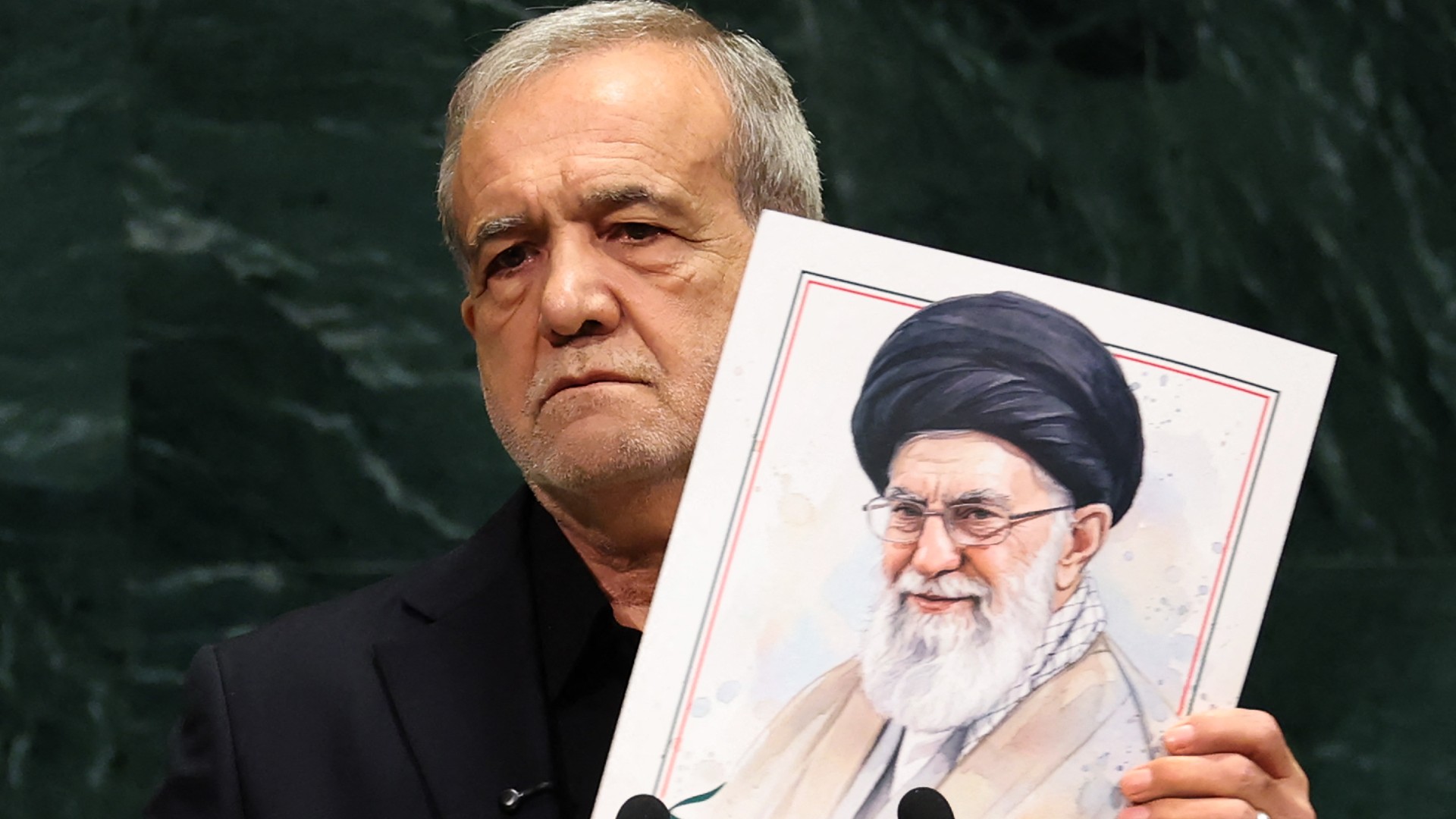
On the second day of the 2025 United Nations General Assembly, Arab and Muslim leaders united to center global attention on two defining regional crises: the ongoing U.S.-Israeli war against Iran and the humanitarian catastrophe unfolding in Gaza. The day’s debates were shaped by sharp, direct pushback against threats and military actions from Washington and Tel Aviv, with leaders laying out their nations’ stances amid shifting regional alliances and escalating conflict. The proceedings opened with a direct response to U.S. President Donald Trump’s combative address delivered a day earlier, where Trump threatened to “annihilate Iran” in the same speech where he floated the possibility of negotiating a end to the war. After Trump labeled the Iranian people “terrorists” during his remarks, Iranian President Masoud Pezeshkian confirmed he revised his planned address to directly address the accusations. Opening his speech by holding images of Iran’s assassinated Supreme Leader Ayatollah Ali Khamenei, killed in the opening U.S.-Israeli strikes on February 28, and graphic photos of Iranian children killed in American airstrikes and their mass graves, Pezeshkian delivered a scathing rebuke of Washington and Tel Aviv. Pezeshkian pushed back forcefully against the terrorist labeling, noting, “Those who are terrorists, and train and protect terrorists, describe us as such. We have only defended ourselves. We are not terrorists. America and Israel attacked us.” He added that over the last two centuries, Iran has never launched an offensive attack on any other sovereign nation, calling the terrorist designation a baseless smear. The Iranian president also addressed U.S. justifications for the war, reaffirming that Tehran has never pursued a nuclear weapon, but will not surrender its right to develop peaceful civilian nuclear technology. “Iran does not accept for nuclear technology to be at the exclusive disposal of some,” he stated. “We will not bow our head and give up the right that is inherently ours. We say it clearly: no nuclear weapons and no limitations to peaceful nuclear technology.” He also called out U.S.-Israeli hypocrisy for pressuring Iran to curb its nuclear program while turning a blind eye to Israel’s widely acknowledged, undeclared nuclear arsenal. On ballistic missile programs, Pezeshkian defended Iran’s right to maintain a robust defensive military capability to deter aggression, noting, “Iran must be powerful, so as to avoid being threatened. We do not wish to use our power for hegemony. Our defensive systems have been built so that no one can think that the bombing of Iranian cities can go unanswered.” He also pushed back on claims that the Islamic Republic lacks popular support, confirming that widespread domestic protests at the start of 2025 were incited and armed by the U.S. and Israel, while massive crowds across Iran have turned out in widespread pro-government and pro-national demonstrations. The United Nations fact-finding mission has already confirmed that there are “reasonable grounds” to believe U.S. strikes on civilian targets in Iran — including a Minab elementary school that killed at least 150 people, 120 of them children, and a sports complex in Lamerd hit with thousands of tungsten pellets — amount to war crimes. Parallel to the Iran debate, U.S. envoys met with Iranian officials for three hours of closed-door talks on a potential ceasefire deal this week. Iran hardened its position ahead of the talks, reiterating that its core precondition for any agreement is the full reopening of the Strait of Hormuz, a critical global chokepoint for energy trade. Tuesday also saw Trump hold a separate meeting with a group of Arab and Muslim leaders, where he offered warm praise for the assembled officials, but the gathering concluded with no tangible agreements or public announcements addressing Middle East regional turmoil. Syrian President Ahmad al-Sharaa, speaking to the General Assembly in one of his highest-profile UN appearances since ousting former President Bashar al-Assad in late 2024, used his address to declare Syria’s formal return to the international community while delivering a fierce condemnation of ongoing Israeli aggression against his country. Sharaa noted that since he took power, Israel has launched more than 500 air strikes, carried out over 1,200 ground incursions, and detained more than 300 Syrians inside sovereign Syrian territory, actions he said directly contradict the global welcome of Syria’s reintegration into global affairs. “The world is joyed by our return but Israel is launching attacks against Syria,” he said. “This is at odds with the orientation we are seeing at a global level. We reject their aggressions.” Sharaa also reaffirmed Syria’s sovereign claim to the Golan Heights, the strategic territory seized by Israel in the 1967 Six-Day War and illegally annexed by Tel Aviv in 1981, a move that Donald Trump unilaterally recognized during his first presidential term in 2019. “Any attempts that violate our sovereignty, that violate international law, will be stopped. Golan will remain Syrian territories,” he said, calling for a full return to the 1974 disengagement agreement that established a UN-patrolled buffer zone between the two nations — a zone Israel currently occupies after invading southern Syria following Sharaa’s ascent to power. The Syrian leader made clear that he will not pursue formal diplomatic relations with Israel as long as Israeli strikes continue and the Golan Heights remains occupied, noting that his own birthplace falls within the illegally held territory. Sharaa also outlined progress his administration has made since taking power, noting that broad security has been restored across the country, transnational criminal networks and the captagon drug trade — which flourished under the Assad government — have been cracked down, and the government is cooperating with international bodies to eliminate leftover chemical weapons stockpiles from the Assad era. While international sanctions on Syria have been lifted, Sharaa acknowledged his government still faces steep challenges, including a collapsed economy and slow progress on post-conflict reconstruction. Still, he closed with an optimistic note: “Syria is rising. We proved to the world that the security of the region has to start in Damascus.” Jordan’s King Abdullah II echoed Sharaa’s warnings in his own address Tuesday, arguing that repeated Israeli strikes on Syria prove Israel has territorial expansion ambitions that stretch far beyond the occupied Palestinian territories. Libyan Presidential Council head Mohamed al-Menfi, speaking later in the day, joined the growing chorus of Arab leaders calling for a sovereign Palestinian state, warning that the ongoing failure to resolve the Palestinian issue is the root cause of endless regional conflict and rising extremism. “Neither the Islamic and Christian holy sites, nor civilians and civilian infrastructure have been spared the ravages of this conflict,” he said, adding that the absence of a Palestinian state directly fuels instability across the Arabian Gulf, where nations have faced repeated attacks from Iranian-aligned groups in response to the U.S.-Israeli war on Iran. Menfi also expressed full solidarity with Saudi Arabia amid ongoing Houthi attacks, stating, “The security of the kingdom and the Gulf, given their Arab and Islamic weight, is not a national matter, but a pillar in the security and stability of our region.” He also drew attention to other conflict zones across the Middle East and Africa, noting that the Sudanese people have “paid a heavy price” for an ongoing civil war funded by outside powers, and warned of growing instability across the Sahel region.
UN General Assembly 2026: Arab and Muslim leaders denounce militarism engulfing region