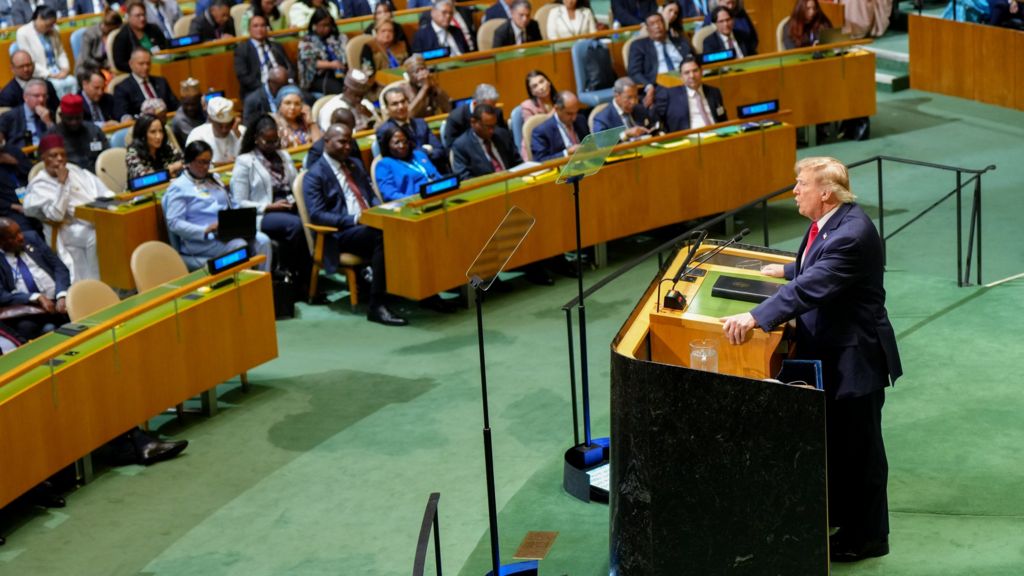
On Tuesday, U.S. President Donald Trump took the stage at the United Nations General Assembly, leveraging the global gathering of world leaders to tout his administration’s policy record while delivering sharp, provocative threats to several nations present in the assembly hall. His wide-ranging speech covered ongoing conflicts, global geopolitics, emerging technology, and U.S. military posture, with BBC correspondents on the ground highlighting five defining moments that underscored the president’s agenda and tone.
Long known for his dismissal of the United Nations as an institution, Trump used his address to repeat his criticism that the body pushes a far-left ideological agenda, even as he embraced the platform it provided to broadcast his message to a global audience. Beyond highlighting his administration’s self-proclaimed achievements and positioning himself as a global peacemaker, Trump laid out a series of aggressive warnings that reaffirmed his longstanding “America First” doctrine. He bluntly stated that the U.S. would continue to deploy its unmatched military power wherever he deemed it necessary to protect American national interests, declaring that Washington would no longer allow threats to the U.S. to gain a foothold anywhere in the Western Hemisphere.
One of the most striking exchanges of the speech came when Trump turned his sights to Cuba, labeling the island nation an “absolutely failed state” and confirming that his administration has been pushing for fundamental systemic change on the island. “It will fall,” he stated plainly. As Trump continued his remarks, the entire Cuban delegation walked out of the assembly hall in protest. Over the past 12 months, Trump has ramped up public criticism of Cuba’s communist government, claiming Tuesday that the regime is under unprecedented pressure and failing on all fronts. However, the White House has yet to outline any concrete vision for what political change in Cuba would look like under U.S. guidance. Cuban Foreign Minister Bruno Rodriguez responded swiftly on social media platform X, denouncing Trump’s comments as a spread of falsehoods and asserting that the U.S. government refuses to accept Cuba’s right to exist as a fully sovereign and independent nation.
On the ongoing conflict involving Iran, Trump issued an ultimatum that drew immediate international alarm: the Islamic Republic must reach a negotiated deal with Washington to rebuild the country, or it will face rapid annihilation. He also repeated his prediction that a deal to end the war would likely be finalized after November’s U.S. midterm elections, laying out his signature coercive diplomacy strategy: keeping the door to negotiations open while threatening overwhelming military force. Experts in international law have previously raised concerns over what they describe as alarming rhetoric from senior U.S. officials, including Trump, who has previously suggested the U.S. could obliterate Iran’s civilian power infrastructure. Tuesday’s references to leaving Iran with “no chance of survival” and “no hope” for future generations have amplified those fears, with many observers noting the bitter irony of delivering an existential threat at the United Nations, an organization founded explicitly to spare future generations from the scourge of war. Despite the harsh rhetoric, the speech was not a declaration that diplomacy is off the table; instead, it sought to set non-negotiable terms for any future talks: Washington remains open to a deal, but only under the shadow of an existential threat to the Iranian state.
Trump also used the speech to publicly celebrate a newly finalized security agreement with Greenland, an agreement that will allow the U.S. to construct two new military bases on the Arctic territory. “We will have the complete ability to do what is necessary to defend the American continent and also Europe,” he said of the deal, which he first announced publicly the previous Friday. He added that the agreement significantly strengthens the transatlantic defense alliance NATO. A joint signing ceremony between the U.S., Denmark, and Greenland was held at the UN shortly after Trump concluded his address. While Greenland is a semi-autonomous territory, it falls under the sovereignty of the Kingdom of Denmark, which handles most of its foreign affairs. Senior Trump administration officials have already praised the agreement as a major win for U.S. national security achieved at minimal cost, with no lasting damage to key diplomatic relationships. The deal marks a resolution to a long-running diplomatic dispute that began when Trump first threatened to take Greenland by force, a comment that roiled NATO and put severe strain on U.S.-Denmark relations after months of Trump’s public attempts to purchase or annex the territory. Many geopolitical analysts now view the final agreement as a quiet win for diplomatic negotiation, ending a months-long standoff between close allies.
In a lighter but widely noted moment, Trump leaned into his well-known passion for rebranding by announcing a new name for artificial intelligence: Super Intelligence, shortened to SI. “The use of the word artificial makes it sound fake,” he explained during the address. “It’s not fake, it’s actually amazing. But we have to be careful. Welcome to the new world of Super Intelligence – SI.” Trump has repeatedly emphasized that the U.S. must claim the top spot in the global race to develop advanced AI, remarking just last week that “whoever wins AI, wins the future.” The president has remained firmly opposed to any new federal government regulation or safety guardrails for AI development, a position that puts him directly at odds with a large majority of world leaders and policymakers gathered at the UN General Assembly, many of whom have pushed for coordinated global regulation of the rapidly advancing technology. For proponents of global oversight, the divide raises urgent questions about whether the slow pace of multilateral diplomacy can keep pace with the breakneck speed of AI advancement.