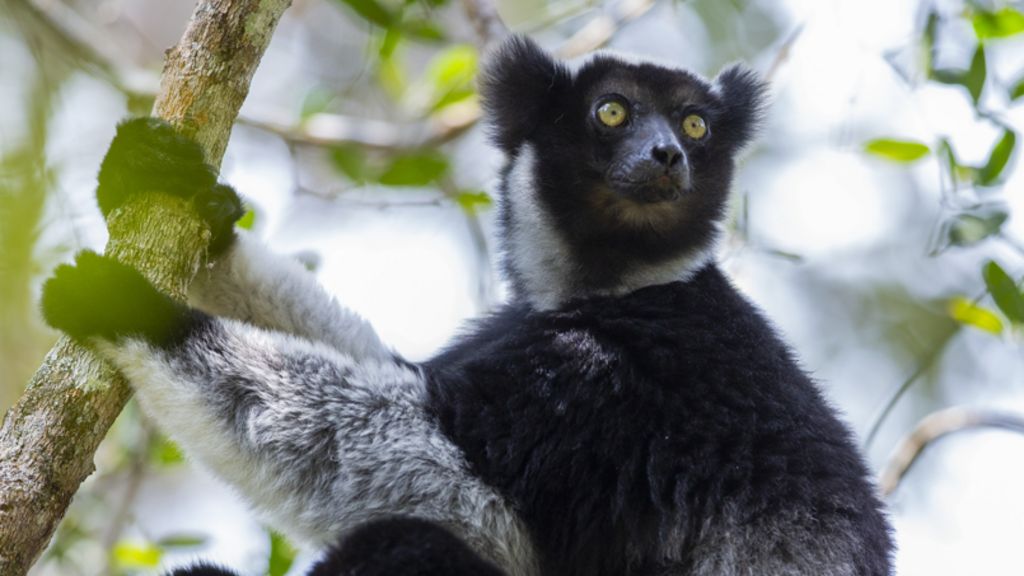
For years, an international team of researchers spanning the United Kingdom, Italy, and Madagascar has worked to unlock the mysteries of one of nature’s most unique vocalists: the singing indri lemur. Now, their long-running investigation has yielded a surprising discovery that blurs the line between human trained performance and wild animal communication: the endangered Madagascan primate uses the same core vocal technique that professional opera singers rely on to project their voices across large concert halls.
Led by researchers from the University of Warwick in the UK and the University of Turin in Italy, in collaboration with local partners in the lemurs’ native Madagascar, the new study marks the first time scientists have ever documented this specific level of vocal tract coordination in a non-human primate. To collect their data, the team captured 83 high-resolution video recordings of 19 wild indri individuals, then deployed precision motion-tracking technology to map subtle changes in the primates’ lip and jaw position as they sang. Frame-by-frame analysis confirmed a clear, consistent pattern: every time an indri shifted to a higher pitch, it widened its mouth opening in lockstep, just as a trained human soprano adjusts her vocal tract to hit high notes.
This coordinated adjustment is called formant tuning, a technique well-known among professional vocalists that amplifies sound frequencies to boost projection and power. For indri lemurs, which live in Madagascar’s dense, thickly forested canopies, this adaptation serves the same core purpose it does for human singers: helping their loud, distinctive songs travel farther across dense vegetation to communicate with other lemur groups across large distances.
Dr. Chiara De Gregorio, an honorary research fellow at the University of Warwick and a lead member of the study team, emphasized how unexpected the finding was. “We typically associate this fine-tuned coordination between vocal output and body movement with trained human singers, not wild lemurs calling from the forest canopy,” De Gregorio explained. “But frame by frame, we could clearly see that every rise in pitch was matched by a wider mouth opening — it was completely consistent across all the individuals we studied.”
The research builds on years of work into indri lemur singing behavior that aims to shed new light on the evolutionary origins of human music. A 2025 study from the same research group already revealed that young indri lemurs learn to sing through practice and social learning, a developmental pattern that mirrors how human children acquire language and musical skill.
While humans and indri lemurs share a distant common ancestor that lived roughly 74 million years ago, the research team notes that the similar formant tuning technique evolved independently in both lineages, a striking example of convergent evolution for effective long-distance communication.
This discovery not only deepens scientific understanding of primate communication but also opens new avenues of research into the deep evolutionary roots of musical ability across species.