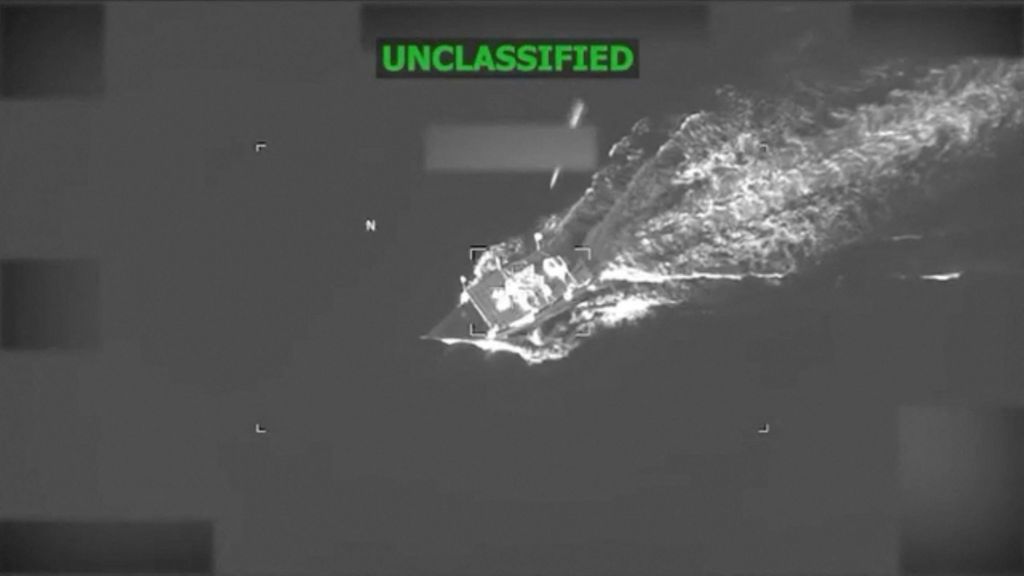
Two days after the U.S. military published imagery of its latest strike on a vessel accused of drug trafficking in the Caribbean, a United Nations investigation has delivered a damning conclusion: the ongoing U.S. campaign of airstrikes on maritime targets outside American territorial waters violates international law, and may qualify as crimes against humanity. The findings, released Monday in an official briefing note by the UN Human Rights Council, come from special rapporteur Ben Saul, who has documented the scale of the operations launched by the U.S. as part of its counternarcotics initiative.
Saul’s investigation confirms that between September of last year and the present, the U.S. has carried out no fewer than 68 such strikes across the Caribbean and Pacific, resulting in the deaths of more than 220 people. Even in cases where targets can be accurately verified as members of internationally designated terrorist or drug trafficking groups, Saul argues the strikes do not meet the legal standard for triggering the right to self-defense under international law. For self-defense to apply, the targeted group would need to have launched an active armed attack against the U.S. — a threshold the U.S. has not met in any of these cases, according to the report.
The UN findings land just 48 hours after U.S. Southern Command, the military body overseeing operations in the region, confirmed its latest attack. In an official statement accompanying grainy aerial footage of the strike, the command said confirmed intelligence proved the targeted vessel was actively involved in narco-trafficking, and that the operation killed four individuals labeled as narco-terrorists. But Saul’s report pushes back hard on the legal justification for the entire campaign, noting that the strikes amount to a pattern of serial extrajudicial killings that violate the fundamental right to life. “Such attacks are unjustified in national or personal self-defence or under international humanitarian law, the international law of the sea, narcotics suppression conventions, or international counter-terrorism law,” Saul wrote in the briefing.
Going a step further, the special rapporteur concluded that there are reasonable grounds to believe the 68 documented strikes that killed 223 people meet the definition of the crime against humanity of murder under customary international law.
The U.S. launched its expanded counternarcotics air campaign, codenamed Operation Southern Spear, in early September of last year. From its launch, the initiative has faced sharp criticism and controversy. U.S. defense leaders have defended the mission, with Defense Secretary Pete Hegseth previously stating the operation focuses on removing “narco-terrorists from our hemisphere” and protecting the U.S. from the flow of illicit drugs that kill thousands of American citizens annually. However, the U.S. has yet to publicly release definitive, verifiable evidence proving all targeted vessels were actively engaged in drug trafficking.
Critics of the operation have included regional leaders, but two of the most prominent opponents have been removed from power in controversial circumstances over the past year. Nicolás Maduro, the then-Venezuelan president who repeatedly spoke out against the strikes, was captured by U.S. forces in a dramatic, widely contested overnight raid on Caracas earlier this year. Meanwhile, Gustavo Petro, the left-wing former president of Colombia who also opposed Operation Southern Spear, left office in August after a Trump-backed candidate won the country’s June presidential election.
As of Tuesday, the UN report has not yet received an official response from the U.S. government. BBC News has reached out to the White House and State Department for comment on the findings.
US strikes on alleged drug boats could be crimes against humanity, says UN