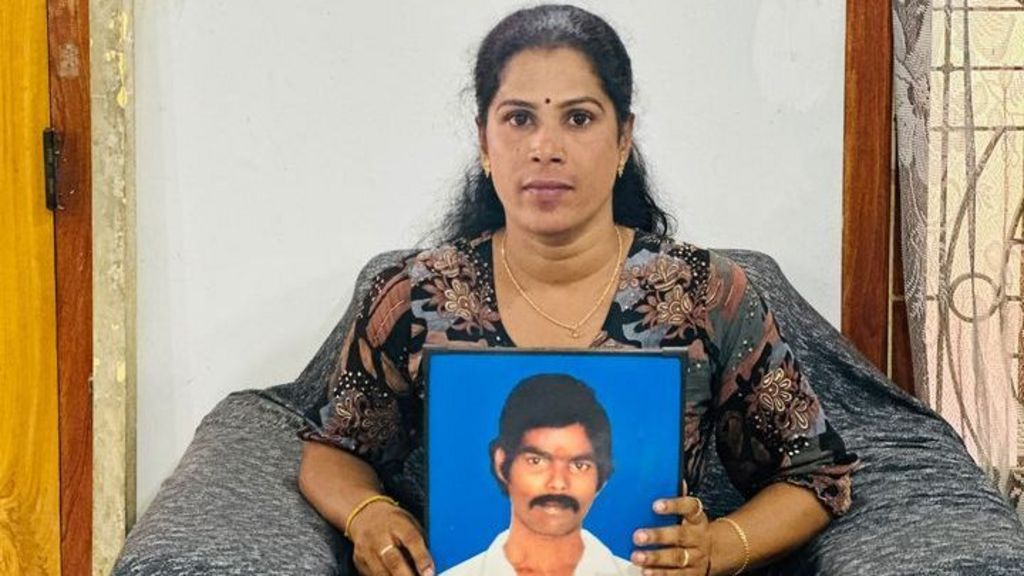
For nearly three decades, Jeyaruby Jeyabalan has carried the same unanswered question: what happened to her father, Kandaiah Jayapalan, who was taken by Sri Lankan security forces at a Chemmani checkpoint in 1996, when she was just 12 years old. Today, her search for truth intersects with a landmark archaeological discovery that has forced long-buried secrets of Sri Lanka’s 26-year civil war back into the global spotlight.
Last February, a routine construction project in Sri Lanka’s Tamil-majority Jaffna region unearthed a tragedy no formal investigation had ever confirmed. Workers expanding a local cremation ground in Chemmani stumbled on fragmented human remains, triggering a systematic excavation that by August had uncovered the skeletal remains of 572 people – including children and infants. Personal artefacts found alongside the bodies, from a child’s milk bottle and school bag to women’s bangles, offer quiet, devastating testimony to the lives cut short here. This is now recognized as the largest mass grave ever discovered in Sri Lanka.
Rumors of a mass burial site in Chemmani have circulated since the late 1990s, when a soldier convicted of the notorious rape and murder of 18-year-old Tamil student Krishanthi Kumaraswamy testified in court that hundreds of executed civilians were buried in the area. Kumaraswamy’s remains, along with those of three family members killed alongside her, were already found in Chemmani in the 1990s, just 100 meters from the newly expanded grave site. A 1998 excavation following the soldier’s testimony recovered roughly a dozen sets of remains, but the investigation stalled amid ongoing conflict and was never followed through on. For decades, the claims of mass extrajudicial killings and enforced disappearances remained unproven – until now.
Sri Lanka’s civil war, which ran from 1983 to 2009, grew out of decades of systematic ethnic discrimination against the island’s Tamil minority by the Sinhalese-dominated national government. The Liberation Tigers of Tamil Eelam (LTTE) waged an armed campaign for an independent Tamil state in the north and east, leaving an estimated 100,000 people dead and roughly 23,000 more – the vast majority of them Tamil – registered as missing. Both government security forces and LTTE rebels have been credibly accused of widespread atrocities and war crimes, a reality that has left generations of Tamil families waiting for accountability.
After the Sri Lankan army retook control of the Jaffna Peninsula from the LTTE in 1995, the entire Chemmani region was designated a high-security military zone, dotted with army camps and checkpoints. Locals at the time described Jaffna as an “open prison,” with thousands of Tamil civilians detained or disappearing at security checkpoints – allegations successive Sri Lankan governments have repeatedly denied. Kandaiah Jayapalan, a government employee who ran a small roadside café near Chemmani, became one of those statistics 12 years after the army took control of the peninsula. Like hundreds of other families, Jeyaruby and her relatives searched every military camp and police station across Jaffna after his disappearance, but found no answers. He never returned home.
Forensic experts examining the newly discovered remains have already drawn damning preliminary conclusions. A 2025 inspection by Sri Lanka’s Human Rights Commission found the burial site does not align with traditional Hindu burial practices, which were standard for the local Tamil population. Most remains were found unclothed, packed tightly into shallow graves just one to two meters below the surface, stacked haphazardly atop one another. Only a small handful of bodies showed signs of formal burial. “There is a reasonable likelihood that the burials were unlawful and pursuant to extrajudicial killings,” the commission concluded in its 2025 report.
For thousands of Tamil families still waiting for information on their disappeared loved ones, the discovery has brought a painful mix of grief, hope, and anger. Sixty-five-year-old Suseela travels to the Chemmani site searching for clues of her only son, Gnanaseelan Ravi, who was detained by the military in 2007 at age 24. “He was my only son, and I keep crying every day remembering him. My life is empty without him,” she told the BBC. Like Jeyabalan, she left the site without finding any evidence linking her son to the grave, and widespread DNA testing needed to identify remains has not yet begun.
All recovered remains are currently held in court-ordered custody at the University of Jaffna’s forensic department. Raj Somadeva, the lead archaeologist heading the excavation, told the BBC an interim report will be submitted to court by the end of September 2026. Some bone samples will be sent overseas for radiocarbon testing to confirm the age of the remains, while separate analyses will attempt to determine causes of death. The government has asked families of the disappeared to submit their own DNA for future matching, but progress has been slow, testing the patience of grieving communities.
Distrust of domestic investigations runs deep among Sri Lanka’s Tamil population. Over the past decades, more than 20 mass graves have been uncovered across the country, but none have resulted in criminal prosecutions, and none have conclusively linked remains to enforced disappearances or extrajudicial killings. The 2018 discovery of a 350-set mass grave in Mannar, another northern Tamil town, ended with inconclusive findings, leaving hundreds of families empty-handed. Many Tamils fear the Chemmani site will follow the same pattern, fading from public attention as political will for accountability fades. The discovery has already become a rallying point for renewed protests across northern Sri Lanka, with families demanding referral of the case to the International Criminal Court for an independent probe.
President Anura Kumara Dissanayake, who took office in September 2024 on a promise of ethnic reconciliation and justice for wartime victims, has insisted his government is fully cooperating with the Chemmani investigation. Justice Minister Harshana Nanayakkara confirmed the government will allocate full funding for excavation and testing, and that the process will move forward to determine how the victims died. But the administration has firmly rejected calls for any international investigative mechanism, a decision that has disappointed Tamil communities and human rights advocates. Sri Lanka’s military spokesman Brigadier Waruna Gamage also denied allegations that security forces massacred and buried civilians, saying all claims must be proven in court.
International bodies and human rights groups have repeatedly criticized Sri Lanka’s history of stalled investigations into wartime atrocities. A 2018 government initiative, the Office of the Missing Persons, was created to investigate disappearances after years of international pressure, but affected families say it has made almost no progress. A recent Human Rights Watch report noted that thousands of cases of enforced disappearance, torture, and extrajudicial killing remain stalled, while victim families and human rights defenders routinely face intimidation and threats.
The United Nations has repeatedly called on Sri Lanka to accept international assistance to build confidence in the investigation. “This is a situation where victims are deeply frustrated, have lived with pain for decades, have come to distrust past investigations,” Rory Mungoven, Asia-Pacific chief for the UN Office of the High Commissioner for Human Rights, told the BBC. “I think involving international assistance would help to bolster confidence in these investigations.”
Human rights groups say the Dissanayake government now has a unique opportunity to break a decades-long pattern of delay and denial, and deliver long-overdue accountability for crimes committed during the civil war. For the families still waiting, that opportunity cannot come soon enough. Many who spent decades campaigning for truth have already died without ever learning what happened to their loved ones. For those still living, the uncertainty is a daily torment. “I don’t know how long I will live with such uncertainty, but I want closure,” Suseela says.