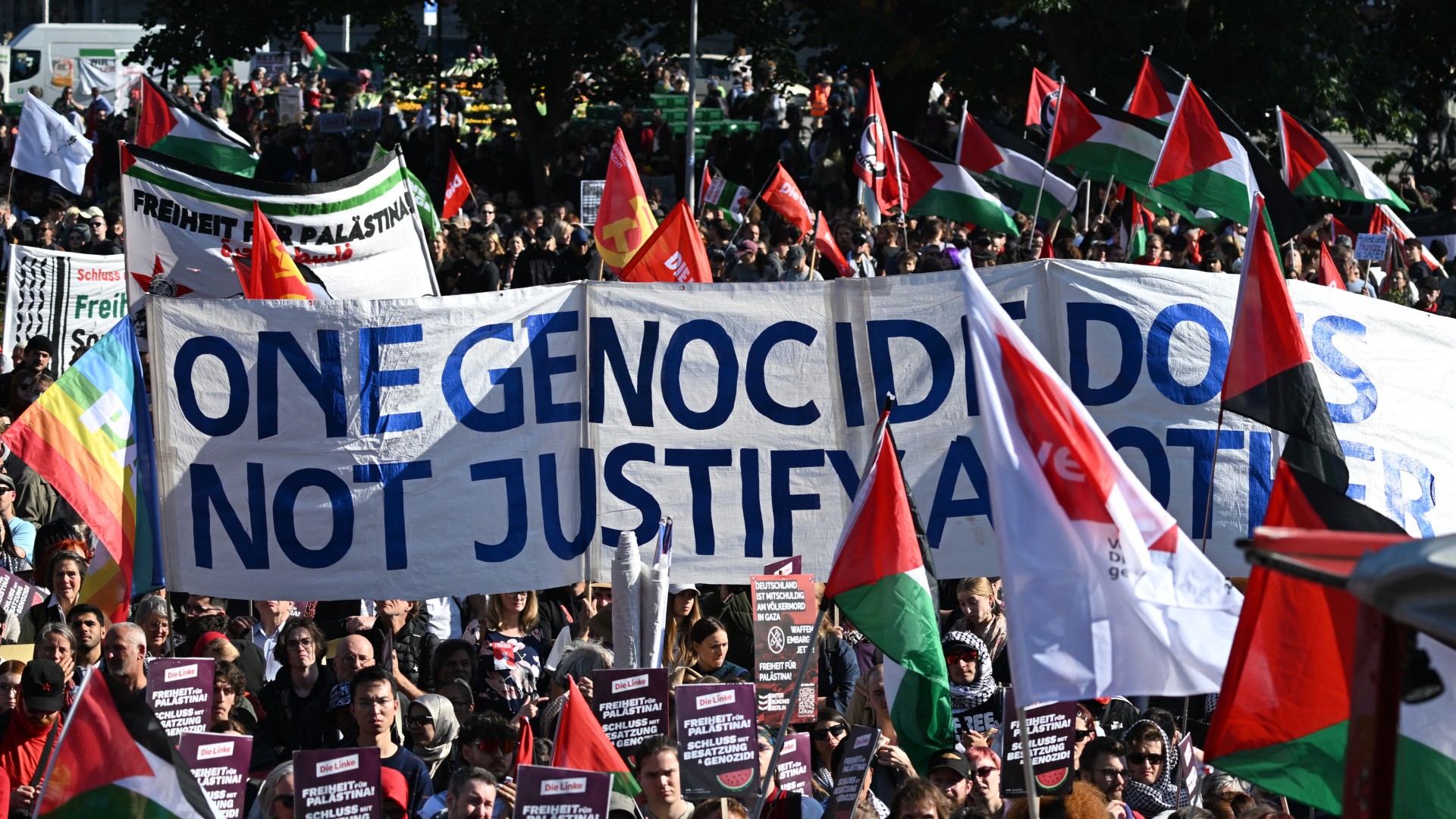
Days ahead of a critical round of German state elections, a public confrontation on a Berlin subway laid bare deep contradictions in how Germany frames antisemitism, debates the Israeli-Palestinian conflict, and enables far-right political gain. The incident centered on Karoline Preisler, a Free Democratic Party (FDP) politician and lawyer who has built a public profile staging provocative solo counter-protests at pro-Palestine demonstrations across the country.
Preisler shared a video of the subway encounter on the social platform X, where she is shown holding up a sign reading “Intifada is a call to violence” directed at two men she labeled “racist white terror supporters.” A supporter accompanying Preisler later claimed they had “experienced antisemitism up close” at the hands of a pro-Palestine activist. But the encounter carried a striking twist: neither Preisler nor her supporter are Jewish, while the activist accused of antisemitism is Jewish, and was wearing a shirt that read “Another Jew for a free Palestine.”
Francesca Albanese, the United Nations Special Rapporteur for the occupied Palestinian territories, quickly responded to the incident with sharp criticism. “Feeling threatened by Jews who oppose genocide defies epistemology. Time to patent misplaced victimhood,” she wrote.
This small but loaded confrontation unfolded just one week before Germany’s far-right Alternative for Germany (AfD) secured a historic landslide victory in the eastern state of Saxony-Anhalt, marking the strongest electoral result for a far-right party in Germany since the end of World War II. The win carries troubling weight: official data shows far-right actors are responsible for 84 percent of all antisemitic hate crimes committed in Germany, making them the dominant source of anti-Jewish violence in the country today.
Yet across mainstream German political and public discourse, antisemitism is routinely conflated with anti-Zionism and criticism of the state of Israel – even when that criticism comes from Jewish people themselves. This framing has enabled harsh, often violent repression of pro-Palestine speech and public protest across the country. The AfD led the charge on this shift as early as 2019, when it tabled a parliamentary motion to fully ban the Boycott, Divestment and Sanctions (BDS) movement calling for economic pressure on Israel over its occupation of Palestinian territory.
That motion paved the way for the German federal government to pass a non-binding anti-BDS resolution, urging all public institutions to refuse platforming any individual even remotely connected to the boycott movement. The policy has already led to dozens of public figures being disinvited from events or de-platformed for their support of BDS or Palestinian rights.
Far-right parties like the AfD have leveraged this mainstream framing to whitewash their own long history of antisemitism, experts argue. By positioning themselves as outspoken proponents of Israel and loud opponents of antisemitism, they have escaped scrutiny for their core ideological commitments. “As antisemitism has been equated with the critique of Israel, far right actors have been able to hide their antisemitism and present themselves as transformed,” explained Esra Ozyurek, an expert on Holocaust memory at the University of Cambridge. “Even though the AfD downplays its antisemitism and emphasizes its Zionism, it still follows the same playbook with its fascist predecessors in demonizing a religious/ethnic minority, scapegoating them for problems in society which have nothing to do with them, and trying to unite a ‘nation’ through the exclusion of a minoritised group.”
AfD officials have openly embraced this strategy. When the 2019 BDS ban motion was tabled, AfD MP Jurgen Braun claimed his party was the only “true friend of Israel” in the German parliament, repeating the false claim that “antisemitism comes from the left and Islam.” The party even elevated Yair Netanyahu, son of Israeli Prime Minister Benjamin Netanyahu, to a prominent poster figure for their cause after he labeled the European Union an “evil globalist organisation.”
While Germany’s diplomatic ties to Israel date back to the early years of the Israeli state, the framing of unwavering support for Israel as a core pillar of modern German national identity is a relatively recent shift, rooted in the aftermath of the 9/11 attacks. It was during this era that Germany began externalizing guilt for the Holocaust onto Muslim communities, redefining national “redemption” from its Nazi past through unconditional support for Israel. That shift was formalized in 2008, when then-Chancellor Angela Merkel delivered a landmark speech to the Israeli Knesset declaring that unwavering support for Israel’s security is part of Germany’s Staatsrason – its core “reason of state.”
For Hans Kundnani, editor of the book *Hyper-Zionism*, that speech marked a fundamental redefinition of how Germany remembers the Nazi era. “Germany went from a universalist understanding of the lessons of the Nazi past to a more particularist one,” he explained, shifting the meaning of the post-Holocaust mantra “Never Again” from a universal commitment to stopping all genocide to a narrow pledge to protect the state of Israel – not Jewish communities globally. “Merkel wanted to take support for Israel out of democratic contestation, to kind of lock it in before it is too late,” Kundnani added.
Today, this commitment cuts across Germany’s entire political spectrum. Even nominally left-wing parties, including the German Greens and Die Linke, routinely conflate pro-Palestine sentiment with Nazism and antisemitism. Remarkably, this elite consensus is not reflected in German public opinion. 2025 polling shows nearly 80 percent of German voters view Israel’s military campaign in Gaza as unjustified, while 62 percent describe it as genocide. Only 10 percent of respondents fully support the idea that Israel’s security should be Germany’s core reason of state, a view that holds across all political divides.
This gap between elite and public opinion is partially driven by generational and demographic change. Younger Germans and Germans with immigrant backgrounds are far more likely to oppose Israel’s actions and support Palestinian statehood, and Berlin is home to the largest Palestinian diaspora community outside the Middle East. For Kundnani, figures like Preisler – the FDP politician behind the subway confrontation – embody the moral arrogance of Germany’s pro-Israel elite. He describes Preisler as a “moral crusader” who actively seeks out confrontation with pro-Palestine members of the public, driven by a sense of national moral superiority.
“The way Germans think about it is that we did our exemplary engagement with the Nazi past, we have this exemplary memory culture, better than anyone else, and thus feel morally superior to the whole world,” Kundnani explained. Under this framework, antisemitism is framed as an external problem that has already been solved within Germany, with immigrant communities – particularly Muslim immigrants – blamed for “reimporting antisemitism” into the country.
Daniel Cohen, a historian at Rice University, argues this framing is tied to a narrow, exclusionary vision of German national identity. “It has become a matter of national identity,” Cohen told Middle East Eye. “Anybody who is defending Palestinian rights is labelled ‘unGerman’ or ‘non-German’ in the interest of protecting a certain German identity – a German white identity, since the fear of antisemitism is also the fear of immigrants.” He added: “Support for Israel has less to do with love for Zionism, but mostly the necessity at all costs to protect the redemption of Germany,” referencing the widespread elite narrative that Germany has fully purged itself of antisemitism to create a post-redemption national identity free of anti-Jewish hate.
Central to enforcing this narrative is Germany’s network of state-appointed Antisemitism Commissioners, who regularly intervene in public discourse to de-platform and cancel figures linked to the pro-Palestine movement. Most of these commissioners are not Jewish; the majority are self-identified Christians who have targeted everyone from German-Israeli academics to Jewish South African photographers for their support of Palestinian rights.
In one high-profile example, commissioner Michael Blume sparked widespread backlash when he labeled *Judische Stimme* (Jewish Voice for a Just Peace in the Middle East) – a network of German Jews who advocate for Palestinian rights – “ostensibly Jewish,” drawing an official formal complaint from the organization. Blume has a long history of controversial statements about Judaism: in a 2015 public conference, he told audiences that Jews are not an ethnic or racial group, but part of an ancient intellectual school that brought literacy to the world, and that the roots of antisemitism lie in public resentment of this supposed special Jewish gift for literacy.
Cohen explains this form of opportunistic “philosemitism” emerged immediately after World War II, allowing German elites to preserve problematic myths about Jewish identity while co-opting Jewish history for their own national narrative. Even today, this dynamic persists: despite Germany having a tiny Jewish population, Jewish-themed baby names are the most popular among non-Jewish German parents, and the trend of non-Jewish Germans converting to Judaism has drawn criticism as an attempt to atone for family members’ Nazi pasts without addressing structural inequities.
Susan Neiman, who once wrote a 2019 book praising Germany’s model culture of Holocaust memory, has since acknowledged that the process has gone “haywire,” contributing to what Kundnani terms “hyper-zionism.” Neiman has labeled the current crackdown on pro-Palestine speech “philosemitic McCarthyism,” arguing that “the determination to root out antisemitism has shifted from vigilance to hysteria” in the months following the October 7, 2023 Hamas attack on Israel.
Amid this nationwide “witchhunt,” as Neiman terms it, *Judische Stimme* was formally classified as a “foreign extremist organization” by Germany’s domestic intelligence service – a designation that was later overturned by a Berlin court. Udi Raz, a board member of *Judische Stimme* and author of the upcoming book *JEW. DESPITE GERMANY*, argues that the entire framework of tying German post-Nazi redemption to Zionism is rooted in the same supremacist ideology that drove Nazism itself.
“For Germany’s governing policymakers, Zionism is the answer to Nazism,” Raz explained. “However, these are…continuations of the same supremacist ideology put into practice by Nazism. But while Nazism placed Jews outside the category of the superior, Zionism places us within it.” Raz added: “The unconditional support of Germany’s government for Israel suggests that Germany has never fully de-Nazified.”