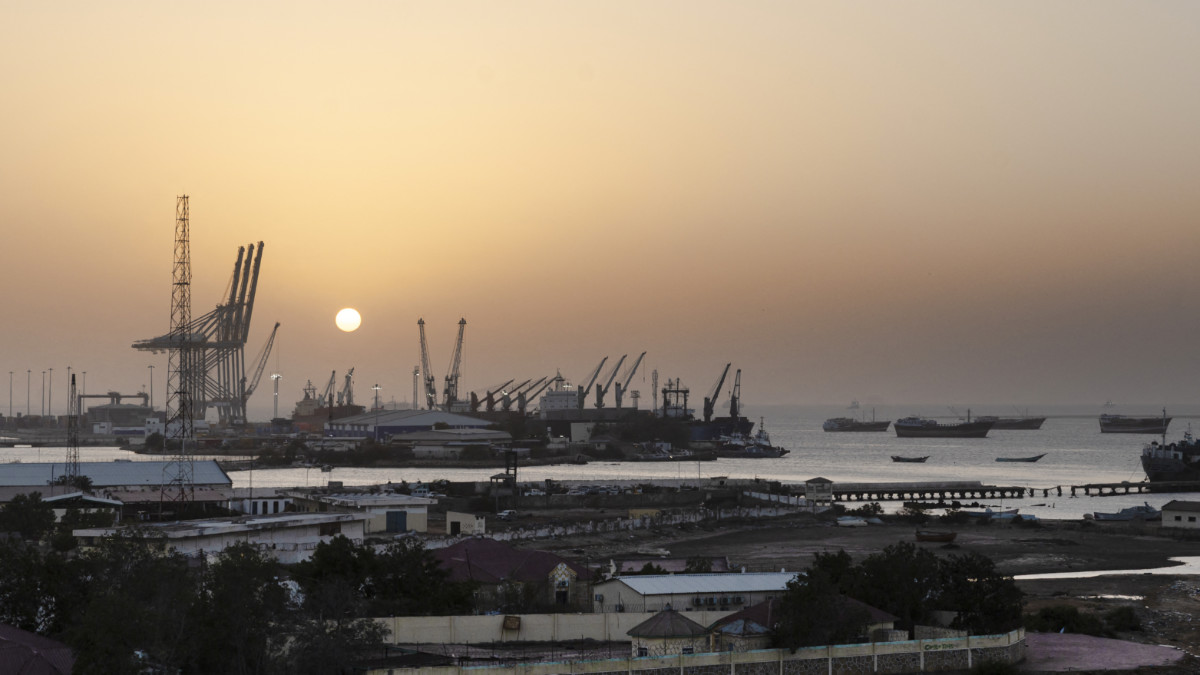
### Berbera: A Port at the Center of Global Power Rivalry
Nestled along the sun-scorched coast of self-declared independent Somaliland, the port of Berbera has stood as a strategic linchpin of East African trade for millennia. Today, it is once again emerging as a critical flashpoint in a new era of great power competition, as the United Arab Emirates (UAE) has stepped in to fill a regional vacuum left by other global powers, reshaping the geopolitics of the Red Sea.
Jama Mohamed Ahmed, commercial director of UAE logistics giant DP World in the Horn of Africa, describes Berbera simply: “Berbera is the heart of Somaliland.” Standing outside DP World’s modern glass-and-steel regional headquarters, a structure that could easily pass for a corporate office in suburban America or the Gulf, the implicit influence of the UAE here is impossible to miss. Even a prominent entrance sign banning the locally popular stimulant khat underscores the stamp of foreign investment on this once-sleepy coastal town.
Berbera’s historical significance stretches back to antiquity. In the 1st century CE, an anonymous Greek traveler documented the port, then called Malao, as a key regional trading hub in the *Periplus of the Erythraean Sea*, noting it operated as a thriving market where Indian copper, cloth, and glass were exchanged for African frankincense, myrrh, and cinnamon. For centuries, it served as a critical gateway between East Africa, the Arabian Peninsula, and South Asia, a role it retains today amid 21st-century power shifts.
#### The UAE’s Growing Footprint
DP World, owned by the Dubai government, invested $45 million to revitalize the decaying port in 2016, transforming operations and creating 1,350 local jobs. Where work was once done entirely by hand, even requiring workers to carry wheelbarrows of cash for payday disbursements, the port now boasts modern software systems, upgraded physical infrastructure, and skilled local workforces. Today, DP World even exports the expertise it has developed here to other operations across the continent, including Tanzanian port of Dar es Salaam.
The UAE’s investment extends far beyond the port itself. A smooth 250-kilometer highway from the Ethiopian border to the coast was built and funded by the UAE, with discreet markers displaying the Gulf state’s flag to remind travelers of its contribution. The UAE also funded a bypass around Hargeisa, Somaliland’s congested capital, to speed up freight traffic to the coast, and donated a boarding school just outside Berbera. Somaliland’s military has also received training and support from the UAE, securing key infrastructure along key transport routes.
Military expansion has accompanied economic investment. In 2017, the UAE established a permanent military base in Berbera, and open-source satellite imagery confirms ongoing expansion, including new surface-to-air missile sites, radar installations, hangars at the city’s airport, and an under-construction naval facility near the commercial port. This military buildup comes as tensions rise across the Red Sea region, between the UAE and its Gulf rival Saudi Arabia, and between Israel and Yemen’s Houthi movement.
#### Historical Context of Somaliland’s Independence
Somaliland’s path to this moment is rooted in colonial history. A former British protectorate, it gained independence in 1960, just five days before neighboring Italian Somalia, and the two entities united to form the Somali Republic. Decades of tense coexistence culminated in a brutal military crackdown by Somali ruler Mohamed Siad Barre in the 1980s, leading to Somaliland’s declaration of independence in 1991. For over 30 years, the breakaway republic went unrecognized by the international community – that is, until Israel formally recognized it in early 2026, a move that shifted regional dynamics dramatically.
Somaliland’s strategic location placed it perfectly for the UAE to expand its influence. When neighboring Djibouti expelled DP World and Emirati troops in 2015, the UAE turned to Somaliland, a long-time rival of Djibouti, which already hosts military bases for both China and the United States. Djibouti currently earns roughly $2 billion annually from landlocked Ethiopia for port access, creating a clear opening for Berbera to compete for Ethiopian trade.
As Bashe Omar, Somaliland’s former ambassador to the UAE who negotiated the 2016 DP World port deal, explains: “The UAE filled the vacuum.” While Saudi Arabia, Somaliland’s closer Gulf neighbor, has long been Somaliland’s main buyer for its critical livestock export, Riyadh long focused inward until recent years under Crown Prince Mohammed bin Salman. Today, Saudi Arabia has aligned with Turkey and Somalia, condemning Israel’s recognition of Somaliland as an “unilateral separatist measure.”
#### Geopolitical Competition and Untapped Economic Potential
For DP World, Berbera’s greatest long-term value is as a gateway to southern Ethiopia, Africa’s second-most populous country, which has long sought alternative access to the Red Sea outside of Djibouti. In 2024, Somaliland and Ethiopia struck a landmark deal: Ethiopia would gain a 50-year lease on a stretch of Somaliland’s Red Sea coast, and in exchange, Ethiopia would formally recognize Somaliland’s independence. The deal promised to boost DP World’s operations dramatically, bringing Berbera’s current 500,000 TEU annual container capacity and 2 million tonnes of bulk cargo capacity to full use.
However, the agreement has never been implemented. Intense pressure from Somalia, Egypt, and Turkey, which has close military and economic ties to Somalia, forced Ethiopia to back away from the deal. Today, Berbera Port operates at only 30% capacity, according to Ahmed. Even so, the 2023 World Bank rankings named Berbera the most efficient port in sub-Saharan Africa, and ongoing activity confirms its strategic value: Russian grain bound for Ethiopia and South Sudan, Chinese containers heading to Egypt, Indian sugar and Malaysian timber for the local market all move through its berths.
Ahmed remains confident that Berbera’s strategic location will eventually bring it to full capacity. Heightened tensions in the Persian Gulf have created new opportunities for the port, as shippers seek alternative, more secure trade routes. “All the cargo coming from East Asia was transshipped to Gulf ports,” Ahmed notes. “Now, they can come to Berbera. We are just 18 days sailing from China.”
#### The Road Ahead
With Israel’s recent recognition of Somaliland, there is growing speculation that Israel may seek to establish its own military base in Berbera. Somaliland’s political leadership has made no secret of its desire to deepen defense ties with both Israel and the United States, arguing that such a presence would deter aggression from Somalia. “I would support a base for both the US and Israel in Berbera because it would make Somalia think twice,” Bashe says. Yet, he also acknowledges the risks: if foreign powers use Berbera as a base to launch attacks on regional rivals like the Houthis, retaliation would be inevitable. “So if they use Berbera for that, it should be in exchange for recognition,” he adds.
For centuries, Berbera has weathered the arrival and departure of foreign powers, from ancient Greek traders to British colonial administrators, from the Soviet Union to the United States. Today, as new global powers compete for influence across the Red Sea, Berbera finds itself once again at the center of geopolitical rivalry. Its untapped economic potential is clear, but for the foreseeable future, Berbera’s commercial fortunes remain inseparable from the shifting tides of regional power politics.