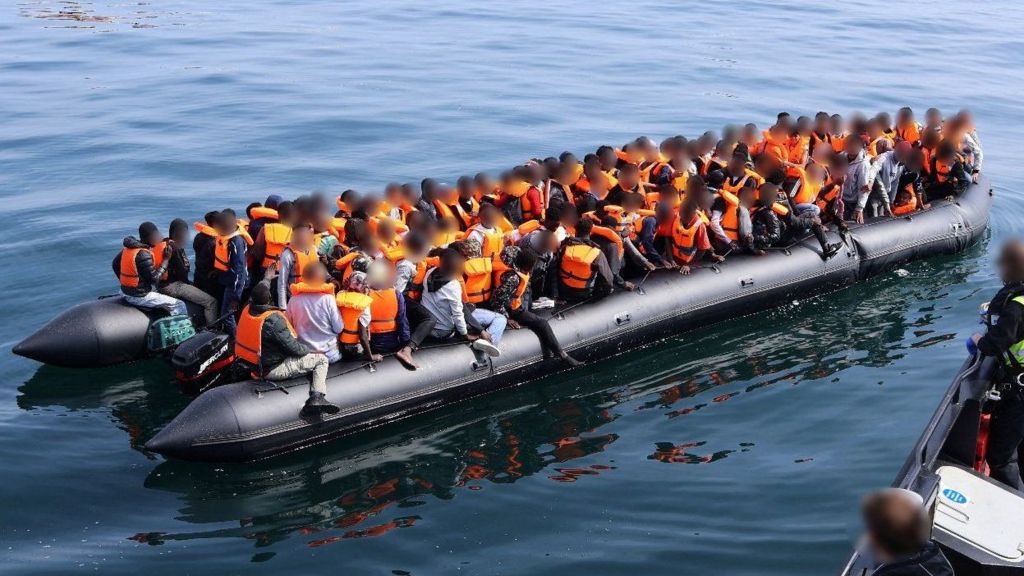
A 19-year-old South Sudanese national who steered a severely overcrowded dinghy carrying 165 migrants across the English Channel to the United Kingdom has been handed a 27-month prison sentence after pleading guilty to endangering the lives of everyone on board. The July 23 crossing marked the largest single small boat migrant crossing recorded at that time, a record that was later broken by an August incident that saw 230 people packed into a single vessel. This conviction marks the 16th secured under the new UK offense of endangerment at sea, which was introduced in January specifically to target small boat helmsmen working with people smuggling networks.
The sentencing hearing at Canterbury Crown Court on Friday delivered a firm ruling from Judge Sarah Counsell, who concluded the crime was so inherently serious that only an immediate custodial sentence could be justified. She also issued a formal warning to the defendant, Chan Mathok Atak, that as a non-UK national he will face automatic deportation at the end of his prison term in most cases.
Prosecutors laid out the full scale of the risks created during the crossing, detailing that the inflatable rigid-hulled dinghy measured just 3.9 meters wide and 14.3 meters long — approximately the same length as a standard city bus — yet carried 165 people, including 31 children as young as 14 years old. Of the vessel’s two outboard engines, only one was functional when it departed from northern France for the UK. By the time UK Border Force crews intercepted the craft mid-Channel, it was already slowly deflating after almost 24 hours adrift at sea.
A joint investigation led by the National Crime Agency (NCA) uncovered multiple catastrophic safety failures that put every passenger at immediate risk of death. The boat was classified as severely overcrowded, with only extremely limited supplies of food, drinking water and necessary medication on board. Lifejackets provided to passengers were found to be completely inadequate for an open sea crossing, and the close proximity of power batteries to exposed fuel cans created a significant fire hazard. Prosecutors confirmed there was no evidence to suggest Atak had any formal maritime training or prior experience navigating open water, meaning he was unqualified to steer any vessel, let alone an overloaded craft in one of the world’s busiest shipping lanes.
Court documents show that as border forces approached the vessel to intercept it, Atak attempted to cover his role as the helmsman: he moved away from the working engine to another section of the boat and removed the black “Italia” branded jacket he had been wearing while steering. However, 90 minutes of aerial surveillance footage captured by law enforcement clearly showed Atak operating the only functional engine for the majority of the crossing, and one passenger was recorded continuously pumping air into the deflating hull to keep it afloat. Initially, Atak told investigators he had paid smuggling gangs €200 to secure a spot on the crossing himself, and denied he had acted as the boat’s pilot.
NCA Senior Investigating Officer John Turner emphasized the extreme recklessness of Atak’s actions, noting that disaster was only avoided because law enforcement intercepted the vessel before it sank or suffered a catastrophic failure. “His actions could have easily resulted in many deaths had this boat not been intercepted,” Turner said. “Not only did he place the lives of 165 migrants in severe peril, this flimsy vessel was entirely unsuitable for crossing one of the world’s busiest shipping lanes.”
UK Border Security and Asylum Minister Anna Turley labeled Atak an “evil criminal”, pointing to the conviction as proof of the government’s crackdown on people smuggling operations across the Channel. “He joins 16 other pilots sentenced in just three months for endangering lives with flimsy, overcrowded dinghies,” Turley said. “This is a stark reminder of the ruthless acts used by smuggling gangs to exploit desperate people for profit, but today shows there is nowhere for them to hide.”
In Atak’s defense, barrister Audrey Mogan argued that her client bore no responsibility for the dangerous conditions of the crossing. Mogan stated there was no evidence linking Atak to decisions around how many passengers were loaded onto the boat, the poor condition of the dinghy, or the lack of adequate safety equipment including working lifejackets and flares. She also told the court that Atak had fled extreme violence in his home country of South Sudan, where he witnessed atrocities including mass shootings, throat slashings and militia-initiated arson on civilian neighbourhoods.