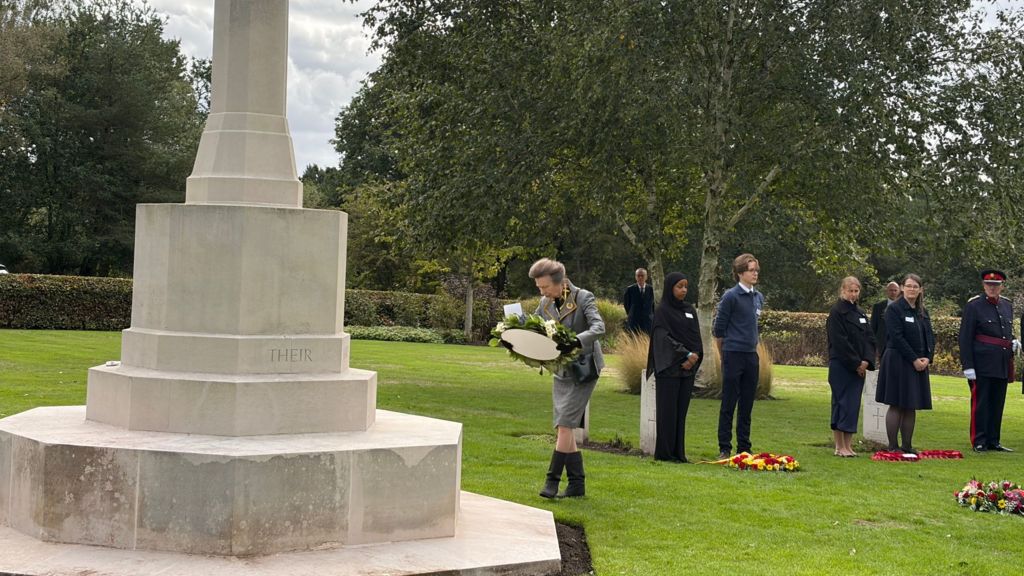
In a landmark ceremony highlighting post-war reconciliation between the United Kingdom and Germany, Princess Anne has officially opened a new purpose-built history centre at the Cannock Chase German Military Cemetery in Staffordshire. The Thursday event drew senior representatives from both nations, gathering at the sombre, historic site that holds the remains of nearly 5,000 German and Austrian service members killed across the two World Wars. An adjacent cemetery also holds the remains of 350 additional personnel, making the location one of the UK’s most prominent sites of shared cross-national commemoration.
Managed and developed in partnership by the German War Graves Commission (Volksbund Deutsche Kriegsgräberfürsorge) and the Commonwealth War Graves Commission, the new facility is designed to turn the cemetery from a site of remembrance into a hub for public education. It features a fully bilingual exhibition and dedicated workshop spaces, which trace the complex shared history of Britain and Germany, and trace the decades-long process of reconciliation that has shaped their modern alliance.
Vice Admiral Peter Hudson, Vice Chairman of the Commonwealth War Graves Commission, spoke at the ceremony, expressing deep honour for his organisation’s role in delivering the project and gratitude for Princess Anne’s participation in the inauguration. He described the Cannock Chase site as a uniquely meaningful space for collective reflection, noting that it honours individual lives lost in the devastating global conflicts of the 20th century. “This new centre is more than a building, it’s a place of learning, of reflection and understanding. It reminds us of the immense human cost of war,” Hudson said. “The stories told within this centre help us understand that cost.”
Hudson emphasized that the centre’s core mission extends beyond remembrance, to educating coming generations about the value of global cooperation and lasting peace. “Perhaps most importantly, the centre will help future generations engage with that history by understanding the past honestly and thoughtfully,” he explained. “People can better appreciate the value of peace, democracy and international cooperation. The friendship that exists today between the United Kingdom and Germany is one of the great achievements of post-war reconciliation. Places like this demonstrate how remembrance can bring people together.”
The project marks a key milestone in cross-border collaborative remembrance work, creating a permanent public space that bridges historical division to foster mutual understanding and respect between former adversaries.