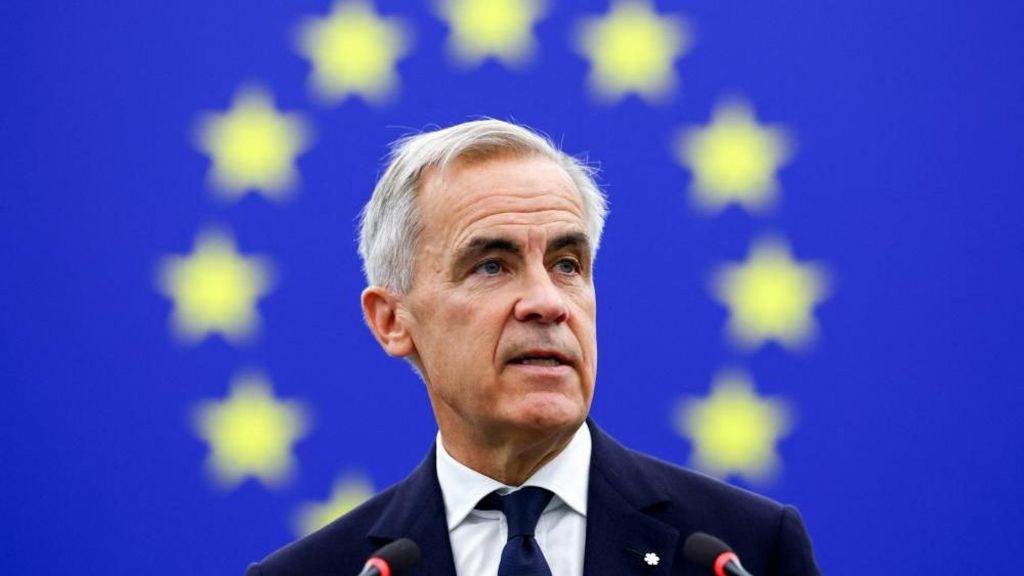
In a landmark address to the European Parliament in Strasbourg on Thursday, Canadian Prime Minister Mark Carney formally embraced the European Commission’s historic proposal to make Canada the European Union’s first-ever associate member, framing the closer partnership as a critical bulwark against rising global geopolitical instability and trade coercion. Carney’s speech came just 24 hours after European Commission President Ursula von der Leyen first floated the framework, a novel status that does not yet exist in EU governance structures.
The proposal has already drawn sharp pushback from U.S. President Donald Trump, who dismissed the idea as “laughable” earlier this week and threatened to impose “very serious tariffs” on European imports if he deems the new Canada-EU arrangement a hostile act against American interests. The threats come amid an already escalating bilateral trade war between Canada and the United States, where negotiations broke down last month, leading both nations to impose retaliatory tit-for-tat tariffs on hundreds of millions of dollars worth of goods.
During his address to European lawmakers, Carney argued that Canada and the EU are “stronger together” as the global order faces mounting “geopolitical rupture.” He outlined three overlapping crises reshaping modern societies: accelerating climate change, the steady erosion of long-standing democratic norms, and the growing weaponization of economic integration and trade policy. “Economic integration is now being weaponised, tariffs being used to exert pressure. Financial mechanisms have been used for coercion. Supply chains constitute weak points to be exploited,” Carney told members of the European Parliament.
Carney stressed that the proposed partnership is not an attempt to build a new competing great power bloc to rival major global actors. “I am not proposing a third bloc in order to become a great-power rival — only with better manners,” he said. “This is about sovereignty, our ability to live as we wish. We do not seek power to dominate others.” He added that the alliance would serve as a “beacon for other democracies” at a time when democratic governance is under growing pressure worldwide.
Responding directly to Trump’s tariff threats during a post-address press conference, Carney reaffirmed Canada’s right to pursue independent international agreements. “This alliance is a positive process, that’s my response to the American president,” he said. “Canadians are united that nobody is going to tell us what language we speak, no-one is going to dictate our culture, or with whom we can strike agreements internationally.” Carney also clarified that Canada has no intention of seeking full EU membership, framing the proposed associate status as a bespoke, flexible new framework tailored to the existing close relationship between the two parties.
Von der Leyen first introduced the proposal during her own address to the European Parliament on Wednesday, outlining that the associate status would unlock deepened cooperation across key strategic areas: advanced manufacturing, digital technology, defence, energy security, critical mineral supply chains, and broader economic security. At present, the exact terms of the relationship remain undefined, as the EU has never created an associate membership category, and implementing the framework could take several years of negotiations. Any final arrangement would also require unanimous approval from all 27 EU member states, and some national governments have already privately raised reservations about creating a new tier of EU association.
Canada and the EU already maintain deep ties, including a comprehensive free trade agreement that has been in force since 2017, and ongoing collaboration in defence, scientific research, and climate action. Carney outlined that closer cooperation would boost both parties’ strategic autonomy, particularly through integrated development of strategic capabilities — most notably critical minerals, which are essential for the global transition to clean energy. He added that Canada could supply the EU with liquefied natural gas and green hydrogen to bolster European energy security in the wake of ongoing global energy disruptions, while Canada would benefit from the EU’s world-leading expertise in clean energy technology.
To deepen people-to-people ties, Carney proposed that Canada join the EU’s flagship Erasmus+ mobility programme, which would allow young people from both sides of the Atlantic to work, study, and live freely across participating nations. He also called for pooled investment in emerging technological research and development to strengthen both regions’ global innovation competitiveness.
Carney described the proposed framework as “a unique, positive approach that we will define together,” noting that the process remains in its earliest stages. A full debate and parliamentary vote will be held in Canada’s national legislature before any final agreement is reached, and senior officials from both sides will begin hashing out detailed terms at a Canada-EU summit scheduled to take place in Montreal at the end of October.