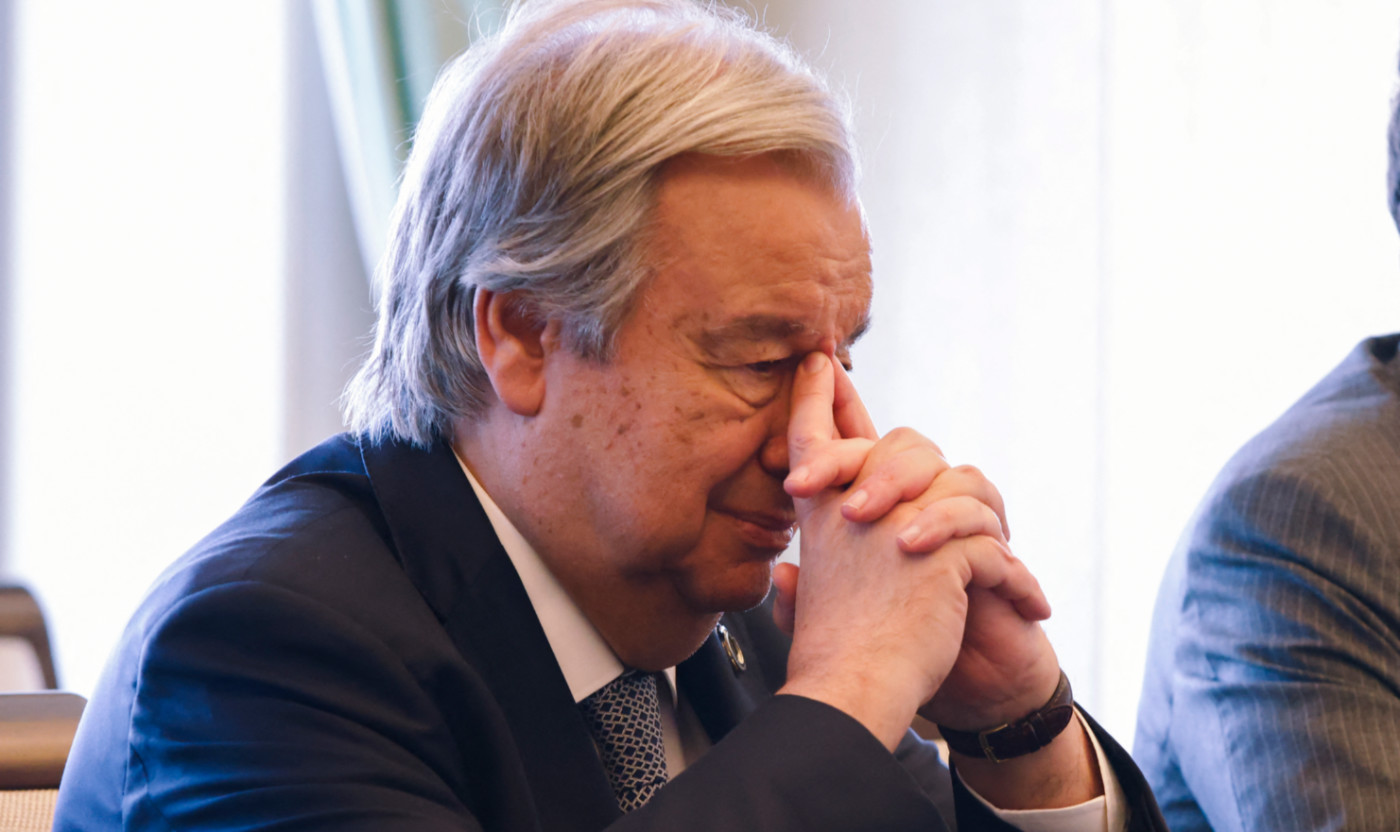
Seventy years after Dag Hammarskjold stepped into what was famously called ‘the most impossible job on Earth’, the United Nations is once again gearing up to select a new leader to succeed incumbent Antonio Guterres, with the successful candidate set to take office on January 1 next year. Long described as one of the world’s most challenging diplomatic roles, the UN secretary-general position operates under longstanding informal rotational norms that point to a Latin American candidate this cycle, with the last holder from the region leaving office in 1992. There is also widespread unwritten expectation that the 80-year-old global body will name its first female secretary-general in this election. Whoever ultimately claims the post will inherit an institution strained by crises on multiple fronts. As the UN’s largest financial contributor, Washington has cut voluntary contributions and withdrawn from the World Health Organization, while widespread unpaid dues from member states have pushed the organisation into a deepening liquidity crisis. Under Guterres’ tenure, the UN Security Council has been gridlocked and unable to stop or prevent mass atrocities in Gaza and Sudan, as well as Russia’s full-scale invasion of Ukraine. Critics have also accused the U.S. of violating UN charter principles over actions including the abduction and detention of a Venezuelan official and its joint military actions with Israel against Iran. The selection process formally kicked off in late November 2025, when the presidents of the UN General Assembly and Security Council put out an official call for nominations, opening the door for candidates to declare their candidacies. Under UN charter rules, the 15-member Security Council first recommends a candidate to the 193-member General Assembly for final approval, a step that has historically functioned as a procedural rubber stamp. The real contest plays out in the Security Council, where a winning candidate needs backing from at least nine of the 15 members, and crucially cannot face opposition from any of the five veto-wielding permanent members: the U.S., UK, France, Russia, and China. The selection process relies on a structured system of anonymous, informal straw polls to gauge member sentiment. In these private ballots, ambassadors mark each candidate as ‘encourage’, ‘no opinion’, or ‘discourage’. If no clear frontrunner emerges after initial rounds with identical unmarked ballots, permanent members switch to colored ballots that reveal whether a veto holder opposes a candidate without exposing which specific country objects. A ‘discourage’ vote from any permanent member is effectively a fatal blow to a candidate’s chances. To date, two rounds of straw polls have been held, with color-coded ballots not yet needed. As of the most recent polling, Guyana’s Carolyn Rodrigues-Birkett has edged into the lead, ahead of Costa Rica’s Rebeca Grynspan and Argentina’s Rafael Mariano Grossi. A seasoned diplomat who served as Guyana’s UN representative and held cabinet roles in foreign and indigenous affairs, Rodrigues-Birkett also represented her country on the Security Council in 2024–2025. Nominated by her home country, she earned formal endorsement from the Caribbean Community (Caricom) in July this year. Positioning herself as a ‘principled, pragmatic’ advocate for small and developing states, Rodrigues-Birkett has pledged to give equal priority to the UN’s three core mandates: peace and security, development, and human rights. On the peace and security front, she has committed to more active use of the secretary-general’s ‘good offices’ authority, and has pledged to invoke Article 99 of the UN Charter to bring emerging threats to international peace directly to the Security Council. She has also highlighted that only 18 percent of UN Sustainable Development Goal targets are currently on track, and called for reform of global financial rules paired with deeper partnerships with the private sector. While she supports the UN secretariat’s ongoing UN80 efficiency reform drive, she has warned against austerity cuts that would erode critical on-the-ground services for vulnerable populations. In the August straw poll, she secured eight ‘encourage’ votes, three ‘discourage’ votes, and four ‘no opinion’ votes, putting her at the top of the field. Close behind Rodrigues-Birkett is Rebeca Grynspan, a Costa Rican economist who led the first round of polling in July with 10 ‘encourage’ votes and only one ‘discourage’ vote, before slipping to seven ‘encourage’ and four ‘discourage’ in the second round. Grynspan has pledged to immediately restructure the secretary-general’s office to prioritize its mediation mandate, building it into a trusted intermediary that relies more heavily on quiet diplomacy. She also advocates for closer collaboration between UN peace operations and regional actors on the ground. Grynspan has called for cutting overlapping bureaucratic responsibilities, improving budget efficiency, leveraging AI and other technologies to speed up crisis response, and strengthening accountability through merit-based appointments and zero tolerance for workplace misconduct. On development, she pushes for fairer borrowing terms for low-income nations and an end to crippling debt repayments that siphon funding away from essential public services. Third place in the August round is held by Rafael Mariano Grossi, the veteran Argentine diplomat who has served as Director General of the International Atomic Energy Agency (IAEA) for seven years. Nominated in late November, Grossi has positioned himself as an independent candidate, personally funding his campaign to avoid reliance on outside backers. Framing himself as a pragmatic, on-the-ground mediator rather than a radical reformer, he argues the UN can restore its global credibility through direct diplomacy and consistent delivery on existing commitments. His five core priorities are peace and security, development through cross-sector partnerships, on-the-ground human rights engagement, institutional and management renewal, and pragmatic multilateralism that engages all global stakeholders. ‘The world still needs the United Nations,’ he has said. ‘But it must be a United Nations that works.’ Like Rodrigues-Birkett, he has highlighted slow progress on sustainable development goals and called for deeper engagement with the private sector and scientific community. He also supports eliminating overlapping UN mandates, digitizing UN operations, and aligning department resourcing with active, funded priorities rather than sustaining outdated programs. Notably, Grossi rarely addresses climate policy as a standalone issue, instead folding it into discussions of energy and nuclear power. His candidacy faces headwinds: he drew six ‘discourage’ votes in the latest poll, more than his top rivals, and his campaign has become linked to Argentina’s recent escalation of sovereignty claims over the Falkland Islands. While the UK, a permanent Security Council member, has stated it evaluates candidates solely on merit, it retains the power to veto his candidacy if it chooses. The remaining four candidates in the eight-person field trail the top three, with varying paths forward. Ecuador’s Maria Fernanda Espinosa, a former UN General Assembly president and the first woman to serve as Ecuador’s defense minister, entered the race in May after being nominated by Antigua and Barbuda. She has argued that the gap between the UN’s promises and its on-the-ground delivery has grown unacceptably wide, and centered her campaign on five pillars of transformation: peace and security, development, energy and digital transformation, improved delivery capacity, and sustainable resourcing. Her signature policy proposal is a Prevention and Early Action Hub that would consolidate scattered UN early warning capabilities under the direct authority of the secretary-general, allowing the body to address crises before they escalate without adding new bureaucratic layers. She also calls for locally led development solutions, debt relief for low-income nations, and a global dialogue to establish shared regulatory safeguards for AI and other emerging technologies. Espinosa only secured four ‘encourage’ votes in the August poll, well short of the nine-vote threshold, but she drew eight ‘no opinion’ votes, meaning she faces little outright opposition and retains an outside chance of gaining momentum if she can win over undecided members. Former Chilean president Michelle Bachelet, who served as UN High Commissioner for Human Rights from 2018 to 2022, was jointly nominated by Chile, Brazil, and Mexico in early 2026, though Chile’s new hard-right government later withdrew its support. A survivor of political detention and torture under the Pinochet dictatorship, Bachelet positions herself as a proven administrator who can make the UN leaner and more effective using existing resources, while strengthening early intervention in emerging crises. She has called for a more preventative approach to conflict, with more staff deployed on the ground in at-risk regions rather than relying on statements from New York headquarters. Bachelet also prioritizes action on the triple planetary crisis of climate change, biodiversity loss, and pollution, with targeted debt relief for small island developing states, landlocked nations, and least developed countries, as well as greater systematic inclusion of women in peacebuilding and decision-making. Once an early favorite, Bachelet has slipped badly in polling, drawing only two ‘encourage’ votes and six ‘discourage’ votes in the August round. Two African candidates are in the race, both facing structural barriers due to the informal regional rotation norm that favors a Latin American candidate this cycle. Former Senegalese president Macky Sall was nominated by Burundi in March, when Burundi held the African Union’s rotating chairmanship, but the AU has never formally endorsed his candidacy. Sall centers his campaign on his African leadership record, campaigning under the slogan ‘For a Renewed and Inclusive Multilateralism’ with the tagline ‘Africa at heart, the world in sight’. He has laid out three priorities for his first 100 days: strengthening UN conflict prevention, reviewing institutional structures and mandates to improve effectiveness and financial governance, and centering human rights and development in all UN work. Sall argues that low-income nations face unfair borrowing costs for crises they did little to cause, and calls for reform of the concentrated wealth and voting power held by the five permanent Security Council members. His poll numbers have remained static between the first and second rounds, and while he has gained backing from Senegal’s current president, the lack of AU endorsement and the presence of a second African candidate in the race have held back his campaign. Veteran Ugandan diplomat Olara Otunnu, a former UN under-secretary-general who held senior roles across four decades of global diplomacy, has posted the biggest gains of any candidate between the two rounds of polling, doubling his number of ‘encourage’ votes. Nominated by Uganda in July with the backing of President Yoweri Museveni, Otunnu frames his candidacy as a chance to restore the UN’s founding mission of preventing war at a time when that mission has been sidelined. He has pledged to prioritize active negotiations on the world’s deadliest ongoing conflicts – including Ukraine, Gaza, the Democratic Republic of Congo, Sudan, and Iran – within his first 100 days, holding dedicated conferences under regional frameworks to advance progress. Otunnu argues that UN restructuring should be led by member states rather than imposed by the secretariat, to cut duplication while preserving institutional legitimacy. He also calls for a dedicated UN agency for AI governance, deployment of digital technology to reduce global poverty, and climate action that balances emissions reductions with economic growth and energy security. While Otunnu has outperformed Sall in polling, he still faces the same structural barrier of not being a female Latin American candidate. The final candidate, Ecuadorian diplomat Ivonne A-Baki, was nominated by Tonga and entered the race just four days before the second straw poll. A-Baki, who has Lebanese descent and gained experience in conflict resolution during the 1980s Israeli bombardment of Beirut, frames conflict prevention as a core economic priority, noting that global violence costs the world economy an estimated $13.6 trillion annually. She proposes a new ‘guarantor method’ of mediation, where a small group of mutually accepted states oversees negotiations and guarantees final settlements, and calls for full implementation of Resolution 2719 to allow UN funding for African Union-led peace operations. A-Baki also supports sweeping Security Council reform, adding permanent representation for historically underrepresented regions including Africa and Latin America, arguing the current permanent member veto system reflects the outcome of a war that ended 80 years ago. She also criticizes structural waste in the UN, pointing to 27,000 annual meetings costing $360 million, and proposes that all institutional mandates automatically expire unless actively renewed. A-Baki drew zero ‘encourage’ votes, eight ‘discourage’ votes, and seven ‘no opinion’ votes in her first poll, leaving her with almost insurmountable ground to make up to remain in contention. Lobbying and informal discussions will continue through the month, ahead of the UN General Assembly’s opening later this September, when the formal appointment of the next secretary-general is expected to be finalized.
The next UN secretary-general: Who would want ‘the most impossible job on earth’?