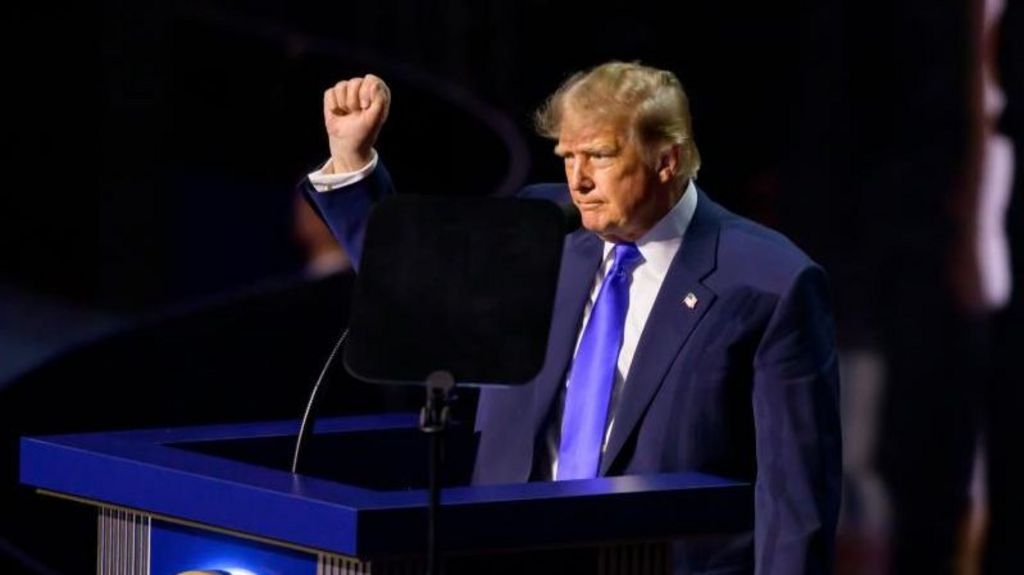
As the 2026 U.S. midterm elections enter their final stretch, former President Donald Trump has sent shockwaves through the nation’s political landscape with a bold, highly contested campaign promise: if the Republican Party secures control of both chambers of Congress in the November vote, every adult American citizen will receive a one-time $5,000 payout, dubbed the “Trump Dividend.”
The proposal was first announced during the first ever in-term Republican National Convention held in Dallas, Texas, where a cheering crowd of party loyalists greeted the announcement with raucous applause. The plan would require an estimated $1.3 trillion in federal government spending, based on the roughly 270 million adults currently living in the United States. In his remarks, Trump mandated that all funds must be spent domestically, barring spending in foreign nations including Canada, China, and Germany, but offered no further framework for how the requirement would be enforced, nor did he outline how the massive payout would be funded or what legislative steps he would take to move the plan forward.
This is not the first time Trump has floated direct cash payouts to voters. During the COVID-19 pandemic, he previously proposed $2,000 stimulus checks funded by incoming tariff revenues, echoing a similar pledge made by Democratic Senate candidates in Georgia during the 2020 runoff elections, where the party promised identical $2,000 relief payments in exchange for winning Senate control.
Even before the details of the plan could be fleshed out, political opponents and policy analysts have raised a flurry of questions about the proposal’s feasibility, legality, and political ethics. The Democratic Party has already rejected the pledge as an empty political stunt designed to buy votes with no basis in practical policy. Legal experts remain divided on whether the promise violates federal election rules: federal statutes prohibit direct payments intended to influence voter behavior, but many analysts argue the pledge could be framed as a tax cut proposal, which falls within legal bounds, and is protected as political speech under the First Amendment to the U.S. Constitution.
The announcement comes as the Trump administration faces mounting pressure over ongoing economic instability tied to a months-long conflict with Iran that began in February. After the U.S. and Israel launched military operations against Iran, Tehran retaliated by blocking all commercial traffic through the Strait of Hormuz, a critical global chokepoint through which roughly 20% of the world’s daily oil and liquefied natural gas supplies transit. The blockage has triggered volatile global oil price swings and driven sustained domestic inflation across the U.S., eroding household purchasing power and creating political friction for Trump within his own party.
Earlier this week, Trump acknowledged the economic pain ahead for Americans, telling supporters that oil prices would not stabilize and the conflict with Iran would not conclude until after the November midterm elections. He has argued that short-term economic hardship is a necessary tradeoff to prevent Iran from developing nuclear weapons, a framing he repeated during the Dallas convention. Even with that justification, the $5,000 dividend proposal is widely seen as an effort to shore up voter support amid anger over rising costs, as Republicans fight to hold or expand their congressional majorities ahead of the 2028 presidential election cycle.