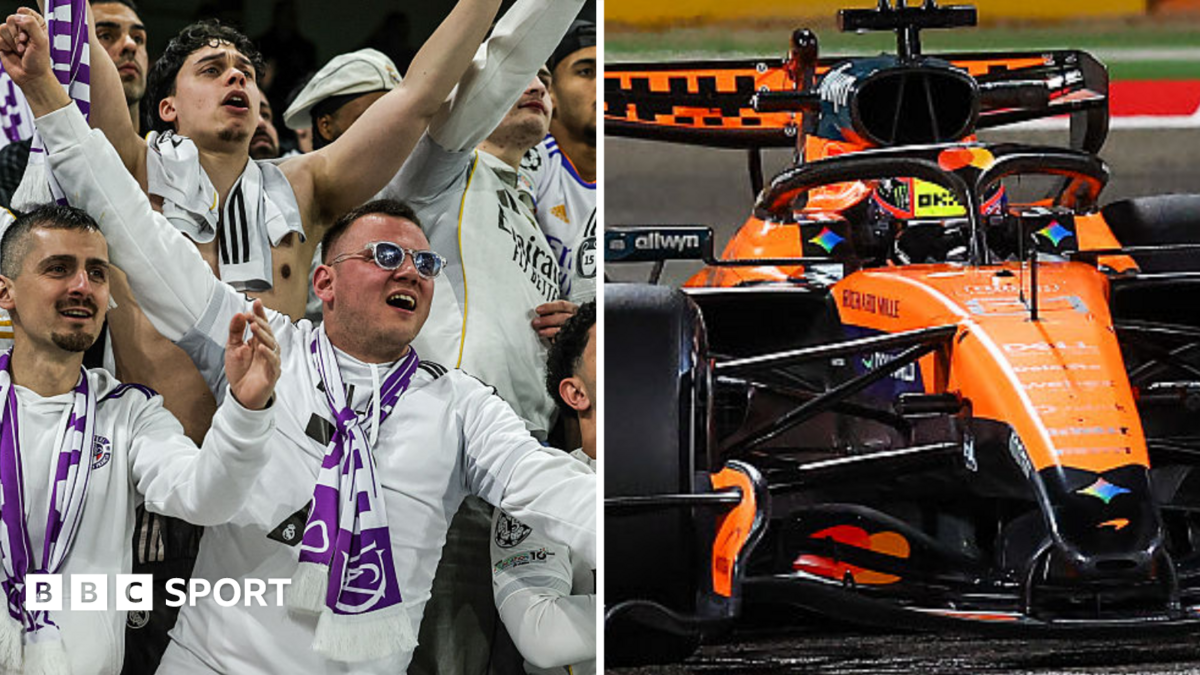
After a 45-year absence, Formula 1 is set to make its historic return to Madrid this weekend, ending a drought that stretches back to the Spanish capital’s last grand prix in 1981. For a city and nation utterly dominated by world-class football, the arrival of F1 represents a high-stakes experiment: can one of motorsport’s biggest global brands carve out a new fanbase in a market already saturated with elite sporting spectacle, and does F1 really need another race on its already crowded European calendar?
Madrid’s football legacy is unmatched: home to Real Madrid, the most decorated club in European football history with 15 European Cup titles and 36 La Liga crowns, and a city that has long turned out elite global talent from Zinedine Zidane and the original Galacticos era to modern superstars like Jude Bellingham and Kylian Mbappe. Just last month, 75,000 passionate Madridistas packed the Santiago Bernabeu to roar on Mbappe’s stunning volley against Malaga, with cross-city rivals Atletico Madrid also competing at the top of La Liga. It begs the question: what room is left for another major sporting attraction in a city where football already fulfills every local sporting appetite?
Yet local fans are far from dismissive of F1’s return. Many Madrilenos have long dreamed of a grand prix on their doorstep, with some making regular trips to Barcelona’s Circuit de Catalunya and overseas races to follow the sport. “It’s good for Madrid,” one local fan told BBC Sport. “This race can show Madrid’s identity beyond football, and getting more exposure on the global stage can only be a good thing. I’m not just excited – I’m curious to see how it goes.” Another local fan added: “We’ve always wanted an F1 race closer to home, so having it back is fantastic. I hope it puts Madrid more in the global spotlight. Madrid can learn a lot from F1 about hosting global events, and F1 can get a true taste of authentic Spanish culture here, unlike the more international vibe of Barcelona.”
The new Madring circuit, built around the IFEMA exhibition precinct adjacent to Madrid-Barajas Airport, was far from an obvious choice for a grand prix. Once written off as little more than a pipe dream – even a joke – the project was spearheaded by Luis Garcia Abad, CEO of Madring and former manager to Spain’s only F1 world champion, Fernando Alonso. “An F1 grand prix is like chasing a unicorn,” Abad explained. “You spend your whole life trying to see it, and most of the time you accept it’s impossible. There’s a huge queue of cities fighting to host an F1 race, so we know they had to pick the right bid. We signed a 10-year contract, and when IFEMA first reached out to me about viability seven or eight years ago, I walked the site one morning and knew: it could work.”
Unlike a purpose-built rural track or a tight street circuit woven through central Madrid’s historic district, the IFEMA location leverages the city’s compact size and extensive high-quality public transport network. Organizers have eliminated most private car parking, asking general admission fans to leave their vehicles at home and take public transit, while VIP guests including celebrities, sports stars and dignitaries will have access to exclusive dedicated parking adjacent to the expansive six-section VIP paddock.
The circuit itself has already turned heads in the F1 world, thanks to its signature corner: the 26-degree banked Turn 12, dubbed La Monumental. Far steeper than the famous banked corner at Zandvoort’s Dutch Grand Prix, La Monumental cuts through a section of the venue that will feel like a small packed town on race weekend, with capacity for more than 30,000 spectators around the bend alone. It even features a dedicated VIP viewing platform perched atop the corner’s hill, sized to accommodate the King of Spain and his family. “Luis always wanted an iconic, recognizable feature for this circuit – something no one would forget,” said Carlos Jimenez, operations director for IFEMA.
Building the new circuit came with no shortage of challenges, from laying tarmac on La Monumental’s extreme 26-degree bank to overcoming the wettest Spanish winter in two decades, which left contractors struggling to stabilize waterlogged clay soil across the site. In total, the project required 150 million euros of investment, 85 million euros of which went to the track itself. Jimenez noted that the build prioritized sustainability, with all race power coming from renewable energy and partial reuse of existing on-site buildings, while crews laid three separate layers of asphalt to address the difficult ground conditions. “Back in 2022, this whole thing sounded like a crazy idea,” Jimenez said. “But Madrid has momentum right now. It’s a vibrant city famous for football, but just like a ski resort needs apres-ski entertainment, a grand prix needs off-track attractions. Madrid’s offer is unbeatable – incredible gastronomy, fantastic mild September weather, and a nightlife that can’t be matched anywhere else.”
Madring is a hybrid street circuit, combining modified public roads with purpose-built track sections, and drivers who have already tested the track in Formula 3 sessions have described it as one of the most intense challenges on the global F1 calendar. With narrow lanes and close retaining walls on both sides, early assessments suggest overtaking will not be easy, but Abad argues that fits F1’s modern identity. “From a driver’s perspective, this is a tough circuit,” Abad said. “Twenty-two corners, elevation changes, banked turns – it’s built to fit the latest F1 regulations. Charles Leclerc told me it’s an amazing track, and while overtaking won’t be free, these are the best drivers in the world – gladiators.”
Bruno del Pino, a Madrid-born F3 driver who tested the circuit, said: “It’s always on the limit, quick corners with walls right on top of you. It’s like Jeddah but even more difficult. When you first approach La Monumental, you see this steep angle going up and it feels like you’re going to fly straight off the track. Turns 10 and 11 are high speed with walls right there – a lot of drivers are going to end up kissing the barriers this weekend.”
British F3 driver Freddie Slater went even further in his praise: “A lap around Madrid is so exhilarating, your adrenaline is just pumping the whole time. It’s one of the best tracks on the whole calendar, if not the best. It’s got real character, bumps, elevation changes – it feels a bit old-school, in the best way.”
For Abad, the success of Madrid’s new grand prix will be defined by the fan experience – and he believes the event could point to the future of F1 as a whole. “It’s not just that Madrid needs F1 – maybe F1 needs Madrid too,” he said. “We’ve invested to create a first-class experience right in the heart of a major city, and that’s the direction the championship is heading. Our spectators are our future, and taking care of them is what matters most.” This weekend, both F1 and Madrid will find out if the 45-year wait for a Madrid grand prix was worth it.