Newly declassified Spanish government documents have pulled back the curtain on a deeply contentious political controversy surrounding the unprecedented mass migrant crossing into the North African Spanish exclave of Ceuta last July, revealing that Spain’s top intelligence agency issued a clear warning about coordinated social media calls for a large-scale crossing a full 24 hours before tens of thousands of people attempted the journey.
The documents were released only after weeks of mounting political pressure on Prime Minister Pedro Sánchez, who has faced persistent accusations from opposition parties that his administration intentionally concealed critical information about the origins and scale of the July 2024 influx. According to the declassified materials, on July 29, Spain’s National Intelligence Service (CNI) formally notified both Moroccan intelligence officials and Ceuta’s local government that organized social media groups were actively mobilizing migrants to launch a mass crossing into the territory the following day.
This revelation directly contradicts repeated public statements from Sánchez, who has consistently maintained to parliament and the Spanish public that the events of July 30 and 31 were entirely unforeseeable. The prime minister previously told legislators that there was “no information that conveyed the magnitude” of the crisis that unfolded over the final two days of July.
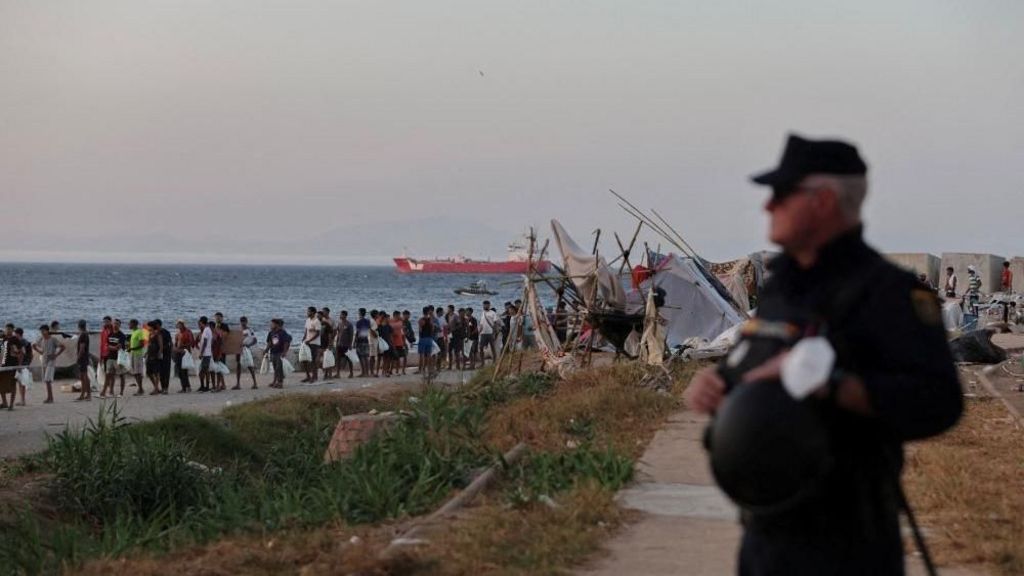
When the crossing did occur, official data from Ceuta’s mayor confirms that at least 72,000 migrants crossed from Morocco into Ceuta, most swimming around the heavily fortified border fence. The dangerous crossing claimed the lives of at least 100 people, according to the official count. While the vast majority of the migrants eventually returned to Morocco, as many as 5,000 remain in the exclave, staying in overcrowded makeshift camps or sleeping rough on city streets and public beaches. The prolonged humanitarian situation has sparked civil unrest among local residents, who have raised widespread safety concerns, taken to destroying migrant shelters and blocking aid convoys from reaching displaced people.
The declassified CNI note dated July 29 details that intelligence analysts identified coordinated mobilization campaigns on two major platforms, WhatsApp and Facebook, that encouraged migrants to reach the exclave “both swimming and via the [border] fence.” The documents show that the messaging reached an audience of roughly 180,000 people, with one post explicitly noting: “Whoever wants to cross has the last chance on Throne Day [30 July] at 8 [am] the authorities will be distracted with the celebrations and parades.” Beyond notifying Moroccan and Ceutan authorities, the CNI also sent a text alert to the central government’s representative in Ceuta and Spain’s national civil guard force to flag the dangerous social media activity.
The 40+ declassified security documents were released amid growing allegations in Spain that Moroccan officials deliberately facilitated the mass crossing, an accusation that gained traction earlier this month when a leaked Spanish police report appeared to tie Moroccan law enforcement to the incident. Sánchez has repeatedly rejected these claims, insisting that no evidence exists to prove Moroccan complicity, and reaffirmed his stance just hours before the documents were published on Wednesday, telling Spanish television that “the mass arrival of migrants was not expected.”
Opposition leaders have seized on the declassified materials to condemn the Sánchez administration, arguing that the documents directly contradict the prime minister’s claims of no advance warning. Ester Muñoz, a senior spokesperson for Spain’s main conservative opposition party the People’s Party, issued a blunt rebuke, saying: “They had the information, they are directly responsible for the invasion of Ceuta and for those who died.” Jorge Buxadé, a leading figure in the far-right Vox party, wrote on social media that the documents proved Sánchez “and his band of criminals should be brought before the Supreme Court for treason and security crimes.”
Members of the ruling government have pushed back against these accusations, standing by their position that the administration acted appropriately based on the information it had prior to the crossing. Foreign Minister José Manuel Albares told reporters that he was “not aware of any report that might have foreseen the magnitude of what happened on July 30.” A senior anonymous government source explained that the published documents “showed that the information available before the mass crossing did not make it possible to anticipate the scale that the crisis would reach or prepare with enough time the necessary response.” Miguel Ángel Pérez Triano, the central government’s delegate in Ceuta, also downplayed the advance CNI text messages sent to his office on July 29, arguing: “The Whatsapps from [July] 29 do not constitute an alert or a report. It is nothing more than an exchange of information.”