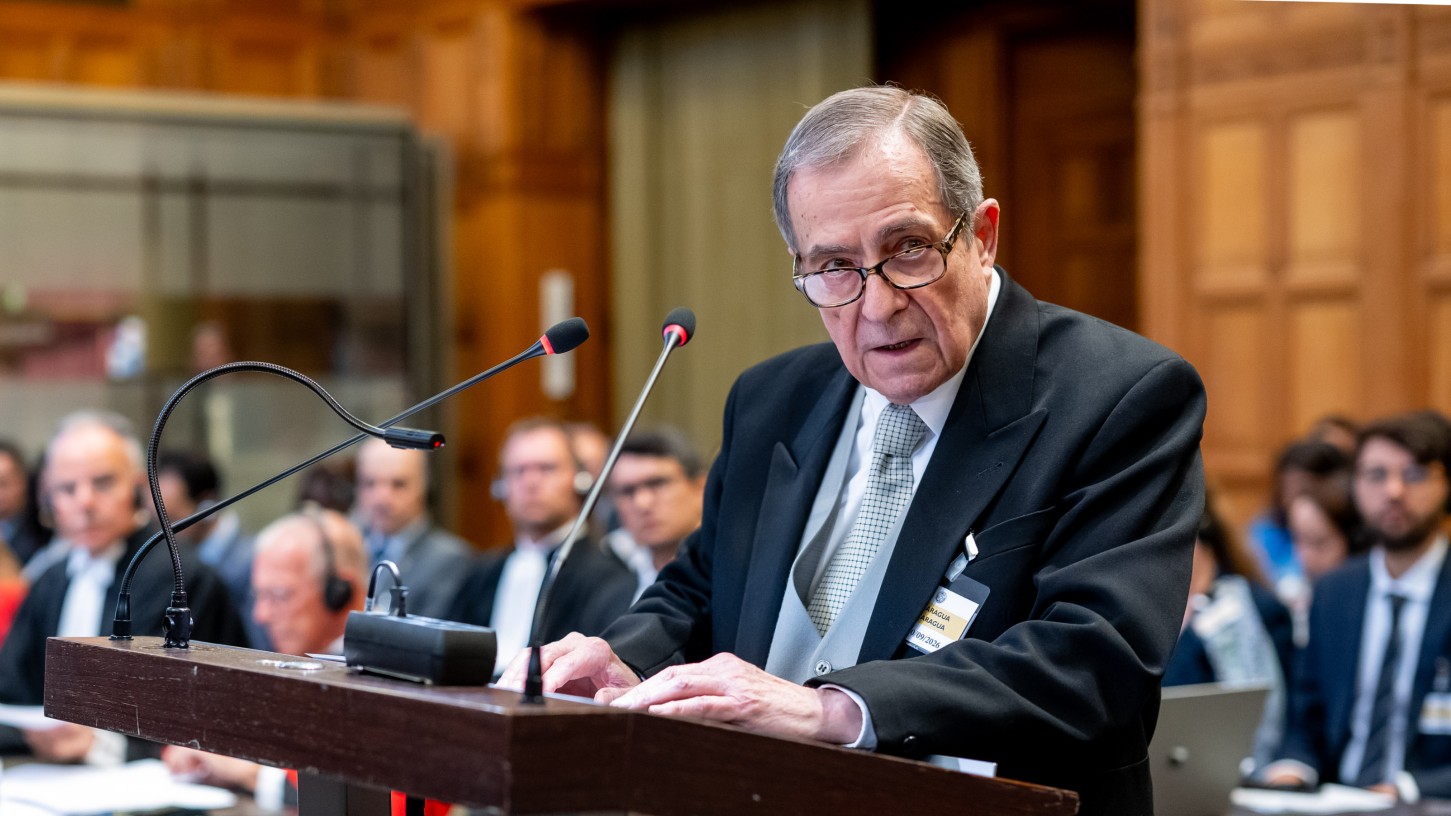
On a Tuesday hearing at the International Court of Justice (ICJ) in The Hague, Nicaragua laid out a forceful case against Germany, accusing Berlin of deliberately evading legal accountability for its ongoing large-scale military exports to Israel despite full awareness of the documented grave risks of genocide and systemic human rights violations against Palestinians in occupied territories.
Nicaragua first initiated this legal proceeding in March 2024, arguing that Germany has not only facilitated potential genocide through sustained arms transfers but also breached international obligations by cutting funding to the United Nations Relief and Works Agency for Palestine Refugees (UNRWA), the key UN body providing life-saving aid to Palestinian communities. Tuesday’s session centered entirely on addressing Germany’s preliminary objections to the court’s jurisdiction and the admissibility of Nicaragua’s claims, with Nicaragua urging judges to reject these procedural hurdles and move the case forward to a full hearing on its substantive merits.
Germany’s core preliminary arguments rest on three main claims: that no formal legal dispute existed between the two nations when Nicaragua filed the suit, that portions of the claims fall outside the temporal bounds of Germany’s acceptance of ICJ jurisdiction, and that the case cannot proceed under the long-standing “Monetary Gold principle” because Israel — an absent non-consenting third party — would have its legal adjudicated in its absence. Nicaragua refuted each of these points, emphasizing that the suit targets Germany’s own independent conduct and obligations under international law, not the actions of Israel.
In his opening address to the court, Nicaragua’s ambassador to the Netherlands Carlos Arguello Gomez noted that the current violence and destruction inflicted on Palestinians is publicly documented and widely streamed in real time, making Germany’s claim of ignorance of the risk of grave violations impossible to sustain. “Over the past three years, every single day people around the world bear witness to horrible scenes of brutality, suffering and destruction,” Arguello stated. “Schoolchildren in Germany are probably more aware today of what is happening in the Occupied Palestinian Territory and particularly the Gaza Strip, than their ancestors were of the horrors during the Nazi regime.”
Arguello stressed that Germany’s deep political, economic and military ties to Israel mean Berlin cannot plausibly claim it is unaware of the serious risk of genocidal acts, adding that as Israel’s second-largest arms supplier and one of its most critical trading partners, Germany holds significant leverage to alter Israel’s conduct. According to data presented by Nicaragua to the court, Germany has authorized more than €1.15 billion ($1.34 billion) in military exports to Israel between early April 2024 and the end of June 2026, with nearly €800 million approved in the first half of 2026 alone. Of that 2026 first-half total, some €508.8 million covers direct weapons of war, including licenses for a major maritime defense project widely reported to involve a submarine, plus ammunition, tank components and other critical military hardware. German-made engines and transmission systems for Israel’s Merkava tanks, which have been deployed extensively across Gaza and the occupied West Bank, are also included in these exports. In total, Nicaragua calculates that the value of German military equipment approved for export to Israel since October 7, 2023, has surpassed €1.5 billion ($1.75 billion).
Nicaragua also dismissed Berlin’s 2025 announcement of a suspension on new military export licenses for equipment that could be used in Gaza as a largely symbolic gesture, noting that deliveries under previously approved licenses were allowed to continue, and new approvals resumed just three months later in November 2025. Germany’s assertion that it reviews each export license individually and receives guarantees from Israel that all equipment will be used in compliance with international humanitarian law does not fulfill Berlin’s binding international obligations, the delegation argued.
Arguello further highlighted the growing bilateral military trade between the two states, pointing to Germany’s expanded purchase of Israel’s Arrow 3 missile defense system, which now carries a total value of approximately $6.6 billion, making it the largest defense export contract in Israel’s history. These deep, mutually beneficial commercial and military ties have effectively insulated Israel from international pressure and sanctions, Nicaragua argued.
The Nicaraguan delegation also pushed back against Germany’s justification for its unwavering support for Israel, which Berlin frames as a core national interest rooted in Germany’s historic responsibility for the Holocaust. “The trial of the war criminals at Nuremberg was for multiple crimes against humanity as a whole and not only for the Jewish Shoah,” Arguello said. “If there is a sincere moral imperative justifying this raison d’état, it must be for the responsibility for all these crimes against humanity, and it should involve the obligation to do all possible to stop this from happening to other human beings. A sincere raison d’état would see Germany doing everything possible to stop the crimes being committed by Israel against the Palestinian people.”
Responding to Germany’s Monetary Gold principle objection, senior counsel Alain Pellet explained that Nicaragua is not asking the court to issue any binding ruling on Israel’s responsibility or adjudicate Israeli conduct. Instead, the suit only requests that the court determine whether Germany itself breached its own independent international obligations, and order Berlin to provide full reparation for any harm resulting from its wrongful acts. While Israel’s actions form the factual context for the case, no formal ruling on Israel’s responsibility is required, Pellet noted.
For most of Nicaragua’s claims, it is sufficient to establish that a serious risk of genocide and other grave violations exists, rather than requiring conclusive pre-judgment of Israeli culpability. The obligation to prevent genocide activates as soon as a state knows, or should reasonably know, that a serious risk of genocide exists, at which point the state is required to use all reasonably available means to deter or prevent the harm. This is an obligation of conduct, not a guarantee of a specific outcome, Pellet argued.
While the ICJ ruled in a 2007 case that a state can only be held responsible for failing to prevent genocide if genocide is ultimately proven to have occurred, Pellet contended that the duty to act arises far earlier, the moment a serious risk becomes known. “Waiting until genocide or crimes against humanity had been completed before addressing a failure to prevent them would be absurd,” he said, as it would defeat the core preventive purpose of the Genocide Convention. Tragically, Pellet added, the risk has already materialized: “genocide has occurred and continues to occur, not only in the Gaza Strip but throughout the occupied Palestinian territory, including East Jerusalem. The gravest violations of human rights and international humanitarian law, which all states have the duty – the legal obligation – to prevent, are continuing; and the Palestinian people’s right to self-determination is being denied more than ever.”
Nicaragua also defended the ICJ’s jurisdiction over its claims related to racial discrimination, racial segregation and apartheid, noting that these prohibitions are not only enshrined in the Convention on the Elimination of All Forms of Racial Discrimination but also form part of customary international law and binding international humanitarian law. The ICJ has previously recognized the prohibition of racial discrimination as an obligation owed to the entire international community, and a core component of humanitarian law, meaning these claims fall squarely within the scope of Germany’s optional declaration accepting the court’s jurisdiction.
In response to Germany’s argument that some claims fall outside the temporal scope of its jurisdiction declaration, which only covers disputes arising from facts or situations after April 30, 2008, Nicaragua countered that the core of the case stems from Germany’s conduct after October 2023, specifically its ongoing arms export approvals and support for Israel, with the long-standing bilateral relationship only serving as historical background.
Nicaragua is scheduled to present its second round of oral arguments and deliver final submissions to the court on Thursday. If the ICJ rules in Nicaragua’s favor and accepts jurisdiction, the case will proceed to a full merits hearing, a process that typically takes multiple years to reach a final judgment. This case runs parallel to a separate ongoing ICJ proceeding brought by South Africa against Israel, which accuses Tel Aviv of breaching the Genocide Convention in its military campaign in Gaza that began in October 2023.
Multiple independent international bodies have already backed the core claims of alleged genocide: a panel of senior UN experts, as well as the world’s largest association of genocide scholars, have both concluded that Israel’s military campaign in Gaza amounts to the crime of genocide. A fragile US-brokered ceasefire has been in place since October 2025, but even during this lull in active fighting, Israeli forces have killed at least 1,300 Palestinians in Gaza, bringing the total confirmed death toll from the campaign to more than 73,651, with thousands more still missing and presumed dead under the rubble of destroyed buildings.