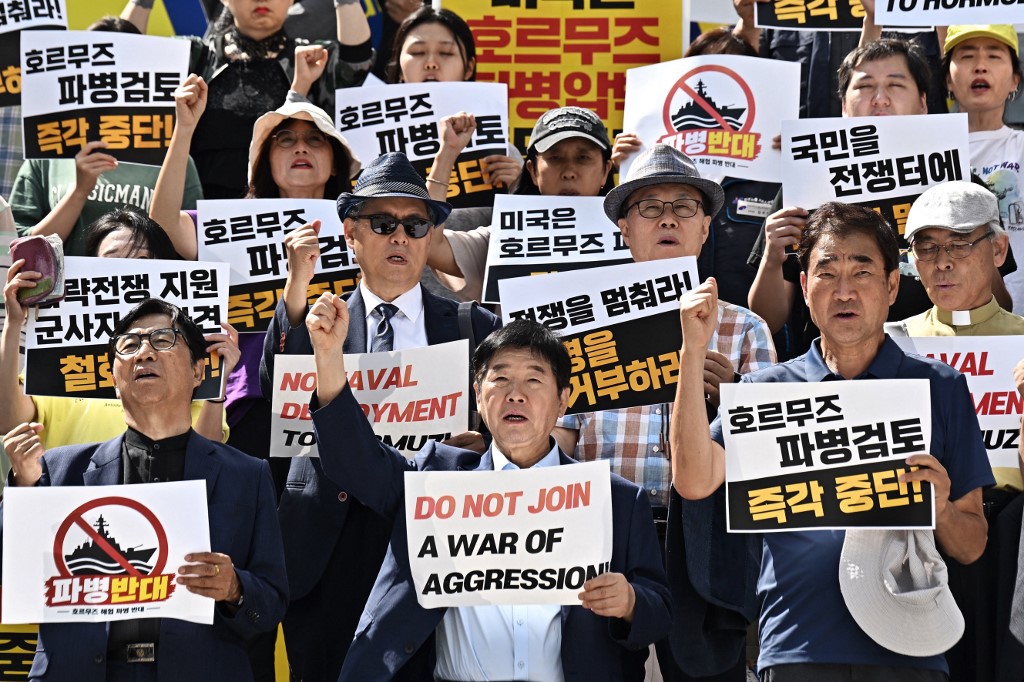
Mass public protests have erupted across South Korea in fierce opposition to the Seoul government’s potential plan to deploy military forces to support U.S.-led security operations in the strategically critical Strait of Hormuz, deepening a domestic and international debate over the country’s role in escalating tensions between the U.S. and Iran.
South Korean officials confirmed on Friday that the administration is actively evaluating options for what it frames as “contributions” to U.S. security initiatives in the strait, a chokepoint that handles nearly a fifth of the world’s daily oil trade. Just days later on Tuesday, a South Korean fact-finding military delegation was dispatched to the region to assess on-ground conditions, according to government statements.
The prospect of a South Korean military deployment has already drawn a sharp rebuke from Tehran. Iranian officials have issued a clear warning that any introduction of South Korean forces to the region would be “regarded as direct support for the party responsible for that aggression and will have serious consequences,” a statement that has amplified anxieties over potential retaliation against South Korean interests.
On Wednesday, hundreds of demonstrators gathered outside the U.S. Embassy in central Seoul, carrying hand-painted placards that called on the South Korean government to reject participation in what organizers labeled a “war of aggression” against Iran. Video footage shared widely across major social media platforms showed local police moving to push back dozens of protesters who had gathered close to the embassy compound, leading to minor scuffles in some instances.
Jung Kyung-jik, a representative of leading South Korean civic group People’s Solidarity for Participatory Democracy, told reporters from Agence France-Presse that he fully understood Iran’s perception of any foreign military intervention as a direct threat to Iranian national security. “As Iran has said, the deployment of our troops to the region would amount to direct participation in an illegal war,” Jung stated. He added that “there have been numerous violations of international law arising from US attacks on Iran, including the bombing of an elementary school and energy infrastructure.”
South Korea has been subjected to mounting diplomatic pressure from Washington for months to formally join the U.S.-led coalition operating in the Strait of Hormuz. Former U.S. President Donald Trump had previously publicly criticized Seoul for failing to back U.S. policy toward Iran, tying the disagreement to broader frictions in the bilateral alliance that have persisted in years since.
For South Korea, the strategic stakes of any decision are exceptionally high: the country’s entire economy relies heavily on energy shipments that pass through the Strait of Hormuz. Data from 2023 shows that 61 percent of South Korea’s total crude oil imports and 54 percent of its naphtha imports traveled through the waterway last year alone, making stability in the region a core national economic priority.
According to reporting from The Guardian, the specific deployment options currently under review by South Korean military planners include sending a P-8 Poseidon maritime patrol aircraft and a naval logistics support vessel. Local South Korean broadcasters have additionally reported that an elite navy explosive ordnance disposal team is also being considered for deployment.
South Korea’s presidential office has clarified that any final decision to deploy new military forces to the Strait of Hormuz would require a multi-step domestic approval process: first a review by the country’s National Security Council, followed by a cabinet resolution, and ultimately formal approval from the unicameral National Assembly.
This is not the first time Seoul has adjusted its military posture in the region amid U.S. pressure. Back in 2019, the South Korean government expanded the operating area of an existing anti-piracy naval unit deployed off the coast of Somalia to cover waters surrounding the Strait of Hormuz, a move that fell short of full participation in the U.S. coalition.
In a recent development, South Korean President Lee Jae Myung held talks with French President Emmanuel Macron this week on Tuesday to discuss the situation in the Strait of Hormuz. However, Seoul’s presidential office emphasized that the discussions focused exclusively on potential South Korean contributions to broader international efforts to uphold freedom of navigation, not any specific plan to deploy combat troops to the region.