On the early morning of August 12, a deceptive calm hung over the war-battered Sudanese city of el-Obeid. Children streamed toward school along packed streets, the calls of street vendors selling fresh fruit drowned out the low rumble of idling buses, and workers ducked into tree shade for a quick cup of tea or coffee before starting their workdays. A fragile wave of optimism had spread through the capital of North Kordofan state, rooted in two long-awaited shifts: the Sudanese Armed Forces (SAF) had partially broken a months-long siege imposed by the paramilitary Rapid Support Forces (RSF), and the annual rainy season had arrived, bringing hope of both agricultural relief and a turning point for a population that had endured crippling shortages of food and clean water.
That fragile calm shattered in minutes. Crowds scattered in panic as residents pointed to the sky, where RSF drones had reappeared, bringing with them a flood of familiar, crippling fear. The thunderous roar of SAF anti-aircraft fire echoed across the city; on-the-ground reporting from Middle East Eye documented at least four drones shot down from the sky, drawing shouts of “Allahu Akbar” from watching bystanders. A young woman was struck and wounded by falling drone debris, and was rushed immediately to a nearby hospital for emergency care.
This morning drone strike marked the first major RSF response to its recent significant defeat in Bara, a city located roughly 60 kilometers north of el-Obeid, and surrounding nearby towns.
For el-Obeid, which has stood on the frontline of Sudan’s three-year civil conflict between the SAF and RSF, drone attacks are nothing new. The scars of constant bombardment are visible across every corner of the city: craters pockmark paved roads, vital oil and electricity infrastructure lies in ruins, and hospitals, public markets, and residential neighborhoods have been reduced to bombed-out shells. Yet, for the estimated one million people still calling the city home, the population has refused to surrender to chaos, clinging as tightly as possible to the rhythms of ordinary life.
“ We adapted ourselves to these RSF attacks on civilians that happen from time to time. We won’t leave this city whatever happens,” Ahmed al-Mardi, a local taxi driver, told Middle East Eye as the drone strikes unfolded around him that August morning.
A local market trader, who asked to remain anonymous out of fear of retaliation, questioned why the RSF consistently targets civilian infrastructure and populations rather than SAF military positions. “The RSF doesn’t care about the civilians or the life of the people of el-Obeid,” he said.
Osman Abdullatif, who leads a civilian committee backing SAF and the auxiliary Popular Resistance units, accused the RSF of intentionally targeting civilian communities as part of a deliberate strategy to force mass population displacement. “We have seen in el-Genena, Khartoum, el-Jazira and el-Fasher that the RSF strategy is dependent on forcing people into displacement,” he explained. Abdullatif noted that el-Obeid residents have already witnessed the RSF’s tactics firsthand: the paramilitary group carried out massacres of Masalit communities in West Darfur’s el-Geneina in summer 2023, after which RSF supporters seized occupied abandoned homes and land belonging to displaced community members. “We understood the lesson and would never leave,” he stressed.
Over the course of three years of war, el-Obeid has spent most of that time trapped under siege and under constant attack. While residents have displayed extraordinary resilience to maintain daily life, the city itself bears the heavy weight of prolonged conflict: streets lie uncleaned, public services are disjointed, basic goods are exorbitantly priced, and essential necessities are often completely unavailable.
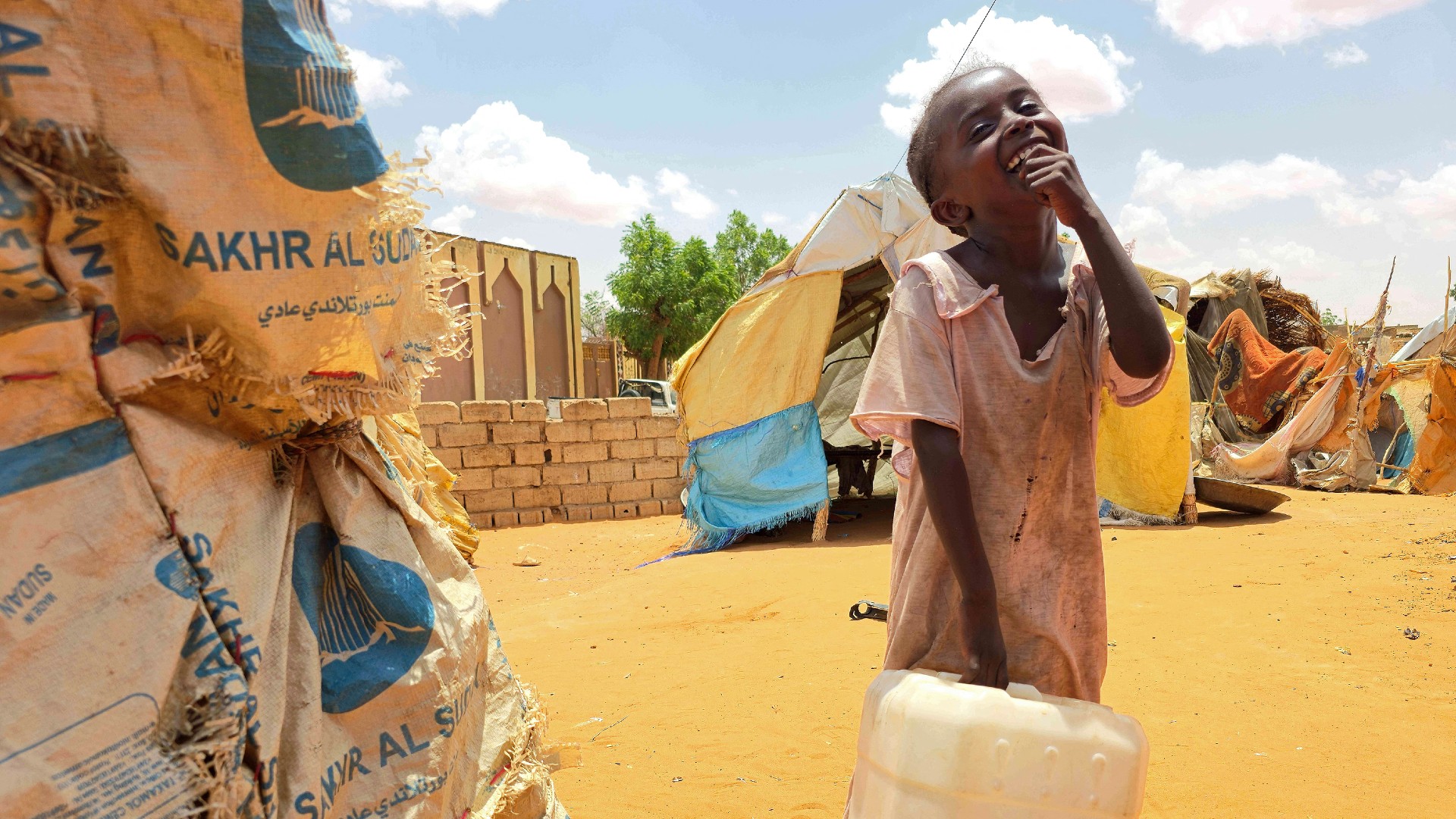
While hundreds of thousands of residents have fled the city to seek safety elsewhere, hundreds of thousands more have flooded into el-Obeid as a refuge after being displaced from their homes across other conflict zones in Kordofan, Darfur, and surrounding regions. Displaced person camps ring the city’s outer boundaries, yet daily life persists against all odds: markets stay open, universities and classes remain in session, and even wedding celebrations continue to be held, even as the threat of attack hangs overhead.
One local activist, who also requested anonymity for security reasons, warned that the outward appearance of normalcy hides deep underlying tensions. The city is heavily populated by SAF troops, former Darfuri rebel fighters integrated into joint military units, and mobilized Popular Resistance civilians, a widespread armed presence that many residents find deeply intimidating. “We have seen more than 40,000 military personnel in the city, destruction and the wide deployment of the undisciplined Joint Forces of the former Darfur rebels. This situation has to be organised, or it will lead to serious consequences,” he warned.
El-Obeid is surrounded by military barricades and checkpoints, with only one primary paved route connecting the city to the capital Khartoum through neighboring White Nile State. The stretch of road runs more than 700 kilometers, requiring roughly 10 hours of travel under the best of conditions. SAF is currently working to secure and reopen the Export Road, the historic strategic trade route connecting Kordofan to Khartoum that, before the war, carried the region’s valuable exports including gum arabic to global markets.
SAF retook Bara and other key towns along the route in July 2026. But the RSF has launched a series of counterattacks in response, leaving control of the critical Export Road still contested. Drone strikes on el-Obeid have increased sharply over the past month, directly tied to these RSF counteroffensives. The RSF has claimed it inflicted heavy casualties on SAF and its allied forces in Gabrat al-Shiekh, Geraigikh, and Girfa – a claim SAF has repeatedly denied.
El-Obeid holds unique strategic importance: it is the largest and most significant city in western Sudan still under full SAF control. For months, it has been the central frontline between the army and the RSF, which currently controls all of Darfur in western Sudan. Its strategic location previously made it a key humanitarian hub during United Nations peace operations in South Sudan and Darfur, a role it could step into again if fighting stabilizes. This status means both sides are desperate to hold full control of the city, to position themselves as the legitimate governing authority the international community must engage with.
According to a senior SAF military source based in el-Obeid, the recapture of Bara has been a transformative turning point for the city’s future. “Our victory in Bara is very strategic, we seized a lot of weapons and military vehicles, lifted the siege of el-Obeid and opened access for more supplies to ourselves,” he said. The source, who spoke on condition of anonymity as he was not authorized to speak to media, added that the RSF is now at its weakest position since Kordofan became the main theater of Sudan’s war, after the RSF seized el-Fasher in October 2025. “We cut the supplies coming from Libya to Kordofan through Darfur, which had been the lifeline for the RSF in North Kordofan,” he said. “We are now ready to move from North to West Kordofan, more specifically al-Nuhud, Mazrob, al-Kwai and Babanousa. If SAF seizes these areas during this rainy season, the way to Darfur would be opened. This is why we have seen the RSF trying to counterattack us in North Kordofan, but we repulsed all their attempts and kept the new areas that we liberated.”
A retired military expert with decades of experience operating in North Kordofan told Middle East Eye that the conflict is currently at a critical juncture, entirely shaped by Kordofan’s strategic geographic position. “We have seen how the two sides have tried to gain more territory in Kordofan as international pressure has grown to stop the fighting and cease fire across the country. SAF wants to liberate the greater Kordofan region and be closer to the RSF capital in Nyala, while the RSF wants to remain a threat to el-Obeid and even Omdurman,” said the expert, who also requested anonymity for security reasons.
He explained that el-Obeid is a critical supply hub for both sides, supporting the movement of fighters and materials. “SAF has managed to secure Omdurman and el-Obeid by seizing Bara and Gabrat al-Sheikh, where the drones were coming from,” he added. “However, the RSF is opening a new front and seized new areas in the Blue Nile State, but I think it is doing so to distract SAF, because the main battle is in Kordofan rather than anywhere else.”