BERLIN — In a historic shift for German regional politics, the far-right Alternative for Germany (AfD) has notched its strongest electoral performance to date, propelled by the approach of 35-year-old party leader Ulrich Siegmund, who has worked to soften the group’s radical image while clinging to its core extremist positions. The party secured a resounding victory in Sunday’s regional election in the eastern German state of Saxony-Anhalt, but stopped just short of an outright majority, leaving its bid to form Germany’s first far-right state government since World War II hanging in the balance.
Siegmund, who was born just weeks after German reunification in October 1990, has emerged as a carefully cultivated public face for the AfD, blending youth-focused energy with targeted nostalgia for past eras that resonates with disaffected eastern German voters. Across Saxony-Anhalt’s campaign trail, his face dominated every AfD campaign poster under the rallying motto “everything is possible.” At public events, crowds of supporters — many sporting custom T-shirts printed with Siegmund’s portrait — lined up for hours to snap selfies and exchange brief words with the candidate.
Unlike many high-profile AfD figures known for abrasive, openly provocative rhetoric, Siegmund has deliberately steered clear of inflammatory public statements, framing himself as a relatable “man of the people” to win over voters who would otherwise reject the party’s well-documented radical stances, which include hardline pro-Russian policy, sweeping anti-immigration positions, and far-right extremist ideology. Despite his moderated public tone, Siegmund remains uncompromising on the AfD’s core platform. Following the election, he made clear the party would not abandon its core beliefs to form a coalition government.
Siegmund’s political trajectory began with a short early stint in Germany’s center-right Christian Democratic Union, the party of current Chancellor Friedrich Merz, before he defected to the AfD. A business management graduate who previously worked in commercial air freshener sales, he is far from a political newcomer: he has served as a legislator in Saxony-Anhalt’s Magdeburg-based state parliament for a decade, and has held the role of co-leader of the AfD’s parliamentary caucus there since 2022. He first built a large loyal following on social media through his vocal criticism of COVID-19 public health restrictions, capitalizing on widespread public discontent to grow his base.
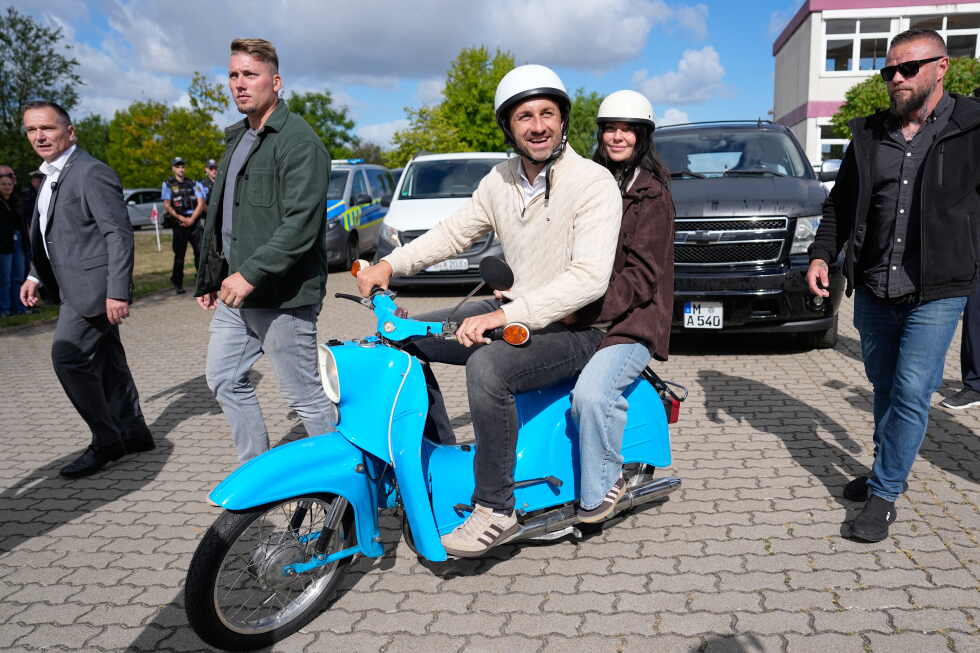
A central pillar of Siegmund’s campaign has been deliberate nostalgia, echoing voter demands for what he frames as “the old, safe Germany back.” He has specifically courted lingering nostalgia for former communist East Germany among older eastern voters, most notably through iconic campaign appearances on vintage Simson mopeds, a beloved East German-manufactured brand. He even arrived at his hometown polling station in Tangermuende on one of the vehicles to cement that image. That choice, however, has sparked significant backlash: the Simson family, whose Jewish ancestors were stripped of their company by the Nazis in the 1930s before fleeing to the United States, has publicly condemned the AfD’s use of the brand.
The Saxony-Anhalt regional branch of the AfD is one of multiple AfD state organizations officially classified as a confirmed right-wing extremist group by Germany’s domestic intelligence agency. Siegmund also faced scrutiny over his attendance at a 2023 secret meeting in Potsdam, where a leading figure in the extremist Identitarian Movement laid out a radical “remigration” plan calling for the mass deportation of immigrants and German citizens with immigrant backgrounds. When the meeting was exposed months later, it sparked massive nationwide protests. As a result of his attendance, Siegmund was removed from his post as chair of the state legislature’s social affairs committee. He has consistently denied any wrongdoing, claiming his presence at the meeting did not equal an endorsement of the plan.
Incumbent Saxony-Anhalt Governor Sven Schulze, when asked in a recent televised debate whether he considered Siegmund a right-wing extremist, declined to issue a direct personal judgment, but noted that “I know who he surrounds himself with,” adding that “very extreme people” make up Siegmund’s closest political circle. The AfD has repeatedly and vehemently rejected all accusations of extremism. Just last month, Siegmund sought to reassure voters, claiming that “no one here needs to be afraid, quite the contrary. Every honest person in Saxony-Anhalt will benefit from an AfD-led government.”
Political analysts note that Siegmund’s carefully crafted public image is the key to the AfD’s historic gains in Saxony-Anhalt. “He manages to come over as likable, open, always smiling,” explained Wolfgang Merkel, a political science professor at the WBZ Berlin Social Science Center. Unlike other prominent AfD leaders, Siegmund deliberately avoids abrasive, overtly ideological or provocative language. “He is avoiding major conflicts at present; that doesn’t have to mean that he is a moderate, or conservative. He isn’t,” Merkel noted ahead of the election, adding that “whether he can govern is something he still has to prove.”