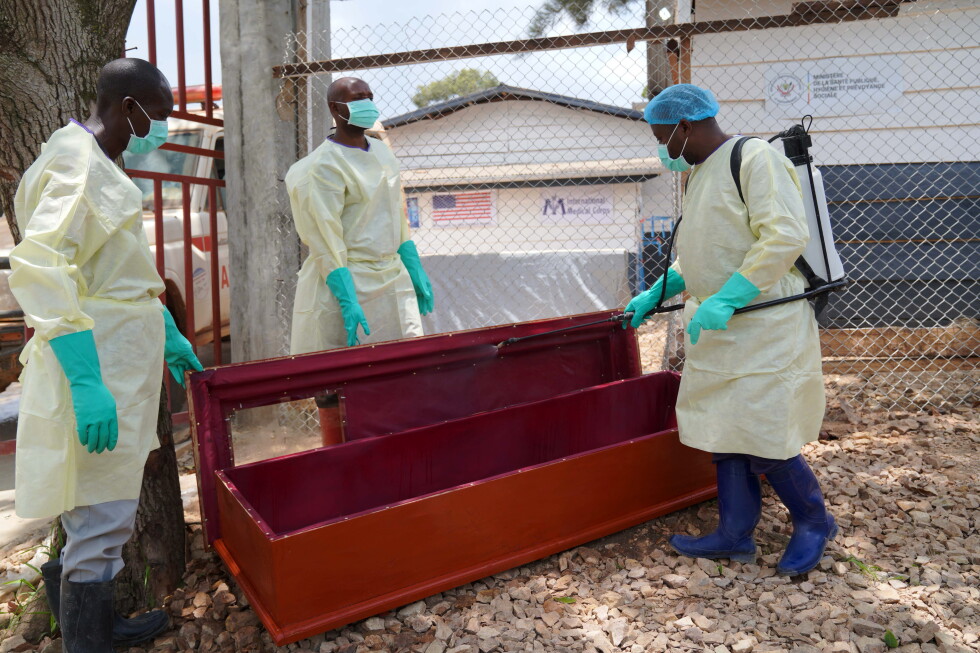
In the conflict-battered province of Ituri, Democratic Republic of Congo, the ground zero of the deadliest Ebola outbreak on record, a small group of frontline workers confronts an unrelenting, life-threatening workload every single day. Yuma Adolphe leads one of these specialized burial teams, tasked with laying Ebola victims to rest safely and with dignity — a job that has pushed him and his colleagues to their breaking points as the out-of-control epidemic continues to claim more lives.
As of the latest reporting, the outbreak has recorded more than 6,500 confirmed and suspected cases, with nearly 3,200 deaths already recorded. Since the epidemic first emerged in mid-May, regional health authorities have deployed dozens of small, specialized burial teams across high-transmission hotspots to manage the steady stream of fatalities. Each team member earns just $20 a day for work that exposes them to the deadly virus on a constant basis, places them in conflict with grieving local communities, and leaves them physically and mentally exhausted.
The core of the conflict between burial teams and local populations stems from a collision between infectious disease protocol and centuries-old cultural tradition. Public health rules require trained workers to handle all remains of Ebola victims, because the virus spreads through direct contact with infected blood and bodily fluids — and experts confirm that deceased victims still carry high levels of active virus that can trigger new chains of transmission. For local communities, however, this restriction means they are barred from carrying out the traditional burial rites that are central to honoring their dead.
This cultural rift has erupted into violence on multiple occasions across the outbreak’s front lines. Since May, Adolphe’s team and similar burial crews have faced repeated assaults from bereaved family members angry at being stripped of their ability to practice their customs. “Under normal circumstances, families would receive their loved one’s body and carry out all the rituals our African traditions demand,” Adolphe explained in an interview with The Associated Press. “But in this crisis, we cannot allow families to handle the body as they normally would. They are denied their sacred customs, and that’s what creates the deep misunderstandings that put us at risk.” Jeanne Alasha, health and humanitarian affairs advisor to Ituri’s military governor, warned that those who attack burial teams will face legal prosecution under regional emergency rules.
Ituri’s already dire crisis is compounded by overlapping layers of instability: the province is not only the epicenter of the Ebola outbreak, but also the heart of an ongoing rebel insurgency in eastern Congo, and is governed by a military administration appointed by national authorities in Kinshasa. The outbreak has now spread to six eastern Congolese provinces, spread by rebel violence, mass population displacement, and constant large-scale population movement. Weak local healthcare and surveillance systems, incomplete contact tracing, and limited laboratory capacity have further hampered response efforts. Making matters worse, the outbreak is being driven by the rare Bundibugyo strain of Ebola, for which no fully approved vaccine or targeted treatment exists. While frontline workers have been given the Ervebo vaccine, which the World Health Organization confirms offers some protection against other Ebola strains, there is no definitive data that it works against the current outbreak’s strain.
The true scale of the crisis is even larger than official figures reflect: health officials estimate the actual number of cases and deaths is likely three times higher than what has been recorded, as the virus continues to outpace containment efforts. The WHO has warned the outbreak could soon surpass the 2014-2016 West African Ebola epidemic, the current deadliest on record which killed more than 11,000 people. Compounding these challenges, frontline health workers have held multiple strikes over unpaid wages, slowing critical response work across the region.
The human cost of the crisis is visible in even the most recent burials. Shortly before noon on a recent Friday, 36-year-old Justine Habineno, a church chorister, was laid to rest in Ituri after dying from Ebola. Her mother, Sofia Wanito, recalled that Habineno only complained of mild headaches before being admitted to hospital and diagnosed with the virus. Under outbreak rules, Wanito was only allowed to see her daughter’s body through a hospital ward window, and was barred from touching the coffin. “We never had to deal with dying like this before,” Wanito said. “I couldn’t even cover her body with a sheet myself, couldn’t give her a final goodbye.” A lay catechist led the shortened ceremony, attended by dozens of community members, while Adolphe’s team — clad in full protective scrubs and boots — stood by to oversee the safe burial.
For the burial team members, the danger of infection and community hostility is paired with constant physical and mental exhaustion, yet most say protecting their communities remains their top priority. Benjamin Muhindo, another team member, said his own family lives in constant fear he will bring the virus home, but he still shows up for work every day to ensure victims are buried properly. “Burial work during this epidemic is incredibly complicated,” Muhindo said. “We work under constant pressure, racing against the clock to stop the spread every single day.”
Trauma experts note that the outbreak’s impact stretches far beyond the official case and death count, leaving deep psychological scars on both bereaved communities and the frontline workers who respond to the crisis. “The trauma of this outbreak doesn’t end when we count the latest case number,” said Rose Tchwenko, country director for the humanitarian organization Mercy Corps in Congo. Breaking the chain of transmission, she added, requires far more than medical intervention: “We need an integrated, holistic response that includes mental health and social support for both grieving families and the frontline workers who carry this heavy load.”
After finishing Habineno’s burial last Friday, Adolphe acknowledged he is exhausted, but said his biggest concern remains the safety of his community. “We have no other choice,” he said. “We are here to protect our people, even when we have to push past our own limits to do it.”
This reporting was contributed by Ope Adetayo from Lagos, Nigeria. The Associated Press receives financial support for global health and development coverage in Africa from the Gates Foundation, and maintains full editorial independence over all content.