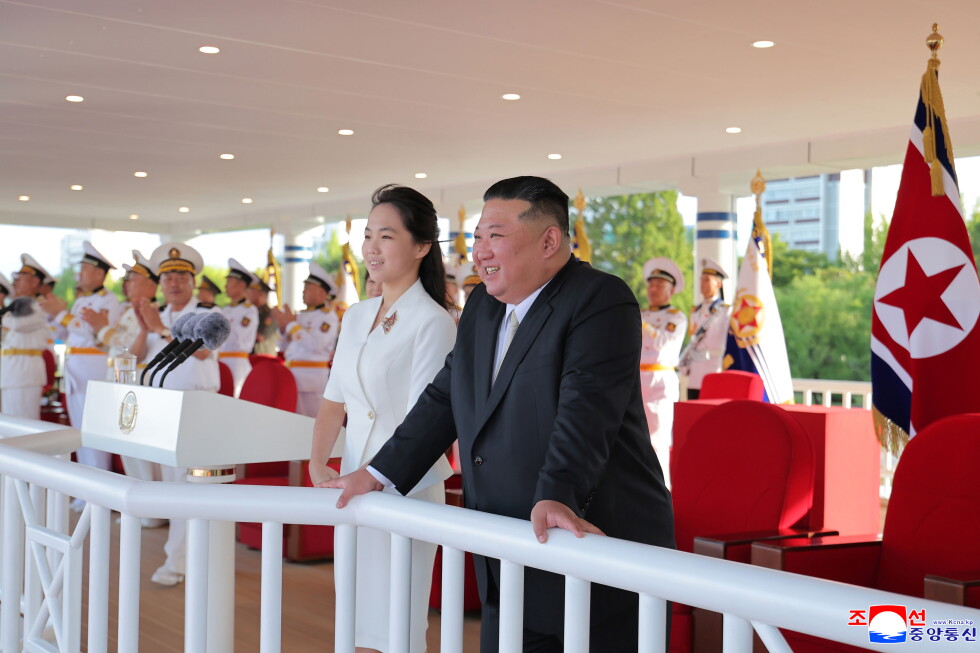
Tensions have escalated sharply on the Korean Peninsula in recent days, as North Korean leader Kim Jong Un oversaw the ceremonial commissioning of his country’s second domestically built guided-missile destroyer while doubling down on calls to expand and strengthen the regime’s nuclear deterrent. The high-profile naval event unfolded Sunday just as the United States, South Korea, and Japan prepared to launch a landmark trilateral military exercise that Pyongyang has long decried as a direct threat to its national security.
The newly commissioned destroyer, named the *Kang Kon*, was welcomed into service at a ceremony held in North Korea’s eastern port of Wonsan. Kim Jong Un was joined at the event by his teenage daughter, who South Korea’s National Intelligence Service has identified as Kim Ju Ae and widely considers the leader’s likely heir. Official state media photos from the ceremony show the young woman dressed in a white dress and light blazer, walking alongside her father on a red carpet, touring the destroyer’s decks, and posing for formal photos with the ship’s crew.
The *Kang Kon* is the second of North Korea’s new 5,000-ton guided-missile destroyers, following the *Choe Hyon* that entered service in June. Both vessels are outfitted to carry nuclear-capable missiles, marking them as the most advanced warships in the North Korean navy’s fleet. In his keynote address at Sunday’s commissioning, Kim emphasized that the sequential launch of these two advanced destroyers transforms the regime’s maritime nuclear capabilities, allowing North Korea to deploy its nuclear deterrent through more diversified and practical channels, a shift that will inevitably deepen anxiety among Pyongyang’s adversaries.
“We must establish more clearly a powerful and reliable nuclear war deterrent, to put into practice the diverse and effective operation of our nuclear combat systems and further strengthen our military activities for maritime defense and war deterrence,” Kim told ceremony attendees.
This latest military advancement comes amid a period of renewed friction between North Korea and the United States, coming after Pyongyang rejected a conciliatory gesture from former U.S. President Donald Trump, who ordered the U.S. military to substantially scale back the annual Ulchi Freedom Shield joint exercise with South Korea last month. The drill was cut six days shorter than originally planned, with Trump citing his positive personal relationship with Kim, who has long characterized large-scale U.S.-ROK joint drills as rehearsal for an invasion of the North.
But the scaled-back exercise failed to win Pyongyang’s approval. Kim Yo Jong, Kim Jong Un’s sister and a top senior regime official, dismissed Trump’s outreach, arguing that merely shortening the drill does nothing to alter its fundamentally provocative and aggressive nature. In response to the exercise, North Korea carried out a threat it had issued previously, launching roughly 10 short-range ballistic missiles into the sea off its coast.
On Monday, the United States, South Korea, and Japan launched their five-day *Freedom Edge* trilateral maritime exercise in waters off South Korea’s southern Jeju Island. South Korea’s defense officials have framed the drill as a defensive training initiative designed to improve coordination to counter North Korea’s growing nuclear and missile threats. Pyongyang, however, has cast the exercise as clear evidence of U.S. escalating confrontational policy toward the North. Last week, North Korea’s Foreign Ministry criticized both the drill and repeated public statements from U.S. officials reaffirming Washington’s commitment to the complete denuclearization of the Korean Peninsula.
Diplomatic analysts broadly view North Korea’s recent escalation of military demonstrations and rhetorical pressure as an effort to extract larger concessions from the United States. Nuclear diplomacy between Kim and the Trump administration collapsed in 2019, after the two sides failed to reach agreement on the scope of sanctions relief North Korea would receive in exchange for taking limited steps toward dismantling its nuclear program. Today, after years of advancing its nuclear and missile programs and strengthening strategic ties with major powers Russia and China, experts note Kim holds far more negotiating leverage than he did during the earlier rounds of talks. Kim has repeatedly stated he is willing to return to diplomatic negotiations only if Washington abandons what he calls its hostile policy toward Pyongyang and formally accepts North Korea’s status as a legitimate nuclear-armed state.